ocr
 5:04
Liquid Democracy In Simple Terms
76K views • 13 years ago
pxi
A five-minute animated explainer of liquid democracy, in which voters can delegate their vote to trusted people. It starts from the origins of democracy and contrasts direct and representative models.
 23:34
Why Democracy Is Mathematically Impossible
10.1M views • 2 years ago
Veritasium
Veritasium explains why no voting system can be perfectly fair, drawing on Arrow's theorem and the work of Eric Maskin. It looks at problems with systems like first-past-the-post and ranked-choice voting.
 7:55
Is the EU Democratic? Does Your Vote Matter?
5.6M views • 7 years ago
Kurzgesagt – In a Nutshell
Kurzgesagt explains how the European Union is governed, how its officials are elected or appointed, and whether a citizen's vote actually matters.
 5:48
Most Cities Got More Democratic. This One Didn't.
6.1M views • 14 years ago
CGP Grey
CGP Grey explains the City of London's unusual governance, including the Lord Mayor, guilds, and how it differs from the rest of London.
 6:31
Why Your Vote Doesn't Count
7.9M views • 15 years ago
CGP Grey
CGP Grey explains first-past-the-post voting and why it pushes elections toward two dominant parties. It is the first in his series on electoral systems.
Topic match · US politics & elections 19:20
The Constitution of Athens
1.5M views • 8 years ago
Historia Civilis
Historia Civilis explains the constitution of ancient Athens, including its assembly, offices and use of sortition to choose leaders. It draws on Aristotle and Plutarch.
 12:04
Why Being Delusional is a Superpower
15.2M views • 6 years ago
Veritasium
Veritasium examines the role of luck in success, with simulations and examples showing how small advantages and chance can compound. It argues that top outcomes are disproportionately luck-driven while still crediting effort.
 6:34
Why Is It So Hard to Do Something That Should Be Easy? (Wall of Awful pt. 1)
2.1M views • 7 years ago
How to ADHD
A short How to ADHD explainer, featuring Brendan Mahan, on why simple tasks can feel impossible for people with ADHD. It introduces the 'wall of awful', a pile of past failures, shame and anxiety that builds up in front of a task and blocks starting it.
 12:01
Why Electronic Voting Is Still A Bad Idea
5.1M views • 6 years ago
Tom Scott
Tom Scott explains why electronic voting is a bad idea. Elections must be trusted by everyone and attacks on software scale in ways attacks on paper do not, so open source or blockchain fixes do not solve it.
Topic match · US politics & elections 4:27
The Voting System That Should Replace Every Election
4.7M views • 15 years ago
CGP Grey
A short CGP Grey explainer on the alternative vote (instant runoff voting) versus first past the post, made around the 2011 UK referendum. It shows how ranked ballots are tallied and why they avoid spoiler effects.
Topic match · US politics & elections 6:47
The Voting System That's Actually Too Good for Politicians to Allow
10.4M views • 12 years ago
CGP Grey
CGP Grey explains the Single Transferable Vote, a proportional ranked-ballot system, and why politicians have little incentive to adopt it. It is a short animated explainer of how multi-winner ranked voting works.
Topic match · US politics & elections 8:21
Why Electronic Voting is a BAD Idea - Computerphile
2.3M views • 11 years ago
Computerphile
Tom Scott explains for Computerphile why electronic voting is a bad idea, arguing that paper ballots are transparent, auditable and hard to tamper with at scale. He covers why moving voting to phones, tablets or computers undermines trust and verifiability.
Topic match · US politics & elections 15:12
JPEG DCT, Discrete Cosine Transform (JPEG Pt2)- Computerphile
697K views • 11 years ago
Computerphile
Mike Pound explains the discrete cosine transform and how it underpins JPEG compression. It is part two of Computerphile's JPEG series.
Topic match · Computer vision, speech & NLP 18:31
Fourier Optics used for Optical Pattern Recognition
103K views • 6 years ago
Huygens Optics
Huygens Optics explains the Fourier transform and shows how a lens performs one optically. A DLP projector is used as a Fourier filter to do simple pattern recognition on lithographic character patterns.
Topic match · Computer vision, speech & NLP 8:34
Was YOUR vote counted? (feat. homomorphic encryption) - Numberphile
198K views • 10 years ago
Numberphile
Numberphile interviews cryptographer Ron Rivest about end-to-end verifiable voting. He explains how homomorphic encryption and receipts let a voter confirm their ballot was counted without being able to prove how they voted to anyone else.
Topic match · US politics & elections 4:29
The Voting System That Gives You Two Votes
3.1M views • 15 years ago
CGP Grey
CGP Grey explains Mixed-Member Proportional representation, the system used in New Zealand where voters get two votes. It covers how it differs from first-past-the-post.
Topic match · US politics & elections 35:49
Breaking The Creepy AI in Police Cameras
3.8M views • 1 year ago
Benn Jordan
Benn Jordan explains how Flock Safety's license plate cameras log and share vehicle locations, and explores how adversarial AI can defeat them. It covers weak security and the surveillance risks of private police-camera networks.
Topic match · Computer vision, speech & NLP 6:18
Animated Voting Methods
16K views • 9 years ago
Unify The Vote
An animated simulation comparing single-winner voting methods such as plurality, instant runoff and STAR. Colored regions show which candidate wins as a randomized electorate shifts across a two-dimensional political space, building on Ka-Ping Yee's earlier diagrams.
Topic match · US politics & elections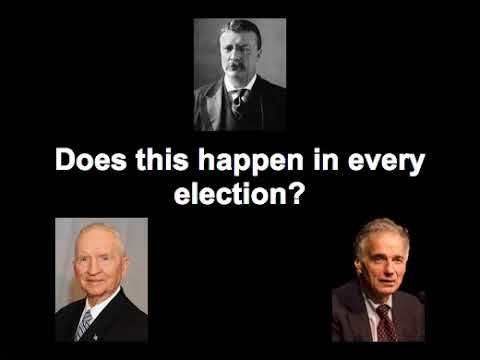 3:35
How our voting system (and IRV) betrays your favourite candidate
35K views • 12 years ago
The Center for Election Science
The Center for Election Science explains favorite betrayal in instant-runoff voting: in some elections, ranking your favorite first can cause your least favorite to win. It contrasts this with plurality voting's spoiler problem.
Topic match · US politics & elections 6:31
You Can Win the Presidency With 22% of the Vote
8.2M views • 15 years ago
CGP Grey
A short CGP Grey animation showing how the US electoral college lets a candidate win the presidency with as little as about 22 percent of the popular vote. It lays out the arithmetic of winning states by narrow margins.
Topic match · US politics & elections 17:40
3D Gaussian Splatting! - Computerphile
273K views • 2 years ago
Computerphile
A Computerphile video in which Dr Mike Pound and PhD student Lewis Stuart explain 3D Gaussian splatting, a quick technique that turns photos of a scene into a 3D model without much compute. It includes a demo and compares the approach to NeRFs.
Topic match · Computer vision, speech & NLP 5:29
How to Fix America's Corrupt Political System
479K views • 10 years ago
RepresentUs
A short RepresentUs explainer on how money corrupts American politics and what an anti-corruption act could do about it. It covers lobbying, super PACs and campaign finance, and pitches the group's proposed reforms. The video was later superseded by an updated version.
Topic match · US politics & elections 4:51
The UK Election Results Were the Worst in History
8.1M views • 11 years ago
CGP Grey
CGP Grey explains how the 2015 UK general election showed the flaws of first-past-the-post voting, with parties like UKIP winning many votes but few seats.
Topic match · US politics & elections 20:39
AI Language Models & Transformers - Computerphile
354K views • 7 years ago
Computerphile
Rob Miles explains on Computerphile how language models generate plausible text and how transformers improved on recurrent networks, with a look at what comes next.
Topic match · Computer vision, speech & NLP 26:48
Algorithmic Redistricting: Elections made-to-order
584K views • 5 years ago
AlphaPhoenix
AlphaPhoenix uses Monte Carlo simulation and annealing-style methods to draw North Carolina congressional district maps, both gerrymandered and fair. He focuses on the fascinating computational problem rather than the politics.
Topic match · US politics & elections 5:51
Corruption is Legal in America
2.3M views • 11 years ago
RepresentUs
A short RepresentUs explainer arguing that US politics is shaped by money, citing the Gilens and Page Princeton study on how little average citizens influence policy.
Topic match · US politics & elections 19:29
Glitch Tokens - Computerphile
353K views • 3 years ago
Computerphile
Rob Miles explains "glitch" tokens, odd strings in large language model vocabularies that make the model produce gibberish. He covers how they likely arise from tokenizer training data, such as Reddit usernames, that never appeared in the model's own training.
Topic match · Computer vision, speech & NLP 18:16
Do these scatter plots reveal fraudulent vote-switching in Michigan?
906K views • 5 years ago
Stand-up Maths
Matt Parker of Stand-up Maths examines scatter plots that were claimed to show fraudulent vote-switching in Michigan's 2020 election. He recreates the analysis and shows that the pattern arises from comparing percentages across different bases, not from fraud.
Topic match · US politics & elections 6:23
How We Should Vote (Range Voting)
43K views • 10 years ago
Undefined Behavior
A six-minute explainer from Undefined Behavior on range (score) voting. It follows an earlier video on Arrow's Theorem and shows how range voting seems to satisfy the criteria Arrow's Theorem says no ranked system can.
Topic match · US politics & elections 17:46
Why do Biden's votes not follow Benford's Law?
3.7M views • 5 years ago
Stand-up Maths
Matt Parker examines claims that Biden's 2020 vote counts violate Benford's Law, explaining the law and why it often does not apply to precinct-level election data.
Topic match · US politics & elections 14:03
Simulating alternate voting systems
4.5M views • 6 years ago
Primer
Primer uses simulations to compare voting systems such as first-past-the-post, approval, ranked choice and others. It shows how each system behaves and can be manipulated, with links to further voting theory resources.
Topic match · US politics & elections 14:20
Reveal Invisible Motion With This Clever Video Trick
2.8M views • 6 years ago
Steve Mould
Steve Mould explains motion amplification and video magnification, techniques that find tiny changes in video invisible to the eye and exaggerate them. He covers the MIT research and industrial uses such as diagnosing vibrating machinery.
Topic match · Computer vision, speech & NLP 19:55
Why was Biden's win calculated to be ONE IN A QUADRILLION?
1.3M views • 5 years ago
Stand-up Maths
Matt Parker of Stand-up Maths examines the Texas Supreme Court filing claiming Biden's 2020 win had a one-in-a-quadrillion chance. He walks through why the statistical argument is flawed.
Topic match · US politics & elections 8:35
Tesla Autopilot Crashes into Motorcycle Riders - Why?
1.1M views • 4 years ago
FortNine
FortNine looks at why Tesla Autopilot has rear-ended motorcyclists, speculating that the vision system misreads motorcycle taillights as a distant car. It argues that radar and other sensors would help.
Topic match · Computer vision, speech & NLP 3:38
The Shortest-Splitline Algorithm: a Gerrymandering Solution [Bonus Video]
692K views • 15 years ago
CGP Grey
A short CGP Grey bonus video explaining the shortest-splitline algorithm, which draws electoral districts by repeatedly splitting a state along its shortest dividing line while balancing population. It is offered as a neutral, algorithmic fix for gerrymandering.
Topic match · US politics & elections 11:28
Here's What's Preventing You From Finishing Projects
147K views • 5 years ago
Zack Freedman
Zack Freedman gives advice on why makers fail to finish projects, including scrapping bad ideas, showing work publicly and writing a plan that keeps projects fun. It is aimed at hardware DIY but generalizes.
 34:39
Gay Frogs: A Deep Dive
2.2M views • 6 years ago
Oki's Weird Stories
A long video essay on the claim that chemicals such as atrazine are feminizing frogs. It covers the science, the EPA and the role of chemical companies.
 22:10
Why Don't You Want To Do Anything After Binging 4 Hours of YouTube Videos...
2.3M views • 3 years ago
HealthyGamerGG
Dr. K of HealthyGamerGG explains why people feel unmotivated and unable to start tasks after hours of YouTube or similar distractions. He frames it as a result of how social media is designed to capture attention, and says not to blame yourself.
 10:59
Your Brain Thinks Your Whole Home Is One Room
6.8M views • 6 years ago
CGP Grey
CGP Grey argues that your brain treats a whole home as one room during lockdown, blurring work, rest and leisure. He recommends creating separate spaces and routines for different activities to stay balanced.
 21:09
The Origins of Russian Authoritarianism
1.9M views • 5 years ago
Kraut
Kraut traces centuries of political development, from Mongol rule and the Orthodox church to Muscovite autocracy, that shaped Russia's authoritarian state. It uses countryball animation and compares Russia with Europe and China.