pc hardware
 1:40:06
KiCad 6 STM32 PCB Design Full Tutorial - Phil's Lab #65
987K views • 4 years ago
Phil’s Lab
A 100-minute tutorial from Phil's Lab on designing an STM32-based 'black pill' PCB in KiCad 6. It covers schematic capture, two-layer layout and routing, USB, and sending the board for manufacture and assembly.
 2:50:28
(Sponsored) KiCad STM32 + USB + Buck Converter PCB Design and JLCPCB Assembly - Phil's Lab #11
1.2M views • 6 years ago
Phil’s Lab
A roughly three-hour screen recording of designing a barebones STM32F4 board in KiCad, covering schematic, four-layer layout and routing, USB and a buck converter. It ends with ordering manufacture and assembly through JLCPCB.
 11:10
An Intro to KiCad – Part 1: How PCBs Are Made | DigiKey
517K views • 8 years ago
DigiKey
Shawn Hymel of DigiKey introduces KiCad and explains how printed circuit boards are manufactured. It is the first part of a beginner series that builds a 555 badge project.
 49:04
Polyend Tracker // Review and Full Tutorial from Sample to Song
355K views • 6 years ago
loopop
Loopop reviews the Polyend Tracker hardware tracker-style sequencer and walks through a tutorial from sampling to finishing a song. It covers most of the device's features.
Topic match · Demoscene & retrocomputing 2:53
Amiga Hardware Programming 1 - Use the Assembler and wait for left click
90K views • 13 years ago
ScoopexUs
The first video in Photon of Scoopex's Amiga hardware programming series. It shows how to set up an assembler and write a minimal 68000 program that waits for a left mouse click.
 41:04
Design Your Own Keyboard!
140K views • 4 years ago
Ben Vallack
Ben Vallack walks through designing a custom keyboard PCB from scratch using Ergogen and KiCad, ending with a gerber file ready to order from a PCB fabricator. The example is a split keyboard.
 15:04
I made a NES emulator in 15 minutes
389K views • 14 years ago
Bisqwit
Bisqwit writes a NES emulator in C++ in about 15 minutes of tool-assisted, sped-up coding, narrated with captions. It shows an accurate emulator built with a compile-time generated 6502 instruction table. Part 2 covers compiling and running it.
Topic match · Demoscene & retrocomputing 13:59
How a Character LCD works Part 1
1.3M views • 9 years ago
The 8-Bit Guy
The 8-Bit Guy explains how character LCD screens work and how to control them directly, first part of a series.
Topic match · Demoscene & retrocomputing 16:25
Converting devices to USB Type-C
8M views • 6 years ago
DIY Perks
DIY Perks shows how to modify devices that use older USB connectors so they charge and connect over USB Type-C. He solders in a USB-C connector board and works through cases such as dongle-dependent gadgets and a mouse receiver.
 21:53
SGI's $250,000 Graphics Supercomputer from 1993 - Silicon Graphics Onyx RealityEngine²
2.3M views • 8 years ago
Dodoid
Dodoid gives an in-depth look at an SGI Onyx RealityEngine2, a $250,000 graphics supercomputer from 1993, covering its history, a physical overview, a teardown and some demos and games.
Topic match · Demoscene & retrocomputing 32:47
The world's worst video card?
7.1M views • 7 years ago
Ben Eater
Ben Eater explains how VGA signals work and builds a breadboard circuit that produces correct sync timing so a monitor recognizes the signal. He then builds toward displaying an image from simple logic chips.
 3:20
Professional SMT Soldering: Hand Soldering Techniques - Surface Mount
4.3M views • 16 years ago
John Gammell
A three-minute demonstration of professional hand-soldering techniques for multi-lead surface mount parts, to IPC class 3 criteria.
 33:07
So how does a PS/2 keyboard interface work?
570K views • 5 years ago
Ben Eater
Ben Eater explains how the PS/2 keyboard interface works, covering its clocked serial protocol and scancodes. He builds up the hardware-level understanding needed to read keypresses.
 42:00
I painted a Landscape with Mathematics
812K views • 4 years ago
Inigo Quilez
Inigo Quilez live-paints a mountain landscape using only math in a shader, building up from a basic polynomial noise surface through fractal terrain, lighting and atmosphere. The code runs in real time on Shadertoy so viewers can edit it as they follow along.
Topic match · Demoscene & retrocomputing 15:00
I wrote a Raytracer for DOS, 16 VGA colors
905K views • 15 years ago
Bisqwit
Bisqwit writes a raytracer from scratch in C++ for DOS, rendering in the 16-color VGA palette at 640x480. The video also covers color quantization and ordered dithering.
Topic match · Demoscene & retrocomputing 27:25
“Hello, world” from scratch on a 6502 — Part 1
5.9M views • 7 years ago
Ben Eater
Ben Eater starts a series building a working computer on breadboards around the 6502 microprocessor. In this first part he gets a 'hello world' running from scratch.
 34:15
How does a USB keyboard work?
3.8M views • 5 years ago
Ben Eater
Ben Eater explains how a USB keyboard communicates, covering the electrical interface, bit and packet encoding, packet contents, and a comparison with PS/2.
 12:50
Turning Smashed TVs into Realistic Artificial Daylight
4M views • 7 years ago
DIY Perks
DIY Perks shows how to turn old or smashed TVs and monitors into realistic artificial window lights, using the backlight and Fresnel lens to simulate distant daylight.
 7:26
Teletype Model 19 - Part 1: A Teletype Arrives for Restoration
33K views • 8 years ago
CuriousMarc
CuriousMarc inspects a newly arrived Teletype Model 19, an early military unit built around a Model 15 keyboard and printer, after an initial rough cleaning. It is the first part of a restoration series and touches on 5-bit Baudot code.
 24:23
World's worst video card? The exciting conclusion
3.2M views • 7 years ago
Ben Eater
Ben Eater finishes building a minimal VGA video card from logic circuits. He explains analog RGB signals, stores an image in an EEPROM and builds a simple digital-to-analog converter to display it.
 40:14
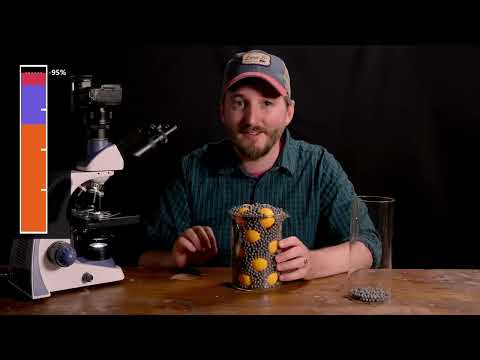
Making Infrared Cooling Paint From Grocery Store Items (w/Novel CaCO₃ Microsphere Synthesis)
1.3M views • 3 years ago
NightHawkInLight
NightHawkInLight shows how to make radiative sky cooling paint from grocery and hardware store materials, including a novel calcium carbonate microsphere synthesis. The paint can cool a surface below ambient air temperature in direct sunlight without electricity.
 3:40
Build a Do-It-Yourself Air Purifier for About $40
2.3M views • 15 years ago
Michigan Medicine
A University of Michigan Medicine demonstration of building a cheap DIY air purifier from a box fan and a HEPA or high-MERV filter using hardware-store parts. It explains why this helps against dust, smoke and viruses and ties it to local air quality readings.
 24:46
Building a 6800 CPU on an FPGA with nMigen (part 1)
27K views • 6 years ago
Robert Baruch
The first part of Robert Baruch's series on building a 6800 CPU on an FPGA with nMigen, a Python-based hardware description language. It introduces the HDL while implementing a simpler 6800 core.
 27:58
Build an electroluminescent glass panel display -- an Apollo DSKY
522K views • 7 years ago
Applied Science
Applied Science builds a replica Apollo DSKY using an electroluminescent driver circuit and screen-printed conductive ink, with source and PCB files published.
 13:02
Making logic gates from transistors
3.1M views • 11 years ago
Ben Eater
Ben Eater shows how to build logic gates out of transistors, including NOR gates. It is part of his clear hardware-from-scratch teaching style.