physics simulation
 5:26
Neural Network Learns The Physics of Fluids and Smoke | Two Minute Papers #118
209K views • 9 years ago
Two Minute Papers
Two Minute Papers covers a paper on speeding up fluid and smoke simulation with convolutional networks. It contrasts the approach with earlier regression forest methods.
 7:23
How Trees Bend the Laws of Physics
5M views • 14 years ago
Veritasium
Veritasium explains how trees lift water from roots to the top of tall trunks, using transpiration pull and the negative pressure that liquid water can sustain. It explains why trees do not need pumps or valves.
 13:41
The Physics of Life (ft. It's Okay to be Smart & PBS Eons!)
771K views • 8 years ago
PBS Space Time
PBS Space Time, together with It's Okay to be Smart and PBS Eons, asks how a universe drifting toward disorder produced something as complex as life. It presents the idea that the laws of physics, through thermodynamics, may actually favor the emergence of life.
 14:34
Visualization of Quantum Physics (Quantum Mechanics)
2.8M views • 9 years ago
udiprod
An animated visualization of basic quantum mechanics using a free particle, with simulations based on the actual equations. It covers waves, particles, and how measurement collapses the wavefunction.
 6:26
Slow Motion Flipping Cat Physics | Smarter Every Day 58
11.3M views • 14 years ago
SmarterEveryDay
Destin of Smarter Every Day films a cat falling in high-speed slow motion to show how cats right themselves in midair, and introduces the physics behind it.
 17:56
A Physics Professor Bet Me $10,000 I'm Wrong
26.3M views • 5 years ago
Veritasium
Veritasium recounts a $10,000 bet with a UCLA physics professor over whether a vehicle can travel downwind faster than the wind. He presents the professor's reasoning and demonstrations, including one without aerodynamics.
 16:43
The Equation That Explains (Nearly) Everything!
1.6M views • 4 years ago
PBS Space Time
PBS Space Time explains the Standard Model Lagrangian, the single equation encapsulating the particle physics theory, and visualizes what its terms mean.
 4:14
Computer Color is Broken
4.3M views • 11 years ago
minutephysics
MinutePhysics explains that computers store brightness nonlinearly, so blurring and blending colors in raw RGB gives wrong, dark results. It shows why mixed colors, such as in gradients, look off.
Topic match · Computer graphics & rendering 4:20
Why It's Impossible to Tune a Piano
4.1M views • 11 years ago
minutephysics
A minutephysics video explaining why a piano cannot be perfectly tuned, comparing equal temperament with just intonation and the math of harmonics.
 12:32
Protecting Privacy with MATH (Collab with the Census)
451K views • 7 years ago
minutephysics
minutephysics, in collaboration with the US Census Bureau, explains differential privacy and why the 2020 census adds noise to protect individuals' data. It walks through how statistics can leak private information.
 6:22
The Unreasonable Efficiency of Black Holes
4.5M views • 8 years ago
minutephysics
Minutephysics compares how efficiently different processes convert mass to energy per E=mc^2, from fire and fission to fusion, antimatter and black holes, which can convert a large fraction of mass to energy.
 11:22
Most People Don't Know How Bikes Work
24.9M views • 4 years ago
Veritasium
Veritasium explains why bicycles are stable, arguing that gyroscopic effects are not the answer. The video shows countersteering and an experiment where riders blocked from steering the opposite way cannot turn.
 13:23
Simulating Green Beard Altruism
4.5M views • 5 years ago
Primer
Primer simulates green beard altruism, where individuals recognize and help others carrying a shared marker, and shows how imposters affect its evolution. It is an animated evolution simulation based on published papers.
 12:36
Why the Muon g-2 Results Are So Exciting!
1.5M views • 5 years ago
PBS Space Time
A PBS Space Time episode explaining the Fermilab Muon g-2 results and why a discrepancy with the Standard Model prediction could point to new physics.
 18:54
The NEW Warp Drive Possibilities
2.8M views • 5 years ago
PBS Space Time
PBS Space Time explains how general relativity permits warp drive in principle and covers recent theoretical advances toward solving the negative energy problem.
 12:04
Why Being Delusional is a Superpower
15.2M views • 6 years ago
Veritasium
Veritasium examines the role of luck in success, with simulations and examples showing how small advantages and chance can compound. It argues that top outcomes are disproportionately luck-driven while still crediting effort.
 19:05
Why No One Has Measured The Speed Of Light
24.3M views • 6 years ago
Veritasium
Veritasium explains why the one-way speed of light has never been measured, only the round-trip speed, since measuring it requires synchronized clocks that assume the answer. It explores the implications for relativity.
 7:07
Feynman: What things really are like FUN TO IMAGINE 1
747K views • 17 years ago
Christopher Sykes
A clip from the 1983 BBC series Fun to Imagine in which Richard Feynman explains heat as the jiggling of atoms and how we perceive it as hot and cold.
 6:18
Animated Voting Methods
16K views • 9 years ago
Unify The Vote
An animated simulation comparing single-winner voting methods such as plurality, instant runoff and STAR. Colored regions show which candidate wins as a randomized electorate shifts across a two-dimensional political space, building on Ka-Ping Yee's earlier diagrams.
 10:31
Wendelstein 7-X – from concept to reality
497K views • 12 years ago
Max-Planck-Institut für Plasmaphysik
A CAD-based animation from the Max Planck Institute for Plasma Physics showing how the Wendelstein 7-X stellarator is configured and what its fusion research aims to achieve. It runs about 11 minutes.
 10:48
The True Nature of Matter and Mass | Space Time | PBS Digital Studios
1.8M views • 10 years ago
PBS Space Time
A PBS Space Time episode asking what matter, mass, and energy really are, starting with inertial versus gravitational mass and what mass-energy equivalence means.
 11:26
Do Complex Numbers Exist?
854K views • 5 years ago
Sabine Hossenfelder
Sabine Hossenfelder asks whether complex numbers are just a convenient tool or necessary in physics. She discusses a recent paper arguing that quantum mechanics cannot be done with real numbers alone.
 8:55
Are Space and Time An Illusion?
3.3M views • 11 years ago
PBS Space Time
A PBS Space Time episode hosted by Gabe Perez-Giz on the nature of spacetime and whether space and time are fundamental. It builds up reference frames and causality in a short, dense format.
 11:21
How does a whip break the sound barrier? (Slow Motion Shockwave formation) - Smarter Every Day 207
6.5M views • 7 years ago
SmarterEveryDay
Smarter Every Day uses high-speed and Schlieren photography to show how a whip crack is a supersonic shockwave formed at the tip. It references academic papers on whip physics.
 18:24
The Holographic Universe Explained
3.5M views • 7 years ago
PBS Space Time
A PBS Space Time episode explaining the holographic principle: the idea that our 3+1 dimensional universe may be described by information on a lower-dimensional boundary. It walks through black hole entropy and the AdS/CFT correspondence.
 10:15
Using ground relays with Starlink
506K views • 6 years ago
Mark Handley
Mark Handley of UCL explains, with simulation visualizations, how early Starlink satellites without inter-satellite links could still give low-latency wide-area communication by hopping via ground relays. He shows it can beat fibre on many long paths.
 16:07
The Geometry of Causality
1.8M views • 9 years ago
PBS Space Time
PBS Space Time explains how spacetime geometry and light cones determine the order of events and what can cause what. It visualizes causality in special relativity.
 4:40
This 1970s tank simulator drives through a tiny world
12M views • 4 years ago
Tom Scott
Tom Scott visits the Swiss Military Museum to see the last surviving 1970s tank-driving simulator. It uses a real camera moving over a miniature model landscape rather than any computer graphics.
 13:43
Why Quantum Information is Never Destroyed
715K views • 8 years ago
PBS Space Time
A PBS Space Time episode asking whether the universe's information can ever truly be lost, tying quantum mechanics, determinism and black holes together. It sets up the black hole information paradox.
 18:02
Why Teslas Are Bad At Towing (Today)
768K views • 6 years ago
Engineering Explained
Engineering Explained uses physics to show why today's electric cars, including Teslas, are poor at towing, pointing to battery energy density and weight. It examines Cybertruck and F-150 towing claims.
 14:03
Simulating alternate voting systems
4.5M views • 6 years ago
Primer
Primer uses simulations to compare voting systems such as first-past-the-post, approval, ranked choice and others. It shows how each system behaves and can be manipulated, with links to further voting theory resources.
 8:25
Calculating a Car Crash - Numberphile
446K views • 8 years ago
Numberphile
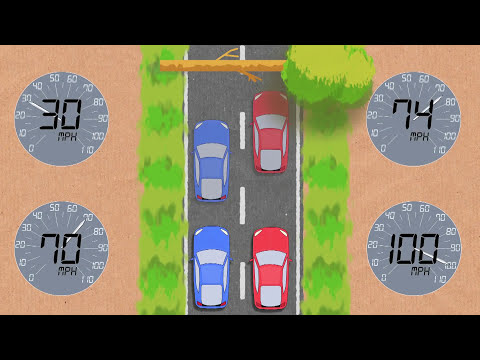
Numberphile's Ben Sparks works through the physics of a car crash, showing how kinetic energy grows with the square of speed and why stopping distance climbs so quickly as velocity increases.
 5:13
DR. QUANTUM - DOUBLE SLIT EXPERIMENT
1.6M views • 15 years ago
Angel Art
A short animated lesson, featuring Dr. Quantum, on the double slit experiment and how observing electrons seems to change their behavior.
 14:28
Superpositions, Sudoku, the Wave Function Collapse algorithm.
764K views • 6 years ago
Martin Donald
Martin Donald explains the Wave Function Collapse algorithm using Sudoku-like constraint solving and shows how he implemented it with Blender and Godot. It links demos and reference articles.
Topic match · Computer graphics & rendering 17:40
3D Gaussian Splatting! - Computerphile
273K views • 2 years ago
Computerphile
A Computerphile video in which Dr Mike Pound and PhD student Lewis Stuart explain 3D Gaussian splatting, a quick technique that turns photos of a scene into a 3D model without much compute. It includes a demo and compares the approach to NeRFs.
Topic match · Computer graphics & rendering 9:32
Disney's Practical Guide to Path Tracing
914K views • 10 years ago
Walt Disney Animation Studios
Walt Disney Animation Studios' short introduction to path tracing, showing how rays are traced and bounced through a virtual scene to simulate light. It explains how this approach is used in animated films.
Topic match · Computer graphics & rendering 4:01
Spherical Geometry Is Stranger Than Hyperbolic - Hyperbolica Devlog #2
1.8M views • 6 years ago
CodeParade
CodeParade's short devlog on how spherical geometry looks in 2D and 3D and why it feels so unusual, part of the Hyperbolica series on a non-Euclidean game.
Topic match · Computer graphics & rendering 9:27
What is a Geometry Kernel? C3D vs ACIS vs Parasolid
25K views • 4 years ago
nickkallen1
The Plasticity creator explains what a geometry kernel is and compares commercial options C3D, ACIS, and Parasolid, describing his months of research and why he chose as he did.
Topic match · Computer graphics & rendering 4:17
AI Learns Noise Filtering For Photorealistic Videos | Two Minute Papers #215
65K views • 8 years ago
Two Minute Papers
A Two Minute Papers episode on NVIDIA's recurrent denoising autoencoder, which cleans up noisy Monte Carlo path-traced image sequences. It shows how a neural network can produce usable renders from very few samples.
Topic match · Computer graphics & rendering 8:09
Google Earth’s Incredible 3D Imagery, Explained
3.1M views • 9 years ago
Nat and Friends
A short explainer from Nat and Friends on where Google Earth's 3D imagery comes from, how it is stitched together, and how often it is updated. It describes aircraft carrying camera rigs and photogrammetry that turns the photos into 3D models.
Topic match · Computer graphics & rendering