Calculating a Car Crash - Numberphile
Numberphile1 HN recommender · recommended in 1 month, 2018-2026
446K views · 8 years ago · explainer · evergreen
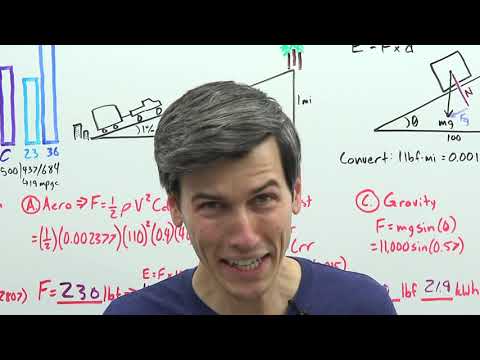
Numberphile's Ben Sparks works through the physics of a car crash, showing how kinetic energy grows with the square of speed and why stopping distance climbs so quickly as velocity increases.
Used as a short explainer when people need to illustrate why speed matters so much in braking and crash severity.
 16:58
Reynolds Number - Numberphile
Numberphile
560K views • 7 years ago
 2:27
What keeps a train on the track?
BoreMeScience
191K views • 17 years ago
 4:29
Tesla Crash Lab | Data-Driven Safety
Tesla
1M views • 5 years ago
 3:34
Complete Solution To The Twins Paradox
minutephysics
2.3M views • 10 years ago
 40:51
Geoffrey West on COMPLEXITY
FQxI
23K views • 15 years ago
 6:17
Why Cars Rarely Crash into Buildings in the Netherlands
Not Just Bikes
1M views • 6 years ago
 4:08
e^(iπ) in 3.14 minutes, using dynamics | DE5
3Blue1Brown
3.4M views • 7 years ago
 18:02
Why Teslas Are Bad At Towing (Today)
Engineering Explained
768K views • 6 years ago
 8:21
The Grille Trend that Kills 509 People per Year
FortNine
1.3M views • 2 years ago
 7:02
Traffic Waves
wbeaty
1M views • 18 years ago
 16:19
BMW's Hydrogen V12 Engine Is A Hilarious Engineering Stunt
Engineering Explained
503K views • 3 years ago
 27:15
The Most Misunderstood Concept in Physics
Veritasium
31.5M views • 3 years ago
 2:27
Feynman: How the train stays on the track FUN TO IMAGINE 7
Christopher Sykes
820K views • 18 years ago
 9:20
An astonishing old calculator - Numberphile
Numberphile
794K views • 8 years ago
 21:38
Risking My Life To Settle A Physics Debate
Veritasium
12.4M views • 5 years ago
 14:27
All the Numbers - Numberphile
Numberphile
1.8M views • 7 years ago
 1:47
The Counterintuitive Physics of Turning a Bike
minutephysics
855K views • 11 years ago
 9:31
Around The Corner - How Differential Steering Works (1937)
US Auto Industry
22.3M views • 17 years ago
 11:22
Most People Don't Know How Bikes Work
Veritasium
24.9M views • 4 years ago
 4:35
The real meaning of MPH- The Original- TCHappenings
Travis Chambers
13.1M views • 14 years ago
4 comments from Hacker News
Fun little anecdote: A blue care is travelling along at 70 units, and a red car (exact same make and model) is catching up to it going 100. When they're both right beside each other a bend in the road reveals an obstacle blocking both lanes, so both cars brake at the same intensity and deceleration. The blue care stops right before the obstacle. Since the red car was going at a faster speed, and braked at the same rate, it doesn't managae to stop: but what speed is it going when it hits the obstacle? The blue car, using ½mv², shed (~70²=) 4900 units of energy (we'll hand wave away the constants). So the red car, which had (100²=) 10000 units of kinetic energy to start, also shed 4900 units, which means it had 5100 units of energy when it collided, and so was going (√5100~) 71. * Numberphile: ▶ this video
Lol, I think they should be low and stay low and there should be more enforcement For me, I live in a quiet neighborhood. The residential street outside my apartment has speed limit signs of 20mph. People are trying to walk their dogs and kids. 9 out of 10 cars go 40-50mph. Part of that is road design. The road is new, straight, barrier and speed bump free. Worse, if you try to obey the law and go 20 the person behind you will get road rage and then illegally pass on the left (going into the opposite lane) or pass on the right and swerve around to get to the left turn lane. That said, a street a block over is 25mph with speed bump and at least 1 of 3 cars races to each bump. And 1 of 20 just flies over the bumps. This is a street with apartments and condos one one side and a park and elementary school on the other. There might be some roads that don't need enforcement (somewhere in Nevada) but even in outside of the city, say LA to Vegas or SF to LA there's enough traffic that speeders cause accidents. There's also a great video I stumbled across yesterday ▶ this video Summary: Kinetic energy = 1/2 * mv^2 So if have a car going 70mph and they slam on their breaks to avoid an accident. When they stop they'll have expended 4900 units of kinetic energy. Another car, same weight, going 100mph slams on the breaks. When their car has expended 4900 units of kinetic energy they still have another 5100 units to get rid before their car will stop because 70^2 = 4900, and 100^2 = 10000. In o
If it's your hobby and like driving 200 km/h, sure please do, on a separate track where it is as safe as possible. But driving it on _public_ roads is inherently dangerous to others. Our society has all kind of rules around protection of others. There are laws and rules around food safety, gun safety, distribution of drugs, hunting, using heavy equipment, operating boats and planes. Often you need a license to do these things. Noone trains for driving at high speeds in driving school. Also a lot of folks do not understand the relationship between velocity and the time you need to come to a stop. So 120km/h is way better than 200km/h. ▶ this video
Numberphile had a recent video on car crashes here: ▶ this video In short: Since kinetic energy goes as (velocity)^2, doubling the speed will quadruple the stopping distance (MANY other factors are significant, this is a rough estimate). 3X of the speed is ~9X the stopping distance, etc. NHTSB guidelines for 'proper' following distance are nearly never seen in LA and NYC, it's typically much shorter. If anything, L5 AVs will probably have longer gaps between AVs than what is currently on the road. Likely, the major improvement of L5 AVs will be in safety, not congestion. It turns out (I think), you can't technology your way out of a political problem. We need higher density housing, not magic carpets (effectively).