problem solving
 11:15
The hardest problem on the hardest test
16.5M views • 8 years ago
3Blue1Brown
3Blue1Brown walks through a very hard Putnam competition problem and its elegant solution, emphasizing the visual intuition and the thought process behind solving it.
 6:14
Turing & The Halting Problem - Computerphile
919K views • 12 years ago
Computerphile
A Computerphile video in which Mark Jago of the University of Nottingham explains Turing's halting problem and how it led to the blueprint for the modern computer.
 13:58
The Josephus Problem - Numberphile
7M views • 10 years ago
Numberphile
Numberphile with Daniel Erman on the Josephus problem, where people in a circle are eliminated in turn. It shows how the survivor's position follows a neat pattern tied to powers of two and binary.
 9:33
Avoiding Negative Side Effects: Concrete Problems in AI Safety part 1
161K views • 9 years ago
Robert Miles AI Safety
Robert Miles introduces the first of several videos on the paper 'Concrete Problems in AI Safety', focusing on how AI systems can cause accidental negative side effects. It explains the problem in accessible terms.
 3:37
Why Web Filters Don't Work: Penistone and the Scunthorpe Problem
3.6M views • 10 years ago
Tom Scott
Tom Scott visits Penistone to explain the Scunthorpe problem, showing why naive web and profanity filters block innocent words.
 3:51
Why “No Problem” Can Seem Rude: Phatic Expressions
5M views • 7 years ago
Tom Scott
Tom Scott explains phatic expressions such as hello, thank you and how are you, which carry social meaning rather than information, and why replies like no problem can seem rude to some people.
 8:29
The Uncracked Problem with 33 - Numberphile
2M views • 11 years ago
Numberphile
Numberphile with Tim Browning on the sum-of-three-cubes problem and why 33 was the lowest unsolved case. The description notes a later solution for 33.
 10:13
The Problem with Time & Timezones - Computerphile
4.4M views • 12 years ago
Computerphile
Tom Scott explains for Computerphile why handling time and timezones in code is so hard, walking through a simple web app that computes how long ago something happened. It covers the quirks of timezones and calendars and ends in an exasperated rant.
 6:59
The Problem With Facebook
3.1M views • 12 years ago
2veritasium
Veritasium's Derek Muller argues that Facebook's business model works against pages and creators, because it charges them to reach the audiences they built. He explains how filtering and paid promotion undermine the value of likes.
 4:30
Traffic Has a Perfect Solution. Humans Are the Problem.
44.6M views • 10 years ago
CGP Grey
CGP Grey explains how traffic jams come from human driving behavior such as tailgating and reaction delays, and how leaving gaps and smoothing speed would reduce congestion. It also touches on self-driving cars.
 18:01
California's Renewable Energy Problem
1.6M views • 7 years ago
Real Engineering
Real Engineering looks at the numbers for running California on renewables, focusing on the large energy storage needed. It argues about the cost of batteries and the role of other sources.
 20:00
AI "Stop Button" Problem - Computerphile
1.4M views • 9 years ago
Computerphile
Rob Miles explains on Computerphile why implementing an off switch for a general AI is hard. A capable agent would resist being stopped because shutdown prevents it from achieving its goal.
 5:24
Diffie-Hellman Key Exchange
547K views • 14 years ago
Art of the Problem
A short Art of the Problem clip explaining Diffie-Hellman key exchange, using a paint mixing analogy for one-way functions and touching on modular arithmetic and discrete logarithms.
 16:30
Who cares about topology? (Old version)
3.3M views • 10 years ago
3Blue1Brown
An older 3Blue1Brown video on why topology matters, built around the inscribed rectangle problem. It walks through how tori and Mobius strips appear in the solution. The channel later replaced it with an updated version.
 32:11
Darts in Higher Dimensions (with 3blue1brown) - Numberphile
2.1M views • 6 years ago
Numberphile
Numberphile talks with Grant Sanderson of 3Blue1Brown about a darts puzzle with a shrinking bullseye. Solving it takes the volumes of high-dimensional spheres, and the answer turns up Euler's number.
 8:38
Diffie-Hellman Key Exchange
938K views • 14 years ago
Art of the Problem
A short explainer on the history and mechanics of public key cryptography and the Diffie-Hellman key exchange. It uses a mixing-paint-colors analogy to show how two parties can agree on a shared secret in public.
 17:35
Bell's Theorem: The Quantum Venn Diagram Paradox
8.1M views • 9 years ago
minutephysics
MinutePhysics, with 3Blue1Brown, explains Bell's theorem using a Venn diagram paradox and polarizing filters. It shows why no local hidden variable theory can reproduce quantum correlations.
 4:36
Don't Be the Last Person to Die
8.2M views • 9 years ago
CGP Grey
CGP Grey argues that aging and death are a problem worth defeating, using a short animated essay. It is part of a pair with a follow-up from Kurzgesagt.
 3:35
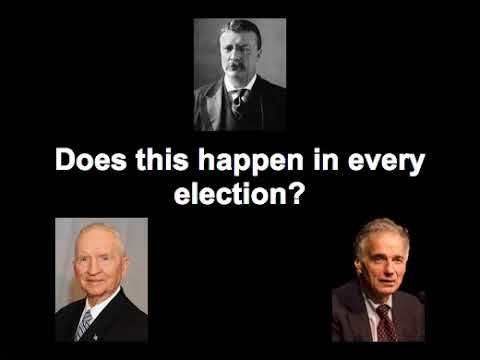
How our voting system (and IRV) betrays your favourite candidate
35K views • 12 years ago
The Center for Election Science
The Center for Election Science explains favorite betrayal in instant-runoff voting: in some elections, ranking your favorite first can cause your least favorite to win. It contrasts this with plurality voting's spoiler problem.
 7:21
How to Cure Aging – During Your Lifetime?
8M views • 9 years ago
Kurzgesagt – In a Nutshell
A Kurzgesagt animated explainer on whether aging could be cured within our lifetimes, made with Lifespan.io and the LEAF foundation. It introduces the idea of treating aging as a medical problem.
 10:09
Dominic Frisby. A simple guide to land value tax
25K views • 11 years ago
Dominic Frisby Comedy Videos
Comedian Dominic Frisby gives a ten-minute explanation of land value tax. He argues it would fix problems of rent-seeking and the economics of land ownership.
 12:31
The Superheterodyne Radio: No really, that's its name
987K views • 7 years ago
Technology Connections
Technology Connections explains why the superheterodyne radio has its name and how mixing frequencies lets it tune stations well. It walks through the underlying wave phenomena and algebra and why the design solved a hard tuning problem.
 5:29
How to Fix America's Corrupt Political System
479K views • 10 years ago
RepresentUs
A short RepresentUs explainer on how money corrupts American politics and what an anti-corruption act could do about it. It covers lobbying, super PACs and campaign finance, and pitches the group's proposed reforms. The video was later superseded by an updated version.
 13:43
Why Quantum Information is Never Destroyed
715K views • 8 years ago
PBS Space Time
A PBS Space Time episode asking whether the universe's information can ever truly be lost, tying quantum mechanics, determinism and black holes together. It sets up the black hole information paradox.
 11:48
Superluminal Time Travel + Time Warp Challenge Answer
1M views • 9 years ago
PBS Space Time
A PBS Space Time episode explaining why faster-than-light travel is equivalent to travelling back in time, using relativity and Minkowski diagrams for different observers.
 7:09
What Is the RNA World Hypothesis?
886K views • 10 years ago
Stated Clearly
Stated Clearly explains the RNA world hypothesis, which resolves the chicken-or-egg problem of genes versus enzymes by proposing that RNA once did both jobs. It outlines how evolution could begin with RNA chains alone.
 22:22
Some light quantum mechanics (with minutephysics)
2.2M views • 9 years ago
3Blue1Brown
3Blue1Brown, in collaboration with minutephysics, introduces the math of superposition and quantum states using polarized light. It builds up the quantum behavior of photons as a simple counting and probability problem.
 5:10
Junction design in the Netherlands
630K views • 12 years ago
BicycleDutch
A five-minute BicycleDutch episode showing how Dutch junctions are designed so cyclists and pedestrians can cross safely. It explains the layout choices that separate and protect them.
 5:43
Design Club - Super Mario Bros: Level 1-1 - How Super Mario Mastered Level Design
1.2M views • 12 years ago
Extra History
A Design Club episode that analyzes how Super Mario Bros. level 1-1 teaches players to play through level design alone, without text tutorials.
 6:18
The artificial gravity lab
7.2M views • 7 years ago
Tom Scott
Tom Scott tours the rotating room artificial gravity facility at Brandeis University's Graybiel lab. It shows how humans cope with rotation-based gravity and the odd effects such as Coriolis forces.
 6:36
Intel ME explained (intel management engine) from insider
12K views • 8 years ago
jessie
A short video explaining the Intel Management Engine, a hidden embedded computer inside Intel machines with deep access to hardware. It is presented from an insider's perspective and raises backdoor and NSA concerns.
 4:01
Dutch junction design - safer for cyclists
52K views • 15 years ago
BicycleDutch
A short BicycleDutch episode showing how Dutch junctions with protected cycle paths are laid out. It argues these are proven, non-experimental designs that make intersections safer for cyclists.
 4:31
Why Photos of the Eiffel Tower at Night are Illegal
12.1M views • 9 years ago
Half as Interesting
Half as Interesting explains why the Eiffel Tower's night-time lighting is under copyright, which makes publishing photos of it at night legally problematic.
 31:58
Kraut Space Magic: the H&K G11
10.3M views • 7 years ago
Forgotten Weapons
Forgotten Weapons examines the Heckler & Koch G11, a West German experimental rifle built around a caseless cartridge. The video covers the G11K2 and its unusual technology before its cancellation for political and economic reasons.