procedural generation
 14:28
Superpositions, Sudoku, the Wave Function Collapse algorithm.
764K views • 6 years ago
Martin Donald
Martin Donald explains the Wave Function Collapse algorithm using Sudoku-like constraint solving and shows how he implemented it with Blender and Godot. It links demos and reference articles.
Topic match · Computer graphics & rendering 20:55
Why ChatGPT Can't Draw a Full Glass of Wine
6.3M views • 1 year ago
Alex O'Connor
Alex O'Connor shows that ChatGPT cannot draw a wine glass filled to the brim, and ties the failure to David Hume's missing shade of blue. It asks what the failure says about how image models learn.
 5:26
Neural Network Learns The Physics of Fluids and Smoke | Two Minute Papers #118
209K views • 9 years ago
Two Minute Papers
Two Minute Papers covers a paper on speeding up fluid and smoke simulation with convolutional networks. It contrasts the approach with earlier regression forest methods.
Topic match · Computer graphics & rendering 4:13
Social Inequalities Explained in a $100 Race - Please Watch to the End. Thanks.
5M views • 9 years ago
Peter D
A short animated explainer that stages a $100 footrace in which contestants start at different distances from the line, depending on the advantages or disadvantages they inherited. It uses the race as a metaphor for how unequal starting points shape outcomes, citing US census income and poverty figures.
 23:10
Juvenoia
10.6M views • 11 years ago
Vsauce
Vsauce looks at 'juvenoia', the exaggerated fear that new media and youth culture are corrupting the young. It gives historical examples of older generations complaining about the next one.
 24:26
The Beauty of Bézier Curves
2.2M views • 5 years ago
Freya Holmér
Freya Holmer explains how Bezier curves work, from the helper-line construction to their uses in animation, text rendering and shapes. It uses visuals from her Unity Shapes plugin and was a SoME1 contest winner.
Topic match · Computer graphics & rendering 1:13:50
The Continuity of Splines
1.9M views • 3 years ago
Freya Holmér
Freya Holmer's 74-minute video essay on splines, covering Bezier curves, B-splines, derivatives and the different levels of continuity (C0, C1, C2), built with custom animation tools. She notes she did not cover non-uniform splines.
Topic match · Computer graphics & rendering 4:14
Computer Color is Broken
4.3M views • 11 years ago
minutephysics
MinutePhysics explains that computers store brightness nonlinearly, so blurring and blending colors in raw RGB gives wrong, dark results. It shows why mixed colors, such as in gradients, look off.
Topic match · Computer graphics & rendering 20:57
Atari's Quadrascan Explained
239K views • 5 years ago
Retro Game Mechanics Explained
Retro Game Mechanics Explained dissects how Atari's Quadrascan vector displays and vector generator hardware drew games like Asteroids and Tempest.
Topic match · Computer graphics & rendering 21:46
Surface-Stable Fractal Dithering Explained
646K views • 1 year ago
runevision
Rune Skovbo Johansen explains Surface-Stable Fractal Dithering, a technique he invented and released as open source. It makes dithering stick to 3D surfaces and covers the experiments and shortcomings along the way, inspired by Return of the Obra Dinn.
Topic match · Computer graphics & rendering 2:12
3D Gaussian Splatting - Why Graphics Will Never Be The Same
2M views • 3 years ago
IndividualKex
A two-minute explainer of 3D Gaussian Splatting, the rendering technique from a 2023 research paper. It outlines why it could change how 3D graphics are made.
Topic match · Computer graphics & rendering 40:45
Exclusive: Metro Exodus Enhanced Edition Analysis - The First Triple-A Game Built Around Ray Tracing
915K views • 5 years ago
Digital Foundry
Digital Foundry's Alex Battaglia analyzes Metro Exodus Enhanced Edition, the first AAA game built around ray tracing. It covers the new global illumination, emissive lighting, DLSS and performance on AMD and Nvidia hardware.
Topic match · Computer graphics & rendering 17:40
3D Gaussian Splatting! - Computerphile
273K views • 2 years ago
Computerphile
A Computerphile video in which Dr Mike Pound and PhD student Lewis Stuart explain 3D Gaussian splatting, a quick technique that turns photos of a scene into a 3D model without much compute. It includes a demo and compares the approach to NeRFs.
Topic match · Computer graphics & rendering 9:32
Disney's Practical Guide to Path Tracing
914K views • 10 years ago
Walt Disney Animation Studios
Walt Disney Animation Studios' short introduction to path tracing, showing how rays are traced and bounced through a virtual scene to simulate light. It explains how this approach is used in animated films.
Topic match · Computer graphics & rendering 4:01
Spherical Geometry Is Stranger Than Hyperbolic - Hyperbolica Devlog #2
1.8M views • 6 years ago
CodeParade
CodeParade's short devlog on how spherical geometry looks in 2D and 3D and why it feels so unusual, part of the Hyperbolica series on a non-Euclidean game.
Topic match · Computer graphics & rendering 9:27
What is a Geometry Kernel? C3D vs ACIS vs Parasolid
25K views • 4 years ago
nickkallen1
The Plasticity creator explains what a geometry kernel is and compares commercial options C3D, ACIS, and Parasolid, describing his months of research and why he chose as he did.
Topic match · Computer graphics & rendering 4:17
AI Learns Noise Filtering For Photorealistic Videos | Two Minute Papers #215
65K views • 8 years ago
Two Minute Papers
A Two Minute Papers episode on NVIDIA's recurrent denoising autoencoder, which cleans up noisy Monte Carlo path-traced image sequences. It shows how a neural network can produce usable renders from very few samples.
Topic match · Computer graphics & rendering 8:09
Google Earth’s Incredible 3D Imagery, Explained
3.1M views • 9 years ago
Nat and Friends
A short explainer from Nat and Friends on where Google Earth's 3D imagery comes from, how it is stitched together, and how often it is updated. It describes aircraft carrying camera rigs and photogrammetry that turns the photos into 3D models.
Topic match · Computer graphics & rendering 14:53
What would we see if we fell into a Black Hole?
7.5M views • 5 years ago
ScienceClic English
ScienceClic visualizes what you would see falling into a black hole, from the approach and the accretion disc to crossing the horizon, in 15 minutes.
Topic match · Computer graphics & rendering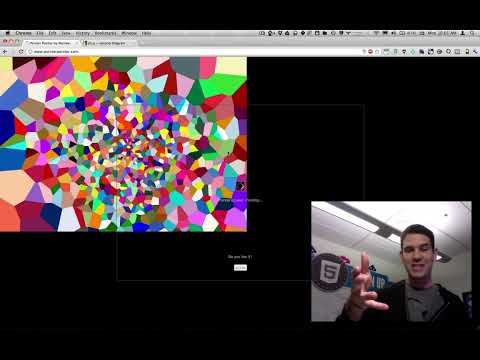 3:45
pointerpointer.com's use of voronoi, canvas, and javascript
40K views • 14 years ago
Paul Irish
Paul Irish explains how pointerpointer.com works. It uses a hidden canvas of colored Voronoi regions to look up which photo matches the cursor position.
Topic match · Computer graphics & rendering 12:36
Why PlayStation 1 Graphics Warped and Wobbled so much | MVG
2.3M views • 6 years ago
Modern Vintage Gamer
Modern Vintage Gamer explains why PlayStation 1 graphics warped and jittered, comparing it with the Nintendo 64. The causes are affine texture mapping and the lack of sub-pixel vertex precision.
Topic match · Computer graphics & rendering 37:20
But how do AI images and videos actually work? | Guest video by Welch Labs
2.2M views • 1 year ago
3Blue1Brown
A guest video by Welch Labs on 3Blue1Brown explaining how text-to-image and video models work. It covers CLIP, shared embedding spaces, diffusion models (DDPM, DDIM), conditioning, guidance and negative prompts.
 16:48
What Really Happened During the Texas Power Grid Outage?
3.7M views • 5 years ago
Practical Engineering
Practical Engineering's explanation of the February 2021 Texas winter storm and the resulting power grid outage. It lays out the facts about ERCOT, the grid's isolation, and how generation across fuel types failed in the cold.
 18:48
Connecting Solar to the Grid is Harder Than You Think
2.4M views • 2 years ago
Practical Engineering
Practical Engineering explains why connecting solar and other inverter-based generation to the grid is hard. It covers grid stability, load balancing and the behind-the-scenes engineering challenges of renewables.
 29:34
How Do Nuclear Submarines Make Oxygen?- Smarter Every Day 251
10.4M views • 5 years ago
SmarterEveryDay
A Smarter Every Day episode from aboard a nuclear submarine on how the crew makes breathable air. It covers oxygen generation from seawater, oxygen candles and CO2 scrubbing with amine.
 8:39
How to Move the Sun: Stellar Engines
19.5M views • 6 years ago
Kurzgesagt – In a Nutshell
Kurzgesagt explains stellar engines such as the Shkadov thruster and Caplan thruster, which could move the Sun and solar system across the galaxy over millions of years to avoid hazards and reach new regions.
 6:00
Rhyme: Why Eminem is one of the most impressive lyricists ever
3.7M views • 13 years ago
Library of Alexandria
A re-upload of a video breaking down Eminem's rhyme schemes, showing multi-syllable and internal rhymes in songs such as Lose Yourself. It aims to show why he is considered a standout lyricist.
 52:22
Power is not energy: why the difference matters
2.3M views • 1 year ago
Technology Connections
Technology Connections explains the difference between power (watts) and energy (watt-hours) and why confusing them leads to errors. It runs about 52 minutes and uses everyday examples.
 27:16
How Do Night Vision Goggles Work?
8.4M views • 3 years ago
Veritasium
Veritasium visits the US Navy's Crane facility to test top night vision goggles. It explains how image intensifier tubes and thermal or digital systems work and compares the generations of the technology.
 16:11
The Economics of Nuclear Energy
2M views • 6 years ago
Real Engineering
Real Engineering looks at why nuclear power plants are expensive and how their economics compare with fossil and renewable alternatives. It is based on a video from the Illinois Energy Professors.
 3:59
The Lava Lamps That Help Keep The Internet Secure
4.3M views • 9 years ago
Tom Scott
Tom Scott visits Cloudflare's San Francisco office to show the wall of lava lamps whose camera feed is used as a source of entropy for random number generation. It is a short explainer on how this helps secure internet encryption.
 40:47
Dyson Spheres
838K views • 9 years ago
Isaac Arthur
Isaac Arthur examines Dyson spheres and swarms, including common myths and misconceptions. He covers uses such as interstellar travel, black hole generation, and computing large enough to simulate universes.
 12:31
The Last Human – A Glimpse Into The Far Future
15.2M views • 4 years ago
Kurzgesagt – In a Nutshell
A Kurzgesagt animation on longtermism, arguing that because the future could hold trillions of people, our actions' effect on future generations may be what matters most.
 5:13
Overview of Illumina Sequencing by Synthesis Workflow | Standard SBS chemistry
2.7M views • 10 years ago
Illumina
Illumina's 3D animation of its sequencing-by-synthesis workflow, from sample preparation and cluster generation to sequencing on a flow cell and data analysis.
 32:01
EEVblog #632 - Solar Roadways Are RUBBISH!
543K views • 12 years ago
EEVblog
Dave Jones of EEVblog debunks the Solar Roadways project, which raised millions through Indiegogo and government funding. He works through the solar generation and LED power calculations to show the idea isn't viable.