quantum causality
 14:40
How the Quantum Eraser Rewrites the Past | Space Time | PBS Digital Studios
2.9M views • 10 years ago
PBS Space Time
PBS Space Time explains the quantum eraser experiment, in which erasing which-path information appears to reverse causality in a double-slit setup. It discusses what this means for quantum mechanics.
 12:51
The Delayed Choice Quantum Eraser, Debunked
718K views • 5 years ago
Sabine Hossenfelder
Sabine Hossenfelder explains the delayed choice quantum eraser and argues it does not rewrite the past, as popular accounts claim. She walks through what the experiment actually shows.
 12:35
The Mathematics of Quantum Computers | Infinite Series
718K views • 9 years ago
PBS Infinite Series
A PBS Infinite Series episode explaining the mathematics of quantum computers, including how qubits store complex numbers and how quantum computation differs from classical computation. Hosted by Kelsey Houston-Edwards.
 17:31
How Quantum Computers Break Encryption | Shor's Algorithm Explained
3.4M views • 7 years ago
minutephysics
MinutePhysics explains Shor's algorithm, showing how a quantum computer factors large integers by finding the period of a number modulo N. It walks through the modular arithmetic and number theory that give the exponential speedup over classical factoring, and why this threatens encryption.
 14:03
Quantum Entanglement and the Great Bohr-Einstein Debate | Space Time | PBS Digital Studios
2.6M views • 10 years ago
PBS Space Time
PBS Space Time explains the Bohr-Einstein debate over quantum mechanics and how quantum entanglement settled it. It covers the weirdness of measurement and nonlocal correlations.
 19:27
Quantum Computing Expert Explains One Concept in 5 Levels of Difficulty | WIRED
8M views • 8 years ago
WIRED
IBM's Dr. Talia Gershon explains quantum computing to five people of increasing expertise: a child, teen, college student, grad student and professional. The WIRED series format moves from simple analogies to technical detail.
 19:19
Was Penrose Right? NEW EVIDENCE For Quantum Effects In The Brain
1.1M views • 2 years ago
PBS Space Time
PBS Space Time examines Roger Penrose's idea that consciousness arises from quantum processes in the brain, and reviews new evidence about microtubules. It ends with an estimate of what replicating consciousness would demand.
 22:22
Some light quantum mechanics (with minutephysics)
2.2M views • 9 years ago
3Blue1Brown
3Blue1Brown, in collaboration with minutephysics, introduces the math of superposition and quantum states using polarized light. It builds up the quantum behavior of photons as a simple counting and probability problem.
 17:05
How Physicists Created a Holographic Wormhole in a Quantum Computer
2.4M views • 3 years ago
Quanta Magazine
Quanta Magazine explains the 2022 experiment that claimed to create a holographic wormhole on Google's quantum computer. The description now notes that a later independent analysis questioned whether any wormhole was created.
 9:16
Quantum Entanglement & Spooky Action at a Distance
4.5M views • 11 years ago
Veritasium
Veritasium explains quantum entanglement and spooky action at a distance, walking through Bell's inequality and the experiments that rule out hidden variables, in under ten minutes.
 14:34
Visualization of Quantum Physics (Quantum Mechanics)
2.8M views • 9 years ago
udiprod
An animated visualization of basic quantum mechanics using a free particle, with simulations based on the actual equations. It covers waves, particles, and how measurement collapses the wavefunction.
 16:32
Pilot Wave Theory and Quantum Realism | Space Time | PBS Digital Studios
1.9M views • 9 years ago
PBS Space Time
A PBS Space Time episode introducing de Broglie-Bohm pilot wave theory, an interpretation of quantum mechanics that avoids much of the strangeness of the mainstream views. It is aimed at curious lay viewers.
 16:36
Hacking at Quantum Speed with Shor's Algorithm | Infinite Series
238K views • 9 years ago
PBS Infinite Series
PBS Infinite Series explains how Shor's algorithm lets a quantum computer break RSA encryption, building on earlier episodes about cryptography and the math of quantum computers. It works through the idea step by step.
 16:07
The Geometry of Causality
1.8M views • 9 years ago
PBS Space Time
PBS Space Time explains how spacetime geometry and light cones determine the order of events and what can cause what. It visualizes causality in special relativity.
 13:43
Why Quantum Information is Never Destroyed
715K views • 8 years ago
PBS Space Time
A PBS Space Time episode asking whether the universe's information can ever truly be lost, tying quantum mechanics, determinism and black holes together. It sets up the black hole information paradox.
 15:53
Quantum Field Theory visualized
2.7M views • 6 years ago
ScienceClic English
ScienceClic gives a 15-minute animated introduction to quantum field theory, covering fields, spin, conserved quantities, the standard model and interactions.
 7:41
Is This What Quantum Mechanics Looks Like?
6.2M views • 10 years ago
Veritasium
Veritasium shows silicone oil droplets bouncing on a vibrating bath, a physical analogue of pilot wave theory that reproduces quantum-like behavior such as double-slit patterns.
 12:00
Do we have to accept Quantum weirdness? De Broglie Bohm Pilot Wave Theory explained
125K views • 9 years ago
Looking Glass Universe
Looking Glass Universe explains de Broglie-Bohm pilot wave theory (Bohmian mechanics) as an alternative to the standard interpretation of quantum mechanics. The video lays out the pros and cons of the theory and links to related videos on contextuality and entanglement.
 5:13
DR. QUANTUM - DOUBLE SLIT EXPERIMENT
1.6M views • 15 years ago
Angel Art
A short animated lesson, featuring Dr. Quantum, on the double slit experiment and how observing electrons seems to change their behavior.
 17:35
Bell's Theorem: The Quantum Venn Diagram Paradox
8.1M views • 9 years ago
minutephysics
MinutePhysics, with 3Blue1Brown, explains Bell's theorem using a Venn diagram paradox and polarizing filters. It shows why no local hidden variable theory can reproduce quantum correlations.
 11:26
Do Complex Numbers Exist?
854K views • 5 years ago
Sabine Hossenfelder
Sabine Hossenfelder asks whether complex numbers are just a convenient tool or necessary in physics. She discusses a recent paper arguing that quantum mechanics cannot be done with real numbers alone.
 33:01
The Strangest Implication of Quantum Mechanics
20.6M views • 1 year ago
Veritasium
A Veritasium video that follows the principle of least action from Bernoulli and Newton to quantum mechanics, asking whether light takes all possible paths at once. It includes experiments showing quantum waves.
 20:30
Does Superdeterminism save Quantum Mechanics? Or does it kill free will and destroy science?
989K views • 4 years ago
Sabine Hossenfelder
Sabine Hossenfelder explains superdeterminism as an interpretation of quantum mechanics, addressing common objections and misconceptions, including the worry that it kills free will or science. She ties it to Bell's theorem and hidden variables.
 4:12
Correlation CAN Imply Causation! | Statistics Misconceptions
744K views • 9 years ago
minutephysics
A four-minute minutephysics video arguing that causal models and causal networks let statistics infer causation from correlation. It touches on Reichenbach's principle, common causes, feedback and quantum causal discovery.
 12:46
The Speed of Light is NOT About Light
7.1M views • 11 years ago
PBS Space Time
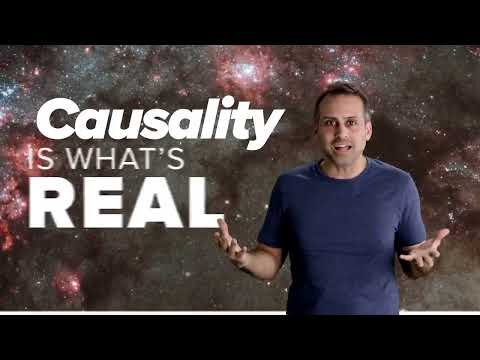
PBS Space Time argues that the speed of light is better understood as the speed of causality, the universal limit on how fast cause and effect propagate. Light travels at that speed because it is massless, but the limit itself is a property of spacetime.
 25:10
How an Atomic Clock Really Works: Inside the HP 5061A Cesium Clock
464K views • 6 years ago
CuriousMarc
CuriousMarc powers up a vintage HP 5061A cesium beam clock and explains both the quantum principle and the HP implementation in detail. It is part of a longer atomic clock series.
 8:55
Are Space and Time An Illusion?
3.3M views • 11 years ago
PBS Space Time
A PBS Space Time episode hosted by Gabe Perez-Giz on the nature of spacetime and whether space and time are fundamental. It builds up reference frames and causality in a short, dense format.
 9:32
The Higgs Mechanism Explained | Space Time | PBS Digital Studios
2.7M views • 10 years ago
PBS Space Time
PBS Space Time explains the Higgs field and how the Higgs mechanism gives particles mass within quantum field theory. It is a ten-minute overview for a lay audience.
 20:00
Why Parallel Universes Are Probably Real
25.4M views • 6 years ago
Veritasium
Veritasium explains the many-worlds interpretation of quantum mechanics, drawing heavily on Sean Carroll's book. It walks through the Schrodinger equation and why wave collapse may be unnecessary if the universe keeps splitting.
 18:07
The more general uncertainty principle, regarding Fourier transforms
2.3M views • 8 years ago
3Blue1Brown
3Blue1Brown shows how the uncertainty principle arises from Fourier transforms. A wave packet cannot be narrow in both position and frequency, so the principle is a property of waves rather than of measurement.
 20:34
How big is a visible photon?
793K views • 5 years ago
Huygens Optics
Huygens Optics shows through a laser interference experiment that the question of a photon's size is really about coherence length. It argues that photons exist as energy exchanges between radiation and matter, not as little particles in free space.
 16:43
The Equation That Explains (Nearly) Everything!
1.6M views • 4 years ago
PBS Space Time
PBS Space Time explains the Standard Model Lagrangian, the single equation encapsulating the particle physics theory, and visualizes what its terms mean.
 16:29
Are Black Holes Actually Fuzzballs?
1.3M views • 4 years ago
PBS Space Time
A PBS Space Time episode on fuzzballs, the string-theory proposal for black holes that replaces the singularity with a tangle of strings. It explains why black holes seem to both have to exist and break known physics.
 11:48
Superluminal Time Travel + Time Warp Challenge Answer
1M views • 9 years ago
PBS Space Time
A PBS Space Time episode explaining why faster-than-light travel is equivalent to travelling back in time, using relativity and Minkowski diagrams for different observers.