relativity
 4:19
How Special Relativity Makes Magnets Work
4M views • 13 years ago
Veritasium
Veritasium explains magnetism as a consequence of special relativity. Length contraction of moving charges makes a current in a wire attract or repel a nearby moving charge.
 16:07
The Geometry of Causality
1.8M views • 9 years ago
PBS Space Time
PBS Space Time explains how spacetime geometry and light cones determine the order of events and what can cause what. It visualizes causality in special relativity.
Topic match · Fundamental physics 12:46
The Speed of Light is NOT About Light
7.1M views • 11 years ago
PBS Space Time
PBS Space Time argues that the speed of light is better understood as the speed of causality, the universal limit on how fast cause and effect propagate. Light travels at that speed because it is massless, but the limit itself is a property of spacetime.
Topic match · Fundamental physics 3:34
Complete Solution To The Twins Paradox
2.3M views • 10 years ago
minutephysics
A minutephysics explainer on the twins paradox in special relativity. It shows why the traveling twin ends up younger and how acceleration resolves the paradox.
Topic match · Fundamental physics 11:57
We all move at the Speed of Light
1.4M views • 8 years ago
ScienceClic English
ScienceClic explains why nothing can go faster than light by treating motion through space and time together, so everything moves at the speed of light through spacetime. It uses animated visuals to cover relativity basics in 12 minutes.
Topic match · Fundamental physics 11:48
Superluminal Time Travel + Time Warp Challenge Answer
1M views • 9 years ago
PBS Space Time
A PBS Space Time episode explaining why faster-than-light travel is equivalent to travelling back in time, using relativity and Minkowski diagrams for different observers.
Topic match · Fundamental physics 15:29
How Time Becomes Space Inside a Black Hole | Space Time
2.5M views • 9 years ago
PBS Space Time
A PBS Space Time episode explaining how space and time swap roles inside a black hole's event horizon. It is part of the channel's black hole series.
Topic match · Fundamental physics 10:48
The True Nature of Matter and Mass | Space Time | PBS Digital Studios
1.8M views • 10 years ago
PBS Space Time
A PBS Space Time episode asking what matter, mass, and energy really are, starting with inertial versus gravitational mass and what mass-energy equivalence means.
Topic match · Fundamental physics 10:00
Is The Alcubierre Warp Drive Possible? | Space Time | PBS Digital Studios
2.5M views • 11 years ago
PBS Space Time
PBS Space Time introduces Miguel Alcubierre's warp drive, explaining how spacetime itself could be warped rather than moving a ship through it, and whether it is physically possible.
Topic match · Fundamental physics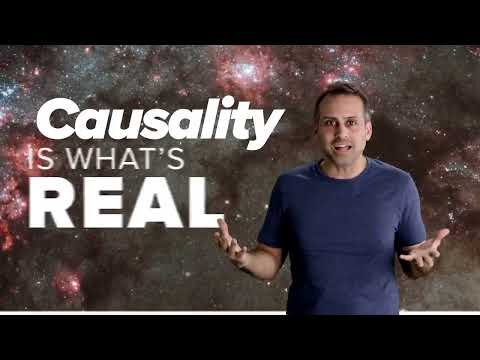 8:55
Are Space and Time An Illusion?
3.3M views • 11 years ago
PBS Space Time
A PBS Space Time episode hosted by Gabe Perez-Giz on the nature of spacetime and whether space and time are fundamental. It builds up reference frames and causality in a short, dense format.
Topic match · Fundamental physics 19:59
What Happens at the Event Horizon? | Space Time | PBS Digital Studios
3.2M views • 9 years ago
PBS Space Time
PBS Space Time explains what happens as you approach and cross a black hole's event horizon, using Penrose diagrams and light cones as the tool for understanding spacetime there.
Topic match · Fundamental physics 15:48
How to Detect Extra Dimensions
1.6M views • 8 years ago
PBS Space Time
A PBS Space Time episode on how gravitational wave observations of a neutron star merger, GW170817, can limit the number of spacetime dimensions. It is based on a 2018 paper.
Topic match · Fundamental physics 56:04
Richard Feynman - The.Character of Physical Law - Part 1 The Law of Gravitation (full version)
1.4M views • 15 years ago
Tinkerin' Thinkers
The first of Richard Feynman's 1964 Cornell Messenger Lectures, The Character of Physical Law, focusing on the law of gravitation. Feynman builds up from planetary motion to the nature of physical laws.
Topic match · Fundamental physics 1:00:18
Quantum Fields: The Real Building Blocks of the Universe - with David Tong
6.9M views • 9 years ago
The Royal Institution
David Tong, a Cambridge theoretical physicist, explains at the Royal Institution that the fundamental building blocks of nature are quantum fields rather than particles. He covers what we know about these fields and how they fit into the Standard Model.
Topic match · Fundamental physics 54:54
The Physics and Philosophy of Time - with Carlo Rovelli
1.4M views • 8 years ago
The Royal Institution
Physicist Carlo Rovelli gives a public lecture at the Royal Institution on how our understanding of time has changed, from Boltzmann and Einstein to quantum theory and loop quantum gravity. He blends physics, philosophy and art to argue that time is stranger than everyday intuition suggests.
Topic match · Fundamental physics 7:35
Feynman: Magnets (and Why?) FUN TO IMAGINE 4/ higher quality version!
359K views • 8 years ago
Christopher Sykes
A 1983 BBC interview in which Richard Feynman is asked how magnets work and explains why 'why' questions are hard to answer in everyday terms. He reflects on what counts as an explanation and the limits of analogy.
Topic match · Fundamental physics 7:23
How Trees Bend the Laws of Physics
5M views • 14 years ago
Veritasium
Veritasium explains how trees lift water from roots to the top of tall trunks, using transpiration pull and the negative pressure that liquid water can sustain. It explains why trees do not need pumps or valves.
Topic match · Fundamental physics 13:02
Noether's Theorem and The Symmetries of Reality
1.1M views • 8 years ago
PBS Space Time
PBS Space Time explains Noether's theorem: conservation laws such as energy and momentum are consequences of deeper symmetries. It also covers why those laws hold only under certain conditions.
Topic match · Fundamental physics 7:33
Richard Feynman. Why.
5.5M views • 14 years ago
firewalker
A short clip of Richard Feynman answering an interviewer's question about why magnets repel, explaining that a 'why' question depends on a shared framework of understanding. It illustrates how hard it is to explain fundamentals to a layperson.
Topic match · Fundamental physics 11:44
World's Roundest Object!
38.5M views • 13 years ago
Veritasium
Veritasium explains the effort to redefine the kilogram, which was still defined by a physical artifact, and how a near-perfect silicon sphere from the Avogadro project helps. It also covers the history of the unit's odd naming.
Topic match · Fundamental physics 1:05:29
Nuclear 101: How Nuclear Bombs Work Part 1/2
2.6M views • 13 years ago
Belfer Center
Harvard Belfer Center lecture by Matthew Bunn explaining how nuclear bombs work, including fission and fusion weapons and which parts of bomb-making are hard. It is part 1 of 2 in the Nuclear 101 series.
Topic match · Fundamental physics 9:19
How to Understand What Black Holes Look Like
11M views • 7 years ago
Veritasium
Veritasium explains what a black hole should look like, using J.P. Luminet's 1979 work and a cardboard 3D model to show how light bends around it. It was made just as the first black hole image was released.
Topic match · Fundamental physics 40:51
Geoffrey West on COMPLEXITY
23K views • 15 years ago
FQxI
Physicist Geoffrey West speaks at an FQXi conference on time about complexity and scaling laws. He covers how metabolism, growth and lifespan scale across organisms and how the same mathematics applies to cities and companies.
Topic match · Fundamental physics 9:49
How We're Redefining the kg
2.8M views • 9 years ago
Veritasium
Veritasium explains why the kilogram is being redefined in terms of Planck's constant rather than a physical metal artifact. It visits NIST to show the Kibble balance and why measuring mass precisely is hard.
Topic match · Fundamental physics 1:18:01
Richard Feynman Lecture -- "Los Alamos From Below"
1.3M views • 10 years ago
The Quagmire
A 78-minute Richard Feynman lecture of anecdotes about working at Los Alamos on the Manhattan Project, followed by about ten minutes of audience Q&A in which he tells three safe-cracking stories.
Topic match · Fundamental physics 51:46
Connections between physics and deep learning
67K views • 10 years ago
MITCBMM
Max Tegmark's MIT CBMM talk on why deep learning works so well. He argues that the laws of physics and the symmetries in physical data make it compressible into small neural networks, tying physics to network structure.
Topic match · Fundamental physics 48:26
Doug McLean | Common Misconceptions in Aerodynamics
856K views • 13 years ago
Michigan Engineering
Retired Boeing Technical Fellow Doug McLean walks through common misconceptions in aerodynamics, drawing on his book Understanding Aerodynamics. He critiques popular explanations of wing lift and rocket thrust and argues for arguing from the real physics.
Topic match · Fundamental physics 1:32:38
Should Google Go Nuclear? Clean, cheap, nuclear power (no, really)
23K views • 14 years ago
GoogleTalksArchive
Robert Bussard's 2006 Google Tech Talk on inertial electrostatic confinement fusion, a compact approach he argued could be cheap and clean, using boron-hydrogen fuel without neutron radiation. It runs about 93 minutes and covers the physics, funding history and his proposed development path.
Topic match · Fundamental physics 3:12
Why is the Solar System Flat?
9.5M views • 12 years ago
minutephysics
A minutephysics explainer on why the planets orbit in a flat plane. It shows how conserved angular momentum flattens a collapsing cloud of matter into a disk.
Topic match · Fundamental physics 3:01
Backspin Basketball Flies Off Dam
61.1M views • 11 years ago
Veritasium
A short Veritasium video showing how far a backspinning basketball would travel dropped off a dam. It demonstrates the Magnus effect and links to Flettner rotor ships and aircraft.
Topic match · Fundamental physics 10:24
Why does light slow down in water?
1.3M views • 7 years ago
Fermilab
Fermilab's Don Lincoln explains why light travels slower in water and glass. He knocks down common wrong explanations such as absorption and re-emission, then gives the wave-mechanics reason tied to refractive index.
Topic match · Fundamental physics 1:06:50
The complete FUN TO IMAGINE with Richard Feynman
5.9M views • 8 years ago
Christopher Sykes
All six episodes of the 1983 BBC series Fun to Imagine, in which Richard Feynman muses on jiggling atoms, fire, rubber bands, magnets, electricity and more. He explains how to think about nature and why imagination is fun.
Topic match · Fundamental physics 16:58
Reynolds Number - Numberphile
560K views • 7 years ago
Numberphile
Numberphile with Tom Crawford of Oxford explains the Reynolds number, the second of three videos on Navier-Stokes and fluid flow, with demonstrations of laminar versus turbulent behavior.
Topic match · Fundamental physics 11:21
How does a whip break the sound barrier? (Slow Motion Shockwave formation) - Smarter Every Day 207
6.5M views • 7 years ago
SmarterEveryDay
Smarter Every Day uses high-speed and Schlieren photography to show how a whip crack is a supersonic shockwave formed at the tip. It references academic papers on whip physics.
Topic match · Fundamental physics 28:35
Magnetohydrodynamics - Propelling Liquid Metal with Magnets!
1.1M views • 8 years ago
Tech Ingredients
Tech Ingredients explains the principles of magnetohydrodynamics and builds several demonstrations, including propelling liquid metal and electrolytes with magnets and a railgun-style setup.
Topic match · Fundamental physics 1:03
The Scientific Method-Richard Feynman
180K views • 13 years ago
Sképseis
A one-minute clip of Richard Feynman describing the scientific method: guess a law, compute its consequences, and compare with experiment. If it disagrees with experiment, it is wrong.
Topic match · Fundamental physics 28:47
Episode 1: Introduction - The Mechanical Universe
503K views • 9 years ago
caltech
The first episode of Caltech's The Mechanical Universe, a 52-part introductory university physics series. David Goodstein introduces ideas from Copernicus to Newton, linking the physics of the heavens and the earth with computer animation.
Topic match · Fundamental physics 52:04
Lecture by Douglas Hofstadter: Albert Einstein on Light; Light on Albert Einstein
23K views • 8 years ago
Uppsala universitet
Douglas Hofstadter lectures at Uppsala University on how analogy and daring thinking drove Einstein's discovery of light quanta. He argues deep insight in physics comes from imaginative leaps rather than rigid logic.
Topic match · Fundamental physics 9:07
The Absurdity of Detecting Gravitational Waves
7.9M views • 9 years ago
Veritasium
Veritasium explains in detail how LIGO detects gravitational waves, with a laser interferometer measuring displacements smaller than a proton. The video focuses on the extreme precision and the techniques needed rather than the general discovery story.
Topic match · Fundamental physics 1:13:39
Why is Time a One-Way Street?
1.7M views • 13 years ago
Santa Fe Institute
Leonard Susskind's Santa Fe Institute talk on the arrow of time: why the past differs from the future when physics equations are time-symmetric. He covers entropy, cosmology and Boltzmann brains.
Topic match · Fundamental physics