scale model
 8:25
Large Language Models from scratch
375K views • 4 years ago
Graphics in 5 Minutes
A short cartoon explaining how language models like ChatGPT work, from autocomplete and conditional probabilities to neural networks, gradient descent and backpropagation. It shows how networks act as universal function approximators.
 25:57
GPT3: An Even Bigger Language Model - Computerphile
446K views • 6 years ago
Computerphile
Rob Miles discusses GPT-3 on Computerphile, covering how scaling parameters kept improving results over GPT-2 and how the model nearly learned arithmetic without anyone knowing exactly how.
 12:08
Tesla Model 3's motor - The Brilliant Engineering behind it
8M views • 5 years ago
Sabin Civil Engineering
An engineering explainer on why Tesla abandoned the induction motor for the Model 3 and used an IPM-SynRM design. It covers the reluctance torque and permanent magnet principles behind the choice.
 16:43
The Equation That Explains (Nearly) Everything!
1.6M views • 4 years ago
PBS Space Time
PBS Space Time explains the Standard Model Lagrangian, the single equation encapsulating the particle physics theory, and visualizes what its terms mean.
 10:56
Model Y E36: The Octovalve Episode
317K views • 6 years ago
Munro Live
Munro Live's Model Y episode 36 has Sandy Munro walk through the disassembled Tesla Octovalve and heat pump system. He explains how the components are made and what each one does.
 12:27
Mach-E Thermal System Part 2: A Detailed Comparison to the Model Y
225K views • 5 years ago
Munro Live
Munro Live's team breaks down the thermal management system of the Ford Mustang Mach-E and compares it with the Tesla Model Y. They look at parts count, coolant loops and heating approaches.
 23:12
Simulating an epidemic
5.2M views • 6 years ago
3Blue1Brown
3Blue1Brown builds toy SIR models to simulate how an epidemic spreads and tests scenarios like social distancing, travel restrictions, central gathering places and quarantine. It was made during the early COVID-19 outbreak.
 8:44
A4 Paper Is Too Perfect
10.5M views • 5 years ago
CGP Grey
CGP Grey explains the elegant ratio of A4 and the metric paper sizes, then zooms out across scales from the Planck length to the observable universe.
 21:37
I wasn't worried about climate change. Now I am.
2.5M views • 2 years ago
Sabine Hossenfelder
Sabine Hossenfelder explains climate sensitivity and why recent observations suggest climate models may have underestimated warming. She says this changed her view on how worried to be.
 27:14
Transformers, the tech behind LLMs | Deep Learning Chapter 5
11.6M views • 2 years ago
3Blue1Brown
3Blue1Brown's visual explanation of how transformers and GPT-style language models work, tracing data through tokens, embeddings and attention.
 18:15
So... the minute hand shows progression — apparently we think of time in wildly different ways
706K views • 4 years ago
Technology Connextras
A Technology Connections video essay on how analog and digital clocks shape different mental models of time, with the minute hand acting as a progress indicator.
 1:19:08
A Million Dollars vs A Billion Dollars, Visualized: A Road Trip
8.3M views • 6 years ago
Tom Scott
Tom Scott makes the difference between a million and a billion dollars tangible by using distance on a road trip instead of volume. The drive makes the scale of a billion intuitively felt.
 10:56
Tesla Is Lightyears Ahead Of... Tesla
1.4M views • 5 years ago
SuperfastMatt
SuperfastMatt looks at how the Tesla Model S retracting door handles were redesigned over time, from many parts to a motor plus sensor, with a focus on engineering and reliability.
 15:53
Quantum Field Theory visualized
2.7M views • 6 years ago
ScienceClic English
ScienceClic gives a 15-minute animated introduction to quantum field theory, covering fields, spin, conserved quantities, the standard model and interactions.
 12:36
Why the Muon g-2 Results Are So Exciting!
1.5M views • 5 years ago
PBS Space Time
A PBS Space Time episode explaining the Fermilab Muon g-2 results and why a discrepancy with the Standard Model prediction could point to new physics.
 19:48
How Dollar Stores Quietly Consumed America
4.2M views • 3 years ago
Wendover Productions
A Wendover Productions video on how dollar store chains expanded across America and why they displace grocery stores in small towns. It covers their business model and supplier leverage.
 37:20
But how do AI images and videos actually work? | Guest video by Welch Labs
2.2M views • 1 year ago
3Blue1Brown
A guest video by Welch Labs on 3Blue1Brown explaining how text-to-image and video models work. It covers CLIP, shared embedding spaces, diffusion models (DDPM, DDIM), conditioning, guidance and negative prompts.
 18:04
How the Higgs Mechanism Give Things Mass
1.9M views • 4 years ago
PBS Space Time
A PBS Space Time episode on how the Higgs mechanism gives particles mass, prompted by Fermilab's heavier-than-expected W boson measurement. It goes beyond the usual pop-science treatment without heavy math.
 16:45
How Airlines Quietly Became Banks
7.4M views • 4 years ago
Wendover Productions
A Wendover Productions explainer arguing that major airlines make much of their profit from loyalty programs and co-branded credit cards rather than flying. It frames airlines as quasi-banks that sell points in bulk, using United's pandemic-era loan as a hook.
 13:23
Simulating Green Beard Altruism
4.5M views • 5 years ago
Primer
Primer simulates green beard altruism, where individuals recognize and help others carrying a shared marker, and shows how imposters affect its evolution. It is an animated evolution simulation based on published papers.
 45:55
Turning Waves Into Particles
194K views • 1 year ago
Huygens Optics
Huygens Optics explores the idea that space is a non-linear elastic medium, and uses simulations to show how wave energy might be confined locally into particle-like objects. It touches on inertia, the Schwinger limit and the vacuum as a medium.
 20:55
Why ChatGPT Can't Draw a Full Glass of Wine
6.3M views • 1 year ago
Alex O'Connor
Alex O'Connor shows that ChatGPT cannot draw a wine glass filled to the brim, and ties the failure to David Hume's missing shade of blue. It asks what the failure says about how image models learn.
 24:07
AI can't cross this line and we don't know why.
2.5M views • 2 years ago
Welch Labs
A Welch Labs explainer on neural scaling laws and the compute-efficient frontier, asking why model loss seems to hit a line it cannot cross. It draws an analogy to an ideal gas law for AI.
 13:52
Ch(e)at GPT? - Computerphile
617K views • 3 years ago
Computerphile
Computerphile video in which Mike Pound explains a University of Maryland paper on watermarking LLM output. The method biases token choices so generated text can later be detected statistically.
 16:31
The TRUTH About How LTT Makes Money
1.9M views • 1 year ago
Linus Tech Tips
Linus Tech Tips breaks down the company's income streams, including sponsors, YouTube Premium, merch and other products. It gives percentages for each revenue source.
 14:11
We WILL Fix Climate Change!
12.3M views • 4 years ago
Kurzgesagt – In a Nutshell
Kurzgesagt's animated take on climate change argues that, despite alarming headlines, there are real reasons for hope as technology, policy and public attitudes shift. It surveys trends and solutions while acknowledging the scale of the problem.
 21:25
Gimbal UFO - A New Analysis
208K views • 4 years ago
Mick West
Mick West analyzes the Navy's Gimbal UFO video and gives four checkable observations suggesting it is an infrared glare that appears to rotate because the camera rotates while tracking. He argues the object is likely a hot craft hidden behind the glare.
 35:33
How does Computer Memory Work? 💻🛠
5.5M views • 4 years ago
Branch Education
A 36-minute animated deep dive from Branch Education into how DRAM works. It shows how memory connects to the CPU and how billions of bits are stored in nanoscale capacitor cells. It also covers why DRAM sits between SSDs and the processor.
 38:31
The $200M Machine that Prints Microchips: The EUV Photolithography System
2.4M views • 1 year ago
Branch Education
Branch Education's animated deep dive into ASML's EUV photolithography machine and how it prints nanometer-scale transistors onto chips. It covers the system's components and the process of chip manufacturing.
 24:13
Gaslighting Your Fans w/ Dolby ATMOS™
888K views • 3 years ago
Benn Jordan
Musician and audio engineer Benn Jordan tries Dolby Atmos as a consumer, covering the theory of immersive audio, its business model, and home theater and headphone listening. He concludes it often falls short of the pitch.
 9:32
The Stealership Trap - Why We Need the Dealership "Rip Off"
1.5M views • 4 years ago
FortNine
FortNine explains the economics of the dealership model, arguing that dealers absorb inventory risk and help manufacturers' finances. It looks at whether cars and motorcycles could be sold more cheaply without them.
 17:40
3D Gaussian Splatting! - Computerphile
273K views • 2 years ago
Computerphile
A Computerphile video in which Dr Mike Pound and PhD student Lewis Stuart explain 3D Gaussian splatting, a quick technique that turns photos of a scene into a 3D model without much compute. It includes a demo and compares the approach to NeRFs.
 11:08
Can Spinlaunch Throw Rockets Into Space?
3.2M views • 5 years ago
Scott Manley
Scott Manley looks at SpinLaunch, which aims to throw launch vehicles out of a spinning launcher at hypersonic speed. He covers its recent Mach 1 test of a one-third scale launcher and the engineering problems that remain.
 18:14
The US Military’s Massive Global Transportation System
3.2M views • 4 years ago
Wendover Productions
Wendover Productions explains how the US military moves people and materiel worldwide, including prepositioned equipment, sealift and airlift. It shows the scale of the logistics system behind US force projection.
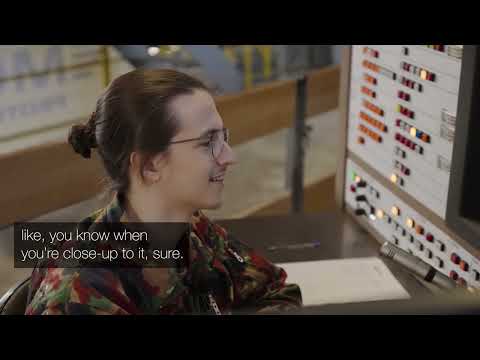 4:40
This 1970s tank simulator drives through a tiny world
12M views • 4 years ago
Tom Scott
Tom Scott visits the Swiss Military Museum to see the last surviving 1970s tank-driving simulator. It uses a real camera moving over a miniature model landscape rather than any computer graphics.
 24:30
Is It Really Impossible To Cool A Datacenter In Space?
1.1M views • 7 months ago
Scott Manley
Scott Manley explains the thermal balance of spacecraft and how a satellite could be configured to radiate away the heat from datacenter-scale computing in space. His rough numbers suggest it is feasible.
 13:52
Is A Toyota SUV "Greener" Than A Tesla?
427K views • 5 years ago
Engineering Explained
Engineering Explained compares the lifetime CO2 emissions of a Toyota RAV4 Prime plug-in hybrid with a Tesla Model Y, looking at break-even mileage and whether electric cars are worse for the environment.
 19:29
Glitch Tokens - Computerphile
353K views • 3 years ago
Computerphile
Rob Miles explains "glitch" tokens, odd strings in large language model vocabularies that make the model produce gibberish. He covers how they likely arise from tokenizer training data, such as Reddit usernames, that never appeared in the model's own training.
 12:55
Humanity was born way ahead of its time. The reason is grabby aliens.
1.7M views • 5 years ago
Rational Animations
Rational Animations explains Robin Hanson's grabby aliens model, which argues that humanity looks suspiciously early in cosmic history. Expanding civilizations set a deadline that explains our timing and bears on the Fermi paradox.
 19:19
Was Penrose Right? NEW EVIDENCE For Quantum Effects In The Brain
1.1M views • 2 years ago
PBS Space Time
PBS Space Time examines Roger Penrose's idea that consciousness arises from quantum processes in the brain, and reviews new evidence about microtubules. It ends with an estimate of what replicating consciousness would demand.