spa
 17:49
How to Land the Space Shuttle... from Space
12.6M views • 10 years ago
Bret
Bret Copeland, in an astronaut costume, gives an energetic talk on how the Space Shuttle landed from orbit, including reentry and the unpowered glide. It includes real-time landing footage with HUD and audio.
 49:43
Nima Arkani-Hamed: The End of Space-Time
254K views • 4 years ago
Max-Planck-Institut für Physik
Theoretical physicist Nima Arkani-Hamed gives a public talk on why spacetime may not be fundamental and what might replace it, including newer approaches to scattering amplitudes.
 46:37
GPUs to Mars: Full-Scale Simulation of SpaceX's Mars Rocket Engine
126K views • 11 years ago
insideHPC Report
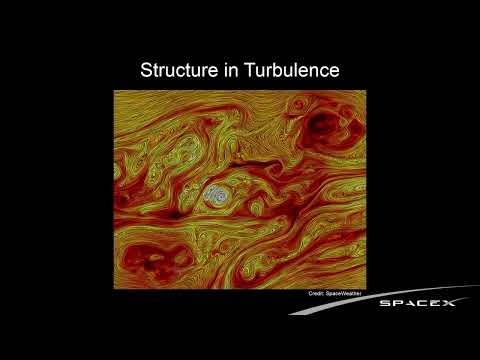
SpaceX engineers present at NVIDIA's GPU Technology Conference on a multi-physics code that simulates the full-scale Raptor methane engine. It covers GPU-based turbulent combustion modeling with adaptive grids and wavelet compression.
 25:54
SpaceX Seattle 2015
46K views • 11 years ago
Cliff O
Full recording of Elon Musk's January 2015 presentation and Q&A at the SpaceX Seattle office announcement. He lays out plans for a satellite constellation to provide low-latency global internet, tied to funding Mars ambitions. Pauses between questions have been edited out.
 16:04
Jonathan Diegelman - Modeling Spacecraft Separation Dynamics in Julia
12K views • 5 years ago
The Julia Programming Language
A JuliaCon talk by a NASA Launch Services Program engineer on modeling spacecraft separation dynamics in Julia. He describes replacing a Simulink-based workflow for checking launch vehicle separation requirements with Julia and ModelingToolkit, with large speedups and much shorter code.
 35:24
The Unreasonable Effectiveness of Multiple Dispatch | Stefan Karpinski | JuliaCon 2019
79K views • 7 years ago
The Julia Programming Language
Julia co-creator Stefan Karpinski explains why multiple dispatch makes Julia code and types reusable across packages with so little friction. He covers sharing basic types and sharing generic algorithms.
 15:12
Bret Victor - Seeing Spaces
21K views • 11 years ago
Colin McDonnell
Bret Victor's talk proposing a new kind of maker space built for seeing and understanding a project's behavior: inside it, across time and across possibilities. It argues for scientific understanding over recipes and rules of thumb.
 54:25
Cgroups, namespaces, and beyond: what are containers made from?
268K views • 10 years ago
Docker
Jérôme Petazzoni explains how Linux containers are built from kernel features like cgroups, namespaces and SELinux. He demonstrates putting the pieces together by hand to make a container and compares runtimes and approaches like jails and zones.
 4:55
Kevin Spacey urges TV channels to give control to viewers
1.6M views • 13 years ago
The Telegraph
Kevin Spacey, giving the MacTaggart Lecture at the Edinburgh Television Festival, urges TV channels to give viewers control. He points to Netflix's House of Cards release as evidence that audiences want to watch on their own terms.
 46:22
Velocity 09: John Allspaw and Paul Hammond, "10+ Deploys Pe
119K views • 17 years ago
O'Reilly
John Allspaw and Paul Hammond's Velocity 09 talk on how Flickr achieved ten or more deploys per day through close cooperation between development and operations.
 18:16
Choice, happiness and spaghetti sauce | Malcolm Gladwell
2M views • 19 years ago
TED
Malcolm Gladwell's TED talk on how Howard Moskowitz found that there is no single perfect spaghetti sauce. He draws a larger point about choice, preference and happiness.
 40:55
"Controlling Time and Space: understanding the many formulations of FRP" by Evan Czaplicki
69K views • 12 years ago
Strange Loop Conference
Evan Czaplicki's Strange Loop 2014 talk surveys the many formulations of functional reactive programming and how they relate historically and theoretically. It then shows how Elm's variant enables hot-swapping and its time-traveling debugger.
 40:05
"Uptime 15,364 days - The Computers of Voyager" by Aaron Cummings
349K views • 7 years ago
Strange Loop Conference
A Strange Loop 2019 talk by Aaron Cummings on the computing systems aboard Voyager 1 and 2, which control the spacecraft and record and return data decades after launch in 1977.
Topic match · Space exploration & spaceflight 1:10:43
The Remote Agent Experiment: Debugging Code from 60 Million Miles Away
23K views • 14 years ago
Google TechTalks
Ron Garret tells the story of the Remote Agent Experiment on NASA's Deep Space 1, where autonomous software controlled a spacecraft in 1999. He describes debugging Lisp code remotely from millions of miles away.
Topic match · Space exploration & spaceflight 1:04:46
Making Humans a Multiplanetary Species
4.2M views • 10 years ago
SpaceX
Elon Musk's 2016 IAC presentation on the technical challenges and architectures for building a self-sustaining human presence on Mars.
Topic match · Space exploration & spaceflight 1:25:30
Starship Update
4.8M views • 7 years ago
SpaceX
SpaceX's September 2019 Starship update presentation, where Elon Musk describes the design and development of Starship and Super Heavy. It covers construction and plans for reusable orbital rockets.
Topic match · Space exploration & spaceflight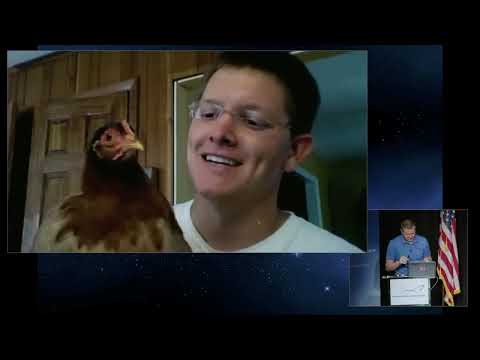 1:05:20
I Was SCARED To Say This To NASA... (But I said it anyway) - Smarter Every Day 293
5M views • 2 years ago
SmarterEveryDay
Destin Sandlin of Smarter Every Day gives a talk to an aerospace audience, comparing how Apollo was engineered and managed with NASA's Artemis program. He raises concerns about unresolved details, the number of launches and in-orbit fuel transfer needed to reach the Moon, and the loss of institutional knowledge.
Topic match · Space exploration & spaceflight 32:10
Robert Moss: Julia and the Next Generation Airborne Collision Avoidance System
4K views • 11 years ago
The Julia Programming Language
Robert Moss's JuliaCon 2015 talk describes using Julia as a specification language for ACAS X, the next-generation airborne collision avoidance system that succeeds TCAS.
Topic match · Aviation & aerospace engineering 4:26
Dr. Robert Zubrin with a brilliant answer to "Why Should We Go To Mars?"
470K views • 10 years ago
Jamin Gray
A short clip of Dr. Robert Zubrin, author of The Case for Mars, answering why humanity should go to Mars. He argues that societies grow by challenging themselves and that exploration inspires young people.
Topic match · Space exploration & spaceflight 35:25
Saving Voyager 1! - Bruce Waggoner at !!Con 2024
8K views • 2 years ago
!!Con
Bruce Waggoner of the Voyager team describes how engineers diagnosed Voyager 1's 2023 loss of telemetry and patched its flight software from 15 billion miles away. The talk covers the spacecraft's architecture and the scarcity of old documentation.
Topic match · Space exploration & spaceflight 53:09
The Original Skunk Works – Nickolas Means | The Lead Developer UK 2017
2.4M views • 9 years ago
LeadDev
Nickolas Means tells the story of Lockheed's Skunk Works and how its engineers built the U-2, SR-71 and F-117 under tight deadlines and budgets. He draws lessons for modern software teams.
Topic match · Aviation & aerospace engineering 1:03:45
How We Diagnosed and Fixed the 2023 Voyager 1 Anomaly from 15 Billion Miles Away
17K views • 1 year ago
Flight Software Workshop
JPL's David Cummings presents at the 2025 Flight Software Workshop how the team diagnosed and fixed the 2023 Voyager 1 anomaly from billions of miles away. It walks through the flight computer and the memory fix.
Topic match · Space exploration & spaceflight 48:36
The Charming Genius of the Apollo Guidance Computer - Brian Troutwine
170K views • 11 years ago
Erlang Solutions
Brian Troutwine's Code Mesh 2015 talk on the Apollo Guidance Computer. It covers the AGC's design, core rope memory, its interrupt and software behavior, and the pioneering engineering effort behind it.
Topic match · Space exploration & spaceflight 48:07
von Neumann probes, Dyson spheres, exploratory engineering and the Fermi paradox
46K views • 14 years ago
Future of Humanity Institute
Stuart Armstrong of the Future of Humanity Institute gives an Oxford physics talk on what exploratory engineering suggests about the Fermi paradox. He argues that von Neumann probes and Dyson spheres are plausibly buildable and asks what traces advanced civilizations would leave.
Topic match · Space exploration & spaceflight 58:37
NVIDIA — Securing the Future of Safety and Security of Embedded Software (Captioned)
5K views • 5 years ago
AdaCore
An AdaCore webinar in which NVIDIA engineers explain why and how they adopted Ada and SPARK for security-critical firmware. It covers the business case and the engineering experience of the transition.
 57:04
Something Deeply Hidden | Sean Carroll | Talks at Google
655K views • 7 years ago
Talks at Google
Sean Carroll's Talks at Google presentation of his book Something Deeply Hidden. He gives an accessible introduction to quantum mechanics and argues for the many-worlds interpretation and the emergence of spacetime.
Topic match · Quantum physics 25:39
H3: Tiling the Earth with Hexagons
53K views • 8 years ago
Uber Engineering
Uber Engineering's Joseph Gilley explains why Uber uses hexagons for geospatial indexing and introduces H3, its open source hierarchical grid system. He covers use cases and how distortion is handled.
 1:01:42
34C3 - The Ultimate Apollo Guidance Computer Talk
324K views • 8 years ago
media.ccc.de
Michael Steil and Christian Hessmann's 34C3 talk explaining the Apollo Guidance Computer end to end: hardware design, operating system, and mission software.
Topic match · Space exploration & spaceflight 3:36:39
QuakeCon 2012 - John Carmack Keynote
445K views • 14 years ago
QuakeCon Official
John Carmack's long QuakeCon 2012 keynote, a free-ranging talk covering software engineering, game platforms, game streaming, and his early head-mounted display and VR work.
Topic match · VR, AR & spatial computing 43:13
How to crash an airplane – Nickolas Means | The Lead Developer UK 2016
1.5M views • 9 years ago
LeadDev
Nickolas Means tells the story of United Airlines Flight 232, which lost all flight control yet saved more than half its passengers. He draws lessons on teamwork, crew resource management and leadership for software teams.
Topic match · Aviation & aerospace engineering 16:36
Mike Mullane - Normalisation of deviance - IAFF - Part 1
179K views • 11 years ago
Stuart Walker
Astronaut Mike Mullane explains normalisation of deviance, where teams gradually come to accept violations of their own safety standards. He uses the Challenger shuttle disaster as the main case, drawing on NASA's ignored warnings before the launch. It is the first part of a talk given to a fire-fighters' association.
Topic match · Space exploration & spaceflight 48:26
Doug McLean | Common Misconceptions in Aerodynamics
856K views • 13 years ago
Michigan Engineering
Retired Boeing Technical Fellow Doug McLean walks through common misconceptions in aerodynamics, drawing on his book Understanding Aerodynamics. He critiques popular explanations of wing lift and rocket thrust and argues for arguing from the real physics.
Topic match · Aviation & aerospace engineering 1:20:28
John Carmack Tech Talk with UMKC-SCE
279K views • 9 years ago
UMKC School of Science and Engineering
John Carmack speaks at UMKC's 2017 commencement event about the difficulties of VR, especially end-to-end latency across hardware and software. He covers why latency and buffering matter and how nausea is addressed.
Topic match · VR, AR & spatial computing 50:56
DEFCON 20: Hacker + Airplanes = No Good Can Come Of This
226K views • 13 years ago
Christiaan008
A DEF CON 20 talk by RenderMan on the security weaknesses of ADS-B, the unencrypted, unauthenticated aircraft tracking broadcast. It shows how easily the data can be spoofed and what that means for security designed in too late.
Topic match · Aviation & aerospace engineering 1:01:32
John Carmack Facebook Connect 2021 Keynote
152K views • 5 years ago
UploadVR
John Carmack's keynote at Facebook Connect 2021, where he speaks candidly about VR, Quest, and Meta's metaverse plans. He pushes back on hype and discusses retention and latency.
Topic match · VR, AR & spatial computing 1:34:57
Oculus Connect Keynote: John Carmack
49K views • 12 years ago
Meta VR
John Carmack's keynote at Oculus Connect 2014 about the Gear VR and development stories from building it. He discusses mobile GPU optimization, latency, and display ideas like programmable interlacing.
Topic match · VR, AR & spatial computing 5:59
Major Brian Shul, USAF (Ret.) SR-71 Blackbird 'Speed Check'
5.3M views • 9 years ago
Jan Johnson
Retired Major Brian Shul tells the story of a ground speed check with LA Center while flying the SR-71 Blackbird. He recounts it live at the Hiller Aviation Museum.
Topic match · Aviation & aerospace engineering 56:00
BTD10: The 835kph Sailplane and Dynamic Soaring
216K views • 9 years ago
TNG Technology Consulting GmbH
Spencer Lisenby explains dynamic soaring, a technique that lets unpowered radio-controlled gliders reach speeds above 835 kph. He covers the physics and the design, build and flying challenges.
Topic match · Aviation & aerospace engineering 1:36:59
Keynote by John Carmack at Oculus Connect 2014
76K views • 12 years ago
kungfl
John Carmack's roughly 90-minute keynote at Oculus Connect 2014, covering mobile VR and the Gear VR work, followed by audience questions.
Topic match · VR, AR & spatial computing 27:56
What VR Could, Should, and Almost Certainly Will Be within Two Years (Steam Dev Days 2014)
128K views • 12 years ago
Steamworks Development
Michael Abrash of Valve explains what affordable VR hardware will be capable of within a couple of years, and describes a prototype showing what that level of hardware can do.
Topic match · VR, AR & spatial computing