stack overflow
 51:59
Learning from StackOverflow.com
139K views • 17 years ago
Google TechTalks
Joel Spolsky's 2009 Google Tech Talk on why StackOverflow was built, how it addresses the mess of searching for programming help, and the community design behind it. He also takes jabs at paywalled answer sites.
 55:39
Founders@Google Presents: The Cultural Anthropology of Stack Exchange
12K views • 14 years ago
Google TechTalks
Joel Spolsky's 2012 Google tech talk on the cultural anthropology of Stack Overflow and Stack Exchange. He explains how the software was designed to shape community norms and curation standards.
 31:26
Joel Spolsky at Startup School 2012
35K views • 13 years ago
Y Combinator
Joel Spolsky, founder of Fog Creek Software and StackExchange, speaks at Y Combinator's Startup School in 2012. He shares his perspective on building startups.
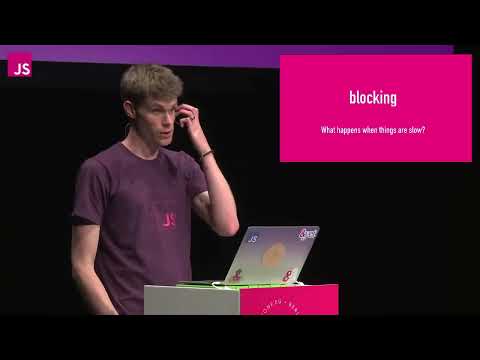 26:53
What the heck is the event loop anyway? | Philip Roberts | JSConf EU
3.8M views • 12 years ago
JSConf
Philip Roberts explains the JavaScript event loop, call stack, callbacks and asynchronous behavior with live visualizations using a tool he built. It demystifies terms like non-blocking and single-threaded.
 40:13
"Programming a 144-computer chip to minimize power" - Chuck Moore (2013)
19K views • 5 years ago
Strange Loop Conference
Chuck Moore, inventor of Forth, presents GreenArrays' 144-core asynchronous chip at Strange Loop 2013. He explains how idle cores draw almost no power and how tight code minimizes energy use.
 31:09
Bringing the Unix Philosophy to Big Data by Bryan Cantrill: FutureStack13
18K views • 12 years ago
New Relic
Bryan Cantrill presents Manta, an object store with in-situ compute that lets tools like grep, awk, and sed run map-reduce style over huge data. He frames it as bringing the Unix philosophy to big data.
 57:39
CppCon 2016: Chandler Carruth “Garbage In, Garbage Out: Arguing about Undefined Behavior..."
94K views • 10 years ago
CppCon
Chandler Carruth's CppCon 2016 talk tries to defuse the heated debate over undefined behavior in C and C++. He explains from the compiler writer's perspective why UB exists and how it enables optimization.
 40:03
Google I/O 2013 - High Performance Audio
62K views • 13 years ago
Google for Developers
A Google I/O 2013 talk by Android audio engineers on why reliable, low-latency audio is hard on the platform. It covers problem areas across the stack, platform work underway and techniques apps can use.
 46:54
"Write a single library to handle all input devices, it'll be easy" they said...
21K views • 6 years ago
linux.conf.au
Peter Hutterer's linux.conf.au 2020 talk on creating libinput, the unified userspace input library, and the difficulties of handling the many quirks of input devices.
 47:34
RailsConf 2011: Aaron Patterson, "Double Dream Hands: So Intense!"
26K views • 15 years ago
O'Reilly
Aaron Patterson's RailsConf 2011 talk on Rails 3.1 performance, showing why deeper Rack middleware stacks slow Rails and how a shallower pipeline helps. It also touches on Rack API design.
 44:10
Jan Willem Nijman - Vlambeer - "The art of screenshake" at INDIGO Classes 2013
386K views • 12 years ago
Dutch Game Garden
Vlambeer's Jan Willem Nijman shows how to make an action game feel great by stacking small effects like screenshake, recoil and particles onto a basic shooter. It was presented at INDIGO Classes 2013.
 37:37
RailsConf 2016 - Turbolinks 5: I Can’t Believe It’s Not Native! by Sam Stephenson
61K views • 10 years ago
Confreaks
Sam Stephenson's RailsConf 2016 talk on Turbolinks 5, showing how small teams can ship fast Rails apps in the browser and hybrid iOS and Android apps sharing one set of web views.
 49:15
Erlang Factory 2014 - That's 'Billion' with a 'B': Scaling to the Next Level at WhatsApp
50K views • 12 years ago
Erlang Solutions
Rick Reed of WhatsApp explains at Erlang Factory 2014 how the service scaled to billions of messages with a very small engineering team. He covers the FreeBSD and Erlang stack, Mnesia usage, server counts and bottleneck work.
 53:55
A Narrative History of BSD, Dr. Kirk McKusick
30K views • 17 years ago
bsdconferences
Kirk McKusick gives a narrative history of BSD from its start at UC Berkeley in the late 1970s through the 1980s releases and the lawsuit that led to 4.4BSD-Lite in 1992. It is full of anecdotes from a key developer.
 31:32
[CVPR'21 WAD] Keynote - Andrej Karpathy, Tesla
51K views • 5 years ago
WAD at CVPR
Andrej Karpathy, then Tesla's head of AI, gives a CVPR 2021 workshop keynote on how Autopilot's neural networks work. A large part covers the move to a vision-only stack, including why radar was dropped and how vision produces depth estimates.
 47:41
"Programming Should Eat Itself" by Nada Amin
43K views • 12 years ago
Strange Loop Conference
Nada Amin's Strange Loop talk on programming languages that build on themselves, centered on towers of interpreters and nestable interpretation in Scheme. She shows how interpreters can be stacked and collapsed.
 54:14
Rick Reed - WhatsApp: Half a billion unsuspecting FreeBSD users
31K views • 11 years ago
iX
Rick Reed of WhatsApp speaks at MeetBSD about running a messaging service on FreeBSD and Erlang at huge scale. He covers the stack, tuning and the challenges of millions of connections per host.
 52:41
Seattle Conference on Scalability: YouTube Scalability
30K views • 19 years ago
Google TechTalks
Cuong Do of YouTube describes how a handful of engineers scaled the site, covering hardware, software and database scalability challenges during its rapid growth. The talk was given at the 2007 Seattle Conference on Scalability.
 25:18
dotScale 2015 - John Graham-Cumming - I got 10 trillion problems, but logging ain't one
7K views • 11 years ago
dotconferences
John Graham-Cumming of Cloudflare talks at dotScale 2015 about handling roughly 10 trillion log lines a month. The talk touches on Cloudflare's hardware, its logging stack and its use of Lua in Nginx.
 31:17
[Minecraft Computer Engineering] - Quad-Core Redstone Computer v5.0 [12k sub special!]
3.6M views • 7 years ago
legomasta99
A showcase of the author's fifth-generation quad-core computer built entirely from Minecraft redstone, after two years of development. It features cache, a hardware stack, a GPU driving a 15x15 display, and serial I/O ports.
 48:13
DeepSec 2010: All your baseband are belong to us by Ralf Philipp Weinmann
30K views • 14 years ago
Sicherheitsforschung
A DeepSec 2010 conference talk by Ralf Philipp Weinmann on attacking the baseband processor of mobile phones rather than the application processor. It covers how open-source GSM base stations make malicious-tower attacks practical against neglected GSM stacks.
 33:43
TSP #183 - Starlink Dish Phased Array Design, Architecture & RF In-depth Analysis
171K views • 5 years ago
The Signal Path
The Signal Path takes apart a Starlink dish layer by layer, analyzing the phased array RF design, system architecture and integrated circuits, with an X-ray of the RF stack.
 49:45
seL4 Is Free – What Does This Mean For You?
10K views • 11 years ago
Linux.conf.au 2015 -- Auckland, New Zealand
Gernot Heiser presents seL4, a microkernel with a mathematical proof connecting security properties to the binary code, and explains what its open-sourcing means for users. It covers its roles as a microkernel, separation kernel and hypervisor.
 33:32
Condition Systems in an Exceptional Language - Chris Houser
16K views • 10 years ago
ClojureTV
Chris Houser's Clojure/conj talk on why Clojure's exceptions destroy information as the stack unwinds, unlike Common Lisp's condition system, which can resume from the error site. He surveys the existing libraries that approximate conditions, explains why they don't compose with each other, and considers what a better design would look like.
 30:08
What it's Like to Work at Valve
154K views • 7 years ago
Tyler McVicker
Valve News Network goes through over twenty accounts from ex-Valve employees, mostly from Glassdoor, about what it is like to work at Valve. It covers the company's flat structure and culture.
 56:50
34C3 - Console Security - Switch
135K views • 8 years ago
media.ccc.de
A 34C3 talk on the security architecture of the Nintendo Switch and the early progress breaking it. It introduces the Switch's custom OS and software stack, with the hackers' reverse-engineering and glitching work.
 20:11
Containers and Steam: Putting games under pressure | FOSDEM 2020
13K views • 6 years ago
Collabora
FOSDEM 2020 talk from Collabora on pressure-vessel, an experimental mechanism that puts Steam games in containers on Linux. It covers using namespaces to give games their own runtime library stack independent of the host.
 23:53
Energy Vault -BUSTED!
749K views • 7 years ago
Thunderf00t
A Thunderf00t video debunking Energy Vault, a gravity-based energy storage scheme that stacks concrete blocks with cranes. He argues it is impractical and compares it to pseudoscience.