stellar orbits
 13:03
5 REAL Possibilities for Interstellar Travel
7.1M views • 11 years ago
PBS Space Time
PBS Space Time surveys five realistic options for interstellar travel, from conventional rocket fuel to antimatter and nuclear pulse propulsion. The options rely only on known physics.
 8:39
How to Move the Sun: Stellar Engines
19.5M views • 6 years ago
Kurzgesagt – In a Nutshell
Kurzgesagt explains stellar engines such as the Shkadov thruster and Caplan thruster, which could move the Sun and solar system across the galaxy over millions of years to avoid hazards and reach new regions.
 10:31
Wendelstein 7-X – from concept to reality
497K views • 12 years ago
Max-Planck-Institut für Plasmaphysik
A CAD-based animation from the Max Planck Institute for Plasma Physics showing how the Wendelstein 7-X stellarator is configured and what its fusion research aims to achieve. It runs about 11 minutes.
 11:05
How to Win an Interstellar War
13.3M views • 2 years ago
Kurzgesagt – In a Nutshell
A Kurzgesagt video exploring how advanced civilizations might wage war across light years. It looks at weapons such as relativistic beams and what they would do.
 5:43
The EU Has Orbits, and the UK Fell Out of All of Them
0 views • 7 years ago
CGP Grey
CGP Grey's six-minute explainer of the relationships the UK could have with the EU, based on Barnier's slide, shown as orbits of different closeness. It explains why the UK's red lines ruled out the closer options.
 6:47
Starlink revisions, Nov 2018
173K views • 7 years ago
Mark Handley
Mark Handley of UCL looks at how SpaceX's November 2018 revisions to the Starlink constellation affect network behavior. The video visualizes the orbits and routing and estimates latencies, building on his earlier video and research paper.
 10:22
How Far Are The Nearest Stars?
3.7M views • 9 years ago
Cody'sLab
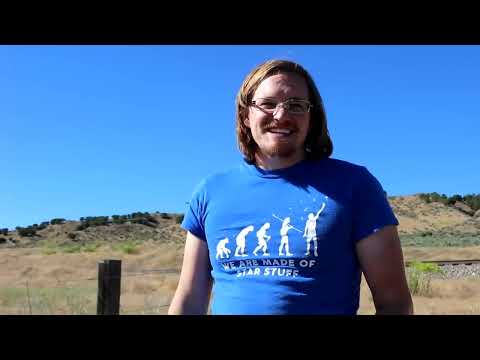
Cody's Lab builds a 200-billionth-scale model to show how far away the nearest stars are, using parallax and light speed. A short astronomy explainer on interstellar distances.
 17:34
The Halo Drive
526K views • 7 years ago
Cool Worlds
Astrophysicist David Kipping presents the halo drive, a proposed way to propel a starship to a good fraction of light speed by gaining energy from a black hole. The video is based on his peer-reviewed paper and explains why energy is the main obstacle to interstellar flight.
 17:32
'Oumuamua Is Not Aliens
790K views • 7 years ago
PBS Space Time
PBS Space Time examines the interstellar object 'Oumuamua and the popular theories about it, including the light-sail hypothesis. It argues that a natural rock is the likeliest explanation.
 36:06
Civilizations at the End of Time: Black Hole Farming
934K views • 10 years ago
Isaac Arthur
An Isaac Arthur episode on civilizations in the dark, post-stellar universe, including black hole farming, accretion disks and the Penrose process as energy sources.
 5:30
The Moon's Orbit is WEIRD
1.9M views • 2 years ago
minutephysics
A minutephysics explainer showing that the Moon's path around the Sun is not a spiral but closer to a 12-sided polygon with curved corners. It argues the Moon arguably orbits the Sun rather than the Earth.
 40:47
Dyson Spheres
838K views • 9 years ago
Isaac Arthur
Isaac Arthur examines Dyson spheres and swarms, including common myths and misconceptions. He covers uses such as interstellar travel, black hole generation, and computing large enough to simulate universes.