text preprocessing
 1:06:26
Over the Shoulder 1 - Text Preprocessing in Forth
25K views • 12 years ago
Andreas Wagner
Samuel Falvo II live-codes a text preprocessor and blog engine in Forth over about an hour. It shows Forth's dictionary being snapshotted and restored in place of mutation, and how a small Forth system gets real work done.
 1:22:13
HandmadeCon 2016 - History of Software Texture Mapping in Games
15K views • 9 years ago
Molly Rocket
A HandmadeCon 2016 panel where Chris Hecker, John Miles, Sean Barrett and Chris Green give an oral history of software texture mapping in 90s games.
 53:46
Dasher: information-efficient text entry
7K views • 19 years ago
Google TechTalks
David MacKay's 2007 Google Tech Talk presents Dasher, a text-entry system driven by continuous gestures and a language model, reaching about 35 words per minute with one finger and 25 hands-free. It explains the information-theory reasoning behind the design.
 1:01:40
Demo: Implicit Context
28K views • 11 years ago
Jonathan Blow
Jonathan Blow gives a formal, hour-long demo of his Jai compiler focused on the implicit context feature. The context carries things like allocators through a program without explicit parameter passing, and the talk walks through the code.
 3:52
Ted Nelson in Herzog's "Lo and Behold"
42K views • 9 years ago
TheTedNelson
A short excerpt from Werner Herzog's film Lo and Behold in which Ted Nelson lays out his ideas about hypertext and interconnection. Herzog concludes that Nelson is the only sane person in computing.
 36:16
RustConf 2016 - A Modern Editor Built in Rust by Raph Levien
43K views • 10 years ago
Confreaks
Raph Levien presents Xi editor at RustConf 2016, a high-performance text editor built in Rust. The talk goes into technical details, building polished GUI apps, and running a community-focused open source project.
 0:23
CygnusEd Professional in Action on an Amiga 2000
11K views • 12 years ago
Casey Muratori
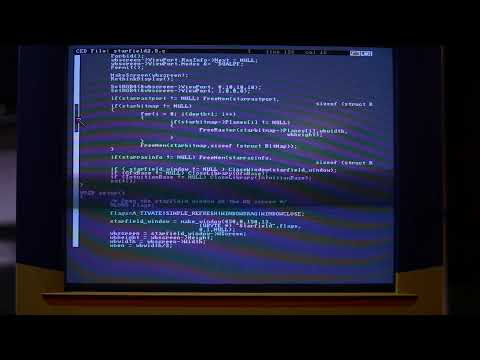
Casey Muratori captures CygnusEd Professional running on an Amiga 2000, showing how smoothly it scrolled text. He notes the real effect is better on a period CRT.
 49:22
Douglas Adams - Hyperland
55K views • 12 years ago
UJ ObscureMedia
Hyperland is a 1990 BBC documentary written by and starring Douglas Adams, who tours an imagined future of hypertext and software agents. It features Ted Nelson among others.
 7:32
Ted Nelson demonstrates Xanadu Space
84K views • 18 years ago
photonhunter
Ted Nelson demonstrates Xanadu Space, his software for representing hypertext in three-dimensional space with linked, referenced content fragments.
 44:38
Joe Armstrong & Jeremy Ruston - Intertwingling the Tiddlywiki with Erlang | Code Mesh LDN 18
11K views • 7 years ago
Code Sync
Joe Armstrong, creator of Erlang, and Jeremy Ruston, creator of TiddlyWiki, discuss hypertext, Ted Nelson's idea of intertwingled knowledge, and a way to combine TiddlyWiki with Erlang. It is a Code Mesh LDN 2018 talk.
 47:57
Here I Stand, at Age 80
25K views • 9 years ago
TheTedNelson
Ted Nelson, the originator of hypertext and Project Xanadu, gives a personal account at age 80 of his ideals, his career, and how a poor career plan led to discoveries and adventures. It works as an alternative history of personal computing and hypertext.
 1:06:00
CppCon 2017: Juan Pedro Bolivar Puente “Postmodern immutable data structures”
31K views • 9 years ago
CppCon
Juan Pedro Bolivar Puente explains immutable and persistent data structures in C++ and how they support value semantics. He presents the Immer library, rrb-trees, and a prototype text editor that opens a huge file instantly.
 12:23
Xanadu Basics 1a - VISIBLE CONNECTION
20K views • 8 years ago
TheTedNelson
Ted Nelson explains the original Xanadu hypertext idea of visible connection, the notion that links between documents should be shown and preserved. He argues that the Web and current document standards lost this concept.
 36:21
Pragmatic Unicode, or, How do I stop the pain?
80K views • 14 years ago
Next Day Video
Ned Batchelder's PyCon 2012 talk gives a quick overview of what Unicode is, then focuses on what a Python programmer needs to handle text correctly. It presents the 'Unicode sandwich' strategy: decode bytes at input, work with Unicode internally, encode at output.
 54:13:03
Larynx Demo
14K views • 5 years ago
synesthesiam
A demonstration of Larynx, an offline open source neural text-to-speech system supporting nine languages. The video itself is narrated with a Larynx-generated voice.
 17:34
Leap Technology
25K views • 15 years ago
aamoviebb
A promotional video for Leap, the navigation technology invented by Jef Raskin, demonstrated on the Canon Cat computer around 1987. It shows keyboard-driven search and cursor positioning in place of a mouse.
 25:48
Ted Nelson struggles with uncomprehending radio interviewer, 1979
19K views • 9 years ago
TheTedNelson
A 1979 CBC radio interview in which Ted Nelson tries to explain how computers could serve as tools for thinking and visualizing. The interviewer keeps failing to grasp the idea, and Nelson patiently answers again and again.
 52:41
Alto System Project: Larry Tesler demonstration of Gypsy
31K views • 7 years ago
Computer History Museum
Archival footage of Larry Tesler demonstrating Gypsy, the modeless text editor he and Tim Mott built at Xerox PARC, running on the Computer History Museum's restored Alto. It is a long hands-on walkthrough of one of the earliest graphical document editors.
 6:15
Canon Cat
17K views • 12 years ago
Storia Informatica
A short Italian-language clip about the Canon Cat, a text-oriented personal computer from Canon designed by Jef Raskin, who started the Macintosh project. It shows the machine in use.
 56:23
Inventing the Computer Mouse | Douglas Engelbart | Talks at Google
30K views • 19 years ago
Talks at Google
A Talks at Google visit by Douglas Engelbart, inventor of the mouse. He presents his lifelong aim of augmenting collective human intelligence, followed by a Q&A.
 5:33:21
George Hotz | Programming | can tinygrad whisper? | AMD Rant | Giving up on AMD | Speech to Text
95K views • 3 years ago
george hotz archive
A long George Hotz live-stream from June 2023 in which he works on tinygrad and rants about AMD's drivers, ultimately declaring he is giving up on AMD. It also touches on hardware and compiler topics.
 45:11
Stevey's Tech Talk E39 -- A guided tour of Emacs
13K views • 4 years ago
Steve Yegge
Steve Yegge records himself working in Emacs and shows off about a dozen features in a roughly 45-minute screen capture. It is an informal, enthusiastic tour rather than a structured tutorial.
 1:04:30
What is in a Lucene index? Adrien Grand, Software Engineer, Elasticsearch
80K views • 12 years ago
LuceneSolrRevolution
Elasticsearch engineer and Lucene committer Adrien Grand explains the design decisions inside a Lucene index and what problems it can and cannot solve. The talk goes into how Lucene stores data for fast search and analytics.
 14:46
Computers for Cynics 0 - The Myth of Technology
33K views • 14 years ago
TheTedNelson
The opening episode of Ted Nelson's Computers for Cynics series, in which he casts doubt on conventional accounts of computer basics. He argues that conventions and packaging are mistaken for technology.
 7:26
Ted Nelson's Eulogy for Douglas Engelbart
17K views • 12 years ago
Computer History Museum
Ted Nelson's short eulogy for Douglas Engelbart, delivered at the Computer History Museum in 2013, reflecting on his friend and Engelbart's ideas.
 9:27
"Silicon Valley Story" — a Very Short Romantic Comedy by Ted Nelson
6K views • 16 years ago
TheTedNelson
A short romantic comedy by Ted Nelson about the 'microcircuitry of love', with Doug Engelbart as his father and Stewart Brand as the villainous CEO.
 32:18
(ninth RacketCon): Andrew Blinn – Fructure: A Structured Editing Engine in Racket
10K views • 7 years ago
Racket
A RacketCon talk presenting Fructure, a prototype extensible structured editing engine in Racket. Language providers define syntactic forms and refactorings as rewrite rules, and editing operates on program structure rather than on text.
 14:02
Computers for Cynics 2 - It All Went Wrong at Xerox PARC
23K views • 14 years ago
TheTedNelson
Ted Nelson, in his Computers for Cynics series, gives a critical history of Xerox PARC's vision of personal computing. He lists what he sees as the limitations and wrong turns in PARC's approach to the desktop and documents.
 10:01
Intentional Programming demo (Part 2) - Compiler
4K views • 20 years ago
dftube
Part 2 of an old Microsoft Research demo of Intentional Programming, showing the compiler side of a system that stores programs as abstract structure rather than text. The uploader says the companion editor clip is clearer.
 44:19
ARCHIVE TEAM: A Distributed Preservation of Service Attack
29K views • 15 years ago
textfilesdotcom
Jason Scott of Archive Team describes how a loose band of volunteers rushes to copy sites like Geocities, Friendster and Yahoo Video before their owners delete them. The talk covers the tactics they use and the argument that this data is history worth saving.
 51:36
Conflict Resolution for Eventual Consistency • Martin Kleppmann • GOTO 2016
46K views • 9 years ago
GOTO Conferences
Martin Kleppmann's GOTO Berlin 2016 talk on how collaborative editors, offline apps, and multi-datacenter databases handle concurrent updates. It covers conflict resolution approaches including operational transformation and CRDTs, with a worked look at text CRDTs.
 48:00
Monktoberfest 2016: Bryan Cantrill - Oral Tradition in Software Engineering
41K views • 9 years ago
RedMonk Tech Events
Bryan Cantrill's Monktoberfest 2016 talk on how software engineers pass knowledge down through oral tradition, from folk rhymes to programmer lore and stories like why C lacks a logical XOR. He argues for writing software with future generations in mind.
 13:43
Symbolics Lisp Machine demo Jan 2013
52K views • 13 years ago
Kalman Reti
Symbolics developer Kalman Reti gives a short introductory demo of a Symbolics Lisp Machine running Genera in an emulator. It shows the context-aware command line, typed on-screen objects, and the live-editable system, including swapping in a C-compiled JPEG decoder.
 15:12
Bret Victor - Seeing Spaces
21K views • 11 years ago
Colin McDonnell
Bret Victor's talk proposing a new kind of maker space built for seeing and understanding a project's behavior: inside it, across time and across possibilities. It argues for scientific understanding over recipes and rules of thumb.
 34:10
Anders Hejlsberg on Modern Compiler Construction
25K views • 9 years ago
Kasper
Anders Hejlsberg whiteboards how compilers are taught versus how modern ones are actually built. He explains the shift to compilers as services with incremental, error-tolerant, IDE-oriented design, as in Roslyn and TypeScript.
 6:46
NOTCURSES III: THE SAGA CONTINUES (1080P)
46K views • 5 years ago
Nick Black
A seven-minute demo from the author of Notcurses, a C library for text user interfaces. It shows the 2.3.0 release, which adds Sixel and Kitty bitmap graphics integrated into its multiplane character-graphics model.
 1:10:10
CRDTs: The Hard Parts
90K views • 6 years ago
Martin Kleppmann
Martin Kleppmann surveys current research on CRDTs, the algorithms for merging concurrent edits across offline replicas. He covers the hard parts such as rich text, moves and merge results that are technically correct but poor.
 44:03
Google Developers Day US - Python Design Patterns
90K views • 19 years ago
GoogleDeveloperDay
Alex Martelli's Google Developers Day talk on classic design patterns (creational, structural and behavioral) and how they appear in Python. He stresses that patterns must be studied in the context of the implementing language.
 1:06:05
Procedural World Generation of Ubisoft’s Far Cry 5 | Etienne Carrier | Houdini HIVE Utrecht
99K views • 8 years ago
Houdini
Ubisoft procedural technical artist Etienne Carrier explains the Houdini-based tools used to build Far Cry 5's roughly 100 square km open world. It covers generating biomes, texturing terrain, freshwater networks, cliff rocks and vegetation placement.
 4:54
Lisp Editing in the 80s - Interlisp SEdit
9K views • 9 years ago
thoughtupquick
A short demo of SEdit, the structure editor for Interlisp-D on Xerox Lisp machines in the 1980s, which edits code as trees rather than text.