user-centric identity
 15:12
Identity 2.0 Keynote
490K views • 20 years ago
Dan Lewis
Dick Hardt's fast-paced OSCON keynote on Identity 2.0 and the move toward user-centric digital identity. It is also famous for its rapid-fire, many-slide presentation style.
 4:23
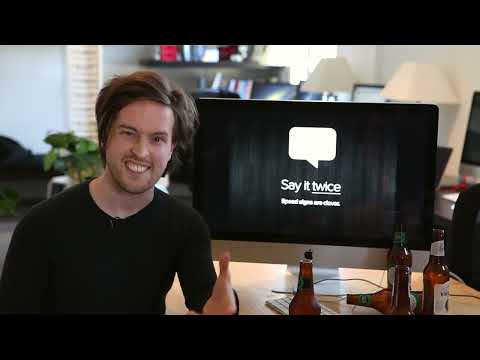
The User is Drunk
275K views • 13 years ago
squareweave
A short talk by Will Dayble of Squareweave arguing that you should design software as if the user were drunk: distracted, impaired in attention and vision, and prone to misreading. It is a user experience talk built around that framing.
 17:10
Xerox Star User Interface: An overview
20K views • 5 years ago
ACM SIGCHI
A 1982 Xerox PARC film, presented at CHI '90, in which Star designers David Canfield Smith and Charles Irby give an overview of the Xerox Star interface. It shows the document-centric, icon-and-window office system.
 1:55
Mitchell & Webb Sound - Identity Theft
305K views • 19 years ago
kevinmurphy
A sketch from That Mitchell and Webb Sound in which a caller learns that identity theft is, in effect, a bank robbery in which the bank blames the customer. It runs about two minutes.
 34:00
User-level threads....... with threads. - Paul Turner - Google
41K views • 13 years ago
Linux Plumbers Conference
Paul Turner of Google presents kernel interfaces for user-level scheduling of real threads, aiming at a uniform synchronous programming model across C++, Java, Go and Python. It introduces the switchto-style system calls behind Google's fibers.
 8:19
Code Bubbles: Rethinking the User Interface Paradigm of Integrated Development Environments
284K views • 16 years ago
AndrewBragdon
A short demo of Code Bubbles, an IDE interface built around editable code fragments in bubbles instead of files. It was a research prototype for Java development.
 26:05
Identity After Authenticity: Abigail Thorn's Profile
219K views • 5 years ago
Carefree Wandering
A philosophy lecture by Professor Moeller on the philosophy of identity. It builds on a discussion of Abigail Thorn's video and covers authenticity, sincerity and how online profiles reshape identity.
 14:05
Userbenchmark - the April Fools that never ends
2.5M views • 5 years ago
2kliksphilip
2kliksphilip examines UserBenchmark, a hardware comparison site known for strongly biased, pro-Intel writing. The video explains the site's credibility problems and points viewers to better sources for CPU and GPU information.
 14:22
Hypercentric optics: A camera lens that can see behind objects
597K views • 6 years ago
Applied Science
Applied Science shows how telecentric and hypercentric optics differ from normal lenses, producing no or negative perspective. The video builds a telecentric system from a Fresnel lens and demonstrates a lens that can see around objects.
 7:49
America Keeps Rejecting an ID Card It Already Has
13.6M views • 9 years ago
CGP Grey
CGP Grey explains the history of the US Social Security card and number, and why they became a de facto national ID despite never being meant for it. He also covers why America resists a proper identity card.
 5:44
Why Teleportation Would Kill You
7.3M views • 10 years ago
CGP Grey
CGP Grey asks whether Star Trek-style teleportation would kill you and recreate a copy, working through the philosophy of identity and the Ship of Theseus. It is a short animated explainer.
 8:42
Xerox Star User Interface (1982) 1 of 2
337K views • 17 years ago
VintageCG
A demonstration of the 1982 Xerox Star user interface, including its desktop, icons, documents, networking and printing. The uploader argues that Apple's later Lisa and Mac interfaces evolved from these ideas rather than copying them.
 8:01
Xerox Star User Interface (1982) 2 of 2
57K views • 17 years ago
VintageCG
Second half of a demonstration of the 1982 Xerox Star user interface. It shows how the Star differed from the later Lisa and Mac interfaces, with strengths in networking and printing and little direct manipulation.
 27:42
Mark DiMarco: User Interface Algorithms [JSConf2014]
52K views • 12 years ago
JSConf
A JSConf 2014 talk visually breaking down algorithms behind everyday UI patterns, such as dropdown menus that vanish when the mouse drifts and picking the nearest target to the cursor. It shows how these are implemented in JavaScript.
 2:33
What is a Browser?
1.4M views • 17 years ago
Ji Lee
Street interviews of over 50 passersby in Times Square, asked what a browser is. Many answers show people confuse browsers with search engines or the internet.
 1:21:16
A New Way to look at Networking
52K views • 19 years ago
Google
Van Jacobson's 2006 Google Tech Talk argues that networking should be rethought around named data rather than host-to-host conversations. He contrasts the circuit and datagram views of the internet and sketches content-centric networking as a replacement for the location-centric TCP/IP model.
 1:06:34
Paxos lecture (Raft user study)
114K views • 13 years ago
Diego Ongaro
John Ousterhout's slides-and-voiceover lecture on Paxos, made for the Raft user study comparing how students learn Raft and Paxos. It is a full introduction to the Paxos consensus algorithm.
 58:23
Evan Czaplicki - Let's be mainstream! User focused design in Elm - Curry On
82K views • 11 years ago
Curry On!
Evan Czaplicki, creator of Elm, talks at Curry On 2015 about user-focused language design. He explains the principles behind Elm and how to make a functional, typed language as approachable as JavaScript.
 31:28
DEF CON 23 - Chris Rock - I Will Kill You
269K views • 11 years ago
DEFCONConference
A DEF CON 23 talk showing how weak controls in electronic death registration systems let someone virtually kill a person and obtain a real death certificate, with consequences for their identity and life.
 58:17
Raft lecture (Raft user study)
87K views • 13 years ago
Diego Ongaro
John Ousterhout lectures on the Raft consensus algorithm, made for the Raft user study comparing how students learn Raft and Paxos. It covers leader election and log repair.
 11:48
John Rauser keynote: "Statistics Without the Agonizing Pain" -- Strata + Hadoop 2014
61K views • 12 years ago
O'Reilly
John Rauser's Strata 2014 keynote argues that programmers can learn statistics quickly by simulating random processes and shuffling data. He explains p-values through resampling rather than formulas.
 3:50
iPhone Magnifier and Voice over
3K views • 6 years ago
Kristy Viers
Kristy Viers demonstrates the iPhone Magnifier combined with VoiceOver to describe the user's surroundings. She shows how the built-in feature reports scenes, faces and lighting.
 28:13
Paul Buchheit at Startup School 08
15K views • 17 years ago
startupschool
Paul Buchheit, creator of Gmail and founder of FriendFeed, speaks at Startup School 08 about listening to users. He covers feedback, features, aiming for 100 happy users, and treating "that's impossible" as a statement of limited experience.
 13:40
Free software, free society: Richard Stallman at TEDxGeneva 2014
487K views • 12 years ago
TEDx Talks
Richard Stallman's TEDxGeneva 2014 talk describing how nonfree programs give companies control over users and what users can do to regain control. It introduces the free software movement and the four freedoms.
 1:30:32
MIX08 Microsoft Office 2007: The Story of the Ribbon
3K views • 10 years ago
zoobean
A MIX08 session from Microsoft's Office team on how the Office 2007 ribbon was designed. It explains the user-feedback and telemetry behind it and the alternatives that were rejected.
 1:26:58
Micro Men - 10th Anniversary - With Chris Curry, Steve Furber and Hermann Hauser
48K views • 7 years ago
The Centre for Computing History
The Centre for Computing History reunites Chris Curry, Steve Furber and Hermann Hauser to rewatch the BBC drama Micro Men on its tenth anniversary. They reminisce about Acorn and the early British home computer era.
 3:46
The Power Of Selling Out: Your Customers As Political Capital - Onion Talks - Ep. 9
434K views • 13 years ago
The Onion
A satirical Onion Talks episode in which a startup founder explains making money by selling his users' data to oppressive governments. It parodies tech conference talks and monetization of communities.
 33:32
Condition Systems in an Exceptional Language - Chris Houser
16K views • 10 years ago
ClojureTV
Chris Houser's Clojure/conj talk on why Clojure's exceptions destroy information as the stack unwinds, unlike Common Lisp's condition system, which can resume from the error site. He surveys the existing libraries that approximate conditions, explains why they don't compose with each other, and considers what a better design would look like.
 0:34
Steve Jobs on Privacy (2010)
8K views • 5 years ago
Kenneth Friedman
A one-minute clip of Steve Jobs in 2010 saying companies should ask users before tracking them, and that people's personal data is like their diary.
 2:18
Google Opt Out Feature Lets Users Protect Privacy By Moving To Remote Village
2M views • 17 years ago
The Onion
A satirical Onion news segment announcing a Google feature that lets users opt out of Google's data collection by moving to a remote village without Google products or sunlight.
 18:14
Stroads are Ugly, Expensive, and Dangerous (and they're everywhere) [ST05]
8.3M views • 5 years ago
Not Just Bikes
Not Just Bikes introduces the "stroad", a street-road hybrid common in the US and Canada that fails at both jobs. He contrasts it with Dutch design, where each road has a single purpose, and covers cost, danger and ugliness.
 23:16
The Machinery Of Freedom: Illustrated summary
164K views • 14 years ago
bitbutter
An illustrated 23-minute summary of David Friedman's talk based on The Machinery of Freedom. It describes how law, police and courts could work as market services in a stateless society, covering private law, polycentric law and objections.
 40:21
Bitcoin - Unmasking Satoshi Nakamoto
1.6M views • 6 years ago
Barely Sociable
Barely Sociable presents a case that Bitcoin creator Satoshi Nakamoto is cryptographer Adam Back. It uses interview clips and circumstantial evidence, and also touches on the block size dispute.
 40:12
Immediate-Mode Graphical User Interfaces - 2005
150K views • 10 years ago
Casey Muratori
Casey Muratori's 2005 video introducing immediate-mode GUIs as an alternative to retained widget toolkits. He explains the motivation and shows minimal-state button logic.
 1:21:16
A New Way to look at Networking
26K views • 14 years ago
GoogleTalksArchive
Van Jacobson's 2006 Google Tech Talk on rethinking networking around named content instead of host-to-host conversations. He recounts packet-networking history and lays out the content-centric networking idea that later became NDN.
 4:08
e^(iπ) in 3.14 minutes, using dynamics | DE5
3.4M views • 7 years ago
3Blue1Brown
A short 3Blue1Brown video explaining Euler's formula e^(i*pi) = -1 through dynamics, treating velocity as the thing that moves a point to a new position. It builds geometric intuition for why an exponent with i produces rotation.
 6:46
NOTCURSES III: THE SAGA CONTINUES (1080P)
46K views • 5 years ago
Nick Black
A seven-minute demo from the author of Notcurses, a C library for text user interfaces. It shows the 2.3.0 release, which adds Sixel and Kitty bitmap graphics integrated into its multiplane character-graphics model.
 1:21:20
A New Way to look at Networking
30K views • 19 years ago
Google TechTalks
Van Jacobson's 2006 Google Tech Talk argues for rethinking networking around named data rather than host-to-host connections. He gives the history and the unsolved problems of the current internet architecture.
 8:37
Avi Bryant demos Dabble db
5K views • 14 years ago
Tavis Rudd
Avi Bryant demos Dabble DB, a web-based spreadsheet-like database for building apps without code. It shows how users can model and relate data through a smooth interface.
 21:42
James Kunstler: How bad architecture wrecked cities
558K views • 19 years ago
TED
James Howard Kunstler's TED talk argues that American public spaces and architecture have become unworthy of care, damaging civic life. He presents suburban sprawl and car-first design as failures of the common good.