wave function collapse
 14:28
Superpositions, Sudoku, the Wave Function Collapse algorithm.
764K views • 6 years ago
Martin Donald
Martin Donald explains the Wave Function Collapse algorithm using Sudoku-like constraint solving and shows how he implemented it with Blender and Godot. It links demos and reference articles.
 20:00
Why Parallel Universes Are Probably Real
25.4M views • 6 years ago
Veritasium
Veritasium explains the many-worlds interpretation of quantum mechanics, drawing heavily on Sean Carroll's book. It walks through the Schrodinger equation and why wave collapse may be unnecessary if the universe keeps splitting.
 14:21
The Antique Microwave Oven that's Better than Yours
2.7M views • 5 years ago
Technology Connections
Technology Connections examines an old feature-rich microwave and shows how it uses a humidity or steam sensor and lookup data to cook food well, arguing it beats many modern ones.
 29:28
Defeating Microwave Weapons! - Part 1
2.4M views • 4 years ago
Tech Ingredients
Tech Ingredients demonstrates how microwaves work and how they affect objects at range, then shows ways to defend against them. It includes a correction about rectifier output frequency.
 45:55
Turning Waves Into Particles
194K views • 1 year ago
Huygens Optics
Huygens Optics explores the idea that space is a non-linear elastic medium, and uses simulations to show how wave energy might be confined locally into particle-like objects. It touches on inertia, the Schwinger limit and the vacuum as a medium.
 12:09
I promise this story about microwaves is interesting.
9M views • 5 years ago
Tom Scott
Tom Scott investigates the claim that the microwave was invented to heat hamsters, and interviews James Lovelock about freezing and microwave-thawing hamsters in the 1950s. It traces early magnetron uses beyond radar.
 11:33
Light Waves Visualized using Photon Sieves.
69K views • 6 years ago
Huygens Optics
Huygens Optics shows how DIY photon sieves shape a laser's wave front, explaining how they differ from zone plates and how aperture count affects the focal point, with time-resolved visualizations of the diffraction.
 22:59
How Does SHA-256 Work?
374K views • 6 years ago
learnmeabitcoin
A step-by-step animated explanation of how SHA-256 works, from padding and message schedule to the compression function and final hash, with source code for the animations.
 26:41
Finding the BEST sine function for Nintendo 64
418K views • 3 years ago
Kaze Emanuar
Kaze Emanuar searches for the best sine approximation for the Nintendo 64, comparing the lookup tables in Mario 64 and Ocarina of Time with polynomial alternatives. It walks through numerics and 3rd, 4th and 5th order approximations.
 21:08
Demographic Collapse — China's Reckoning (Part 1)
3M views • 5 years ago
PolyMatter
PolyMatter's first part of a series on China's demographic collapse, covering the effects of the one-child policy, shrinking workforce and economic consequences.
 14:48
Is 5G Spelling Our DOOM?! How EM Waves Can Hurt
4.2M views • 6 years ago
ElectroBOOM
ElectroBOOM examines whether 5G and other electromagnetic waves can harm people, explaining the EM spectrum and the difference between ionizing and non-ionizing radiation. It includes experiments and measurements in his usual humorous style.
 28:34
But why would light "slow down"? | Visualizing Feynman's lecture on the refractive index
2.9M views • 2 years ago
3Blue1Brown
3Blue1Brown visualizes Feynman's lecture on the refractive index, explaining why light appears to slow down in glass and why the effect depends on color. It builds the idea from waves produced by oscillating charges in the material.
 46:24
How are holograms possible?
7.2M views • 2 years ago
3Blue1Brown
3Blue1Brown explains how holograms record a 3D scene on 2D film, using wave diffraction and phase. The video includes demonstrations of several real holograms.
 17:48
All you need to know to understand 5G
1.6M views • 5 years ago
Sabine Hossenfelder
Physicist Sabine Hossenfelder explains how 5G works and examines the health concerns around millimeter wave radiation. She reviews the scientific evidence and the open letters from scientists.
 14:47
SOUTH KOREA IS OVER
15.9M views • 1 year ago
Kurzgesagt – In a Nutshell
A Kurzgesagt animation on South Korea's record-low fertility rate and rapidly aging population. It explains why a demographic collapse looks hard to reverse and projects the population shrinking sharply by 2060.
 15:14
The most deadly project on the Internet
6.8M views • 4 years ago
bigclivedotcom
BigClive explains why microwave oven transformer projects are extremely dangerous, since the high voltage and high current can kill. He contrasts them with spot welder builds where the secondary is replaced by low-voltage heavy wire.
 55:02
GradIEEEnt half decent: The hidden power of imprecise lines
391K views • 3 years ago
suckerpinch
Tom 7 (suckerpinch) delivers a long, comedic digression on gradient descent and floating-point imprecision. He shows how rounding behavior can supply the nonlinearity needed to build a neural network.
 26:29
Watch electricity hit a fork in the road at half a billion frames per second
3M views • 2 years ago
AlphaPhoenix
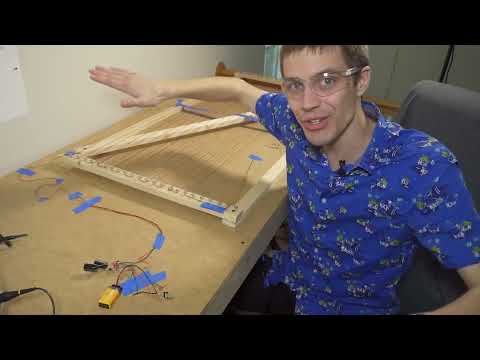
AlphaPhoenix uses a custom high-speed measurement setup to watch voltage waves travel down wires and split at a fork. It answers how electricity knows where to go and how quickly that process happens.
 17:06
What Is A Black Start Of The Power Grid?
3.1M views • 3 years ago
Practical Engineering
Practical Engineering explains what a black start is: restarting a power grid after total collapse. It shows why most plants need outside power to start and why rebuilding a synchronized grid is delicate and high-stakes.
 8:25
Large Language Models from scratch
375K views • 4 years ago
Graphics in 5 Minutes
A short cartoon explaining how language models like ChatGPT work, from autocomplete and conditional probabilities to neural networks, gradient descent and backpropagation. It shows how networks act as universal function approximators.
 12:25
This Invention Made Disney MILLIONS, but Then They LOST It!
7.3M views • 2 years ago
Corridor Crew
Corridor Crew tracks down Disney's lost sodium vapor prism process, used for Mary Poppins-era transparency mattes. They explain how a narrow sodium wavelength and a beam splitter enabled better compositing than green screen.
 33:01
The Strangest Implication of Quantum Mechanics
20.6M views • 1 year ago
Veritasium
A Veritasium video that follows the principle of least action from Bernoulli and Newton to quantum mechanics, asking whether light takes all possible paths at once. It includes experiments showing quantum waves.
 19:47
Why There are Now So Many Shortages (It's Not COVID)
7.8M views • 5 years ago
Wendover Productions
Wendover Productions explains the wave of supply shortages in 2021, arguing the causes go beyond COVID. It covers how just-in-time manufacturing was applied, container imbalances and the chip shortage.
 17:13
India's Semiconductor Failure
1.6M views • 5 years ago
Asianometry
Asianometry explains why India, a chip design powerhouse, cannot fabricate chips, tracing the 1980s government attempt to build a national semiconductor champion and how it collapsed. It includes the sabotage at the SCL fab.
 16:36
JWST just made the "Crisis in Cosmology" WORSE
1.3M views • 3 years ago
Dr. Becky
Astrophysicist Dr. Becky explains the Hubble tension, the disagreement between expansion-rate measurements from the cosmic microwave background and the distance ladder, and what early JWST Cepheid observations add.