Decerebrate Cat walks and exhibits multiple gait patterns
0zxrCited 4× on HN, 2014-2023
635K views · 16 years ago · demo · evergreen
An old lab video of a decerebrate cat walking on a treadmill and shifting between gait patterns as the speed changes. It is used to illustrate that much locomotion control comes from the spinal cord and body mechanics rather than the brain.
Used as a vivid example of spinal pattern generators and morphological control in locomotion discussions.
 5:21
Flexible Muscle-Based Locomotion for Bipedal Creatures
Goatstream
1.9M views • 12 years ago
 6:26
Slow Motion Flipping Cat Physics | Smarter Every Day 58
SmarterEveryDay
11.3M views • 14 years ago
 1:02:31
How Your Brain Works & Changes
Andrew Huberman
2.1M views • 5 years ago
 1:51
Google's DeepMind AI Just Taught Itself To Walk
Insider Tech
11.5M views • 9 years ago
 2:42
Atlas, The Next Generation
Boston Dynamics
40.8M views • 10 years ago
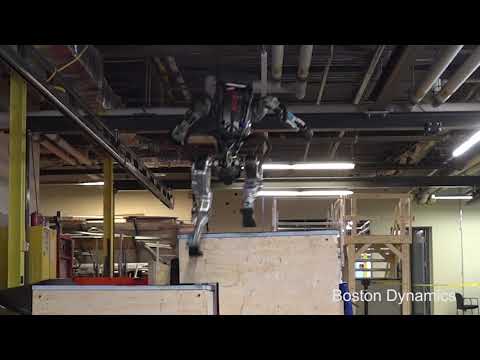 0:30
Parkour Atlas
Boston Dynamics
13.5M views • 8 years ago
 0:39
More Parkour Atlas
Boston Dynamics
16.9M views • 7 years ago
 2:03
GE Walking Truck - Cybernetic Anthropomorphous Machine (CAM) 1969.
Reuben Hoggett
248K views • 16 years ago
 2:39
TMS Bicycle, stable without gyros or trail (TMS=two-mass-skate)
Arend Schwab
44K views • 15 years ago
 1:06
Atlas | Partners in Parkour
Boston Dynamics
17.3M views • 5 years ago
 15:28
The Braitenberg Vehicles
Brian Douglas
65K views • 10 years ago
 2:09
Introducing WildCat
Boston Dynamics
40.5M views • 13 years ago
 7:58
The Backwards Brain Bicycle - Smarter Every Day 133
SmarterEveryDay
31.6M views • 11 years ago
 2:55
Do You Love Me?
Boston Dynamics
42.4M views • 5 years ago
 52:07
What Bodies Think About: Bioelectric Computation Outside the Nervous System - NeurIPS 2018
The Artificial Intelligence Channel
103K views • 7 years ago
 0:45
Cats in a Cat Cafe in Japan Reacting to an Earthquake - 994393
RM Videos
367K views • 8 years ago
 4:33
Amputee Makes History with APL’s Modular Prosthetic Limb
Johns Hopkins Applied Physics Laboratory
10.9M views • 11 years ago
 1:21
Atlas Gets a Grip | Boston Dynamics
Boston Dynamics
11.5M views • 3 years ago
 3:26
BigDog Overview (Updated March 2010)
Boston Dynamics
9.1M views • 16 years ago
 25:22
The Fastest Maze-Solving Competition On Earth
Veritasium
25.3M views • 3 years ago
4 comments from Hacker News
If the babies don't see objects, they don't "develop" object permanence. Yeah, here we can summon the "use it or use it" copeout, but then the nativist account becomes unfalsifiable. Being able to crawl within minutes (and even somewhat run within hours as horses do) is mostly due to anatomy and "reflex pathways". E.g. a cat can walk without brains [1], as can famosly headless chicken. Human babies too have these kinds of reflexes but they are "abandoned" well before the baby learns to walk. [1] ▶ this video
the decerebrate cat experiments illustrate this perfectly (although perhaps people dont like to talk about it because of the ethics of the experiments) ▶ this video
Uhm... all kinds of animals actually, but you need ethics approval if you use vertebrates. And I don't think you will find non-crazy volunteers for the invasive experiments... I took neuroscience courses - and a lot of what I learned was made possible by such experiments, so I'm not against them. However, the cost for the animals that get selected is high. You can't do that with humans, only the most benign experiments. But many experiments involves cutting open the head. inserting electrodes at the very least, sometimes you want to see the brain too - there are things you can do, like two-photon microscopy (example: link -- you have to expose the brain), or inject dyes, and other options). A possible setup (for invasive experiments) is that the animal is drugged, the brain exposed, electrodes inserted, the head fixated. Now you can, stimulate the retina, or the ears, or whiskers, and follow what happens in the living brain. Here is an example for what you get from such an experiment: link > Mice were head-fixed using a titanium head postimplant... For implantation, mice were anesthetized with isoflurane..., and maintained at 37°C body temperature on a thermal blanket (Harvard Apparatus). Following a local injection of Marcaine (50 μl), the scalp and periosteum over the dorsal surface of the skull were removed. The skull was then coated with a thin layer of cyanoacrylate adhesive (Krazy Glue, Elmer's Products).... (etc.) What sane human would allow an experiment like this
Remember that a lot of 'standard' movements aren't fully controlled from the brain. Instead, the brain generators modulating signals to structures/systems lower in the spinal - ie increasing or decreasing your rate of walking. There's lots of evidence of these 'Central Pattern Generators' being located below the brain - which would reduce signal lag. For a somewhat disturbing example of this, here's a 'decerberated' cat on a treadmill. ▶ this video That said, the fact that any vertebrae (even our selves) are able to move and react so well is pretty amazing, given that our own neural lag is in the ~100ms range. It's really a testament to the robustment of the multi-tier control that we (animals in general.. but especially large animals) have evolved.