How to Create a Mind | Ray Kurzweil | Talks at Google
Talks at GoogleCited 5× on HN, 2012-2013
250K views · 13 years ago · talk · dated
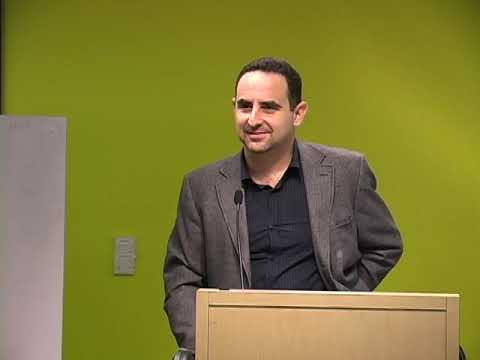
Ray Kurzweil presents his book How to Create a Mind at Google, on reverse engineering the brain and using that understanding to build intelligent machines. He shows his graphs of exponential technological progress.
Linked in threads about Kurzweil joining Google, mostly as a source for his exponential progress charts and his ambitions there.
 12:31
The Last Human – A Glimpse Into The Far Future
Kurzgesagt – In a Nutshell
15.2M views • 4 years ago
 1:00:52
Joscha: From Computation to Consciousness (31c3)
Joscha Bach
28K views • 11 years ago
 1:10:38
Consciousness in Artificial Intelligence | John Searle | Talks at Google
Talks at Google
482K views • 10 years ago
 1:01:45
Information, Evolution, and intelligent Design - With Daniel Dennett
The Royal Institution
586K views • 11 years ago
 3:33:35
Daniel Schmachtenberger on The Portal (with host Eric Weinstein), Ep. #027 - On Avoiding Apocalypses
Eric Weinstein
389K views • 6 years ago
 1:16:22
If Brains are Computers, Who Designs the Software? - with Daniel Dennett
The Royal Institution
873K views • 9 years ago
 55:03
Your Brain at Work
Google TechTalks
353K views • 16 years ago
 23:28
Nick Bostrom - The Simulation Argument (Full)
Science, Technology & the Future
615K views • 13 years ago
 1:02:13
35C3 - The Ghost in the Machine
media.ccc.de
79K views • 7 years ago
 52:07
What Bodies Think About: Bioelectric Computation Outside the Nervous System - NeurIPS 2018
The Artificial Intelligence Channel
103K views • 7 years ago
 2:09:42
Jeff Hawkins: Thousand Brains Theory of Intelligence | Lex Fridman Podcast #25
Lex Fridman
329K views • 7 years ago
 1:00:15
Superintelligence: Science or Fiction? | Elon Musk & Other Great Minds
Future of Life Institute
664K views • 9 years ago
 1:02:06
Building Brains to Understand the World's Data
Google TechTalks
84K views • 13 years ago
 23:00
Consciousness is Not a Computation (Roger Penrose) | AI Podcast Clips
Lex Fridman
2.3M views • 6 years ago
 2:15:36
Jeff Dean & Noam Shazeer — 25 years at Google: from PageRank to AGI
Dwarkesh Patel
349K views • 1 year ago
 1:00:14
The Neuroscience of Consciousness – with Anil Seth
The Royal Institution
1.9M views • 9 years ago
 37:16
Eric Schmidt and Peter Thiel - Fortune Debate, 2012
kykeon
208K views • 11 years ago
 19:46
David Deutsch: Chemical scum that dream of distant quasars
TED
173K views • 19 years ago
 1:02:04
A.I., Mars and Immortality: Are We Dreaming Big Enough? | Interesting Times with Ross Douthat
Interesting Times
1.3M views • 1 year ago
 21:51
Do we see reality as it is? | Donald Hoffman | TED
TED
3.1M views • 11 years ago
5 comments from Hacker News
Two rings to rule 'em all. (One for Larry, one for Sergey.) All joking aside, I watched a presentation by Ray Kurzweil at Google and it's pretty (what's the word?) what they're up to. ▶ this video
Hey Paul, thanks for responding. Just in case you’re interested, this Time cover story on him from a couple of years back actually does a reasonably good job on the broad strokes: link as does this NY Times one: link - there's also this intro by Peter Norvig to a Google Talks event with Ray from a month ago: ▶ this video The basic idea is that exponential growth in tech will result in strong AI, advanced nanotech, biotech, and neural interfaces that will lead to a near utopian civilization (if things go smoothly) in less than forty years. As outlandish as it seems, he actually makes a fairly convincing, well-researched case, and has had a pretty impressive career as an inventor and tech prognosticator. Needless to say, he’s a very polarizing figure.
God damn it... Not this again. =================MY PREVIOUS POSTS================= I don't think that's a very fair assessment of Kurzweil's role in technology. He was on the ground, getting his hands dirty with the first commercial applications of AI. He made quite a bit of money selling his various companies and technologies, and was awarded the presidential Medal of Technology from Clinton. As I was growing up, there was a series of "Oh wow!" moments I had, associated with computers and the seemingly sci-fi things they were now capable of. "Oh wow, computers can read printed documents and recognize the characters!" "Oh wow, computers can read written text aloud!" "Oh wow, computers can recognize speech!" "Oh wow, computer synthesizers can sound just like pianos now!" I didn't realize until much later that Kurzweil was heavily involved with all of those breakthroughs. =========================================== In addition, I'd rank Minsky, Larry Page, Bill Gates, Dean Kamen, Peter, Norvig, Rafael Reif, Tomaso Poggio, Dileep George, and Kurzweil's other supporters as much more qualified to judge the merits of his ideas, than Kurzweil's detractors like Hofstadter, Kevin Kelly, Mitch Kapor, and Gary Marcus. It seems that Hofstadter is the only one of that group who is really qualified to render a verdict. link ===================================== Here's Peter Norvig himself on Kurzweil: “Ray’s contributions to science and technology, through research in character and speec
gotta love this guy: > 1%... you're pretty much finished... try that with product submission schedules [1] ...so now we know who to blame for future Google product delays. [1]: ▶ this video EDIT: added the source link
How can you call people getting access to technology for the first time "stagnation"? It's the exact opposite of that. Here's Ray Kurzweil showing a graph from 1800 till recently that demonstrates how technology has had a direct effect on the wealth of the nations and on the average "conditions of living" for everyone: ▶ this video Also a relevant bit from Louis CK on how we take technology for granted at every step: link longer audio version: link