8-bit computing
 54:35
"An approach to computing and sustainability inspired from permaculture" by Devine Lu Linvega
19K views • 3 years ago
Strange Loop Conference
Devine Lu Linvega of Hundred Rabbits talks about low-power, offline computing, esoteric languages and the Uxn virtual machine, informed by years of sailing the Pacific. The talk frames computing sustainability through a permaculture lens.
 1:28:23
Quantum Computing for Computer Scientists
2.2M views • 8 years ago
Microsoft Research
An 88-minute Microsoft Research talk that explains how quantum computers beat classical ones using basic linear algebra, qubits, superposition and gates. It works through the Deutsch oracle problem and ends with entanglement, teleportation and a live demo.
 1:14:51
Lisp at the Frontier of Computation, by Robert Smith at Rigetti Computing
16K views • 8 years ago
Arthur Gleckler
Robert Smith of Rigetti Computing talks at a Bay Area Lisp and Scheme meetup about using Common Lisp for quantum computing. He covers the technical, sociological and psychological sides of working across disciplines.
 28:19
Bitcoin 2012 London: Mike Hearn
79K views • 14 years ago
Independent POV
Mike Hearn's talk at the 2012 London Bitcoin Conference on the future of Bitcoin, new applications and rebuilding the banking system. He covers lesser-known protocol features such as contracts, escrow and scripting.
 30:20
Blockchain vs. Bullshit: Thoughts on the Future of Money [Classic Bitcoin & Open Blockchain Talk]
383K views • 9 years ago
aantonop
Andreas Antonopoulos explains how to tell Bitcoin-style blockchains from corporate blockchain hype. He argues the goal should be de-banking everyone rather than banking the unbanked.
 27:08
Peter Rizun, Andrew Stone -- 1 GB Block Tests -- Scaling Bitcoin Stanford.
12K views • 8 years ago
OnChain Scaling
Peter Rizun and Andrew Stone present results of tests running 1 GB blocks on a Bitcoin test network at Scaling Bitcoin Stanford. The talk argues for big-block scaling and discusses its consequences.
 17:24
Forget big change, start with a tiny habit: BJ Fogg at TEDxFremont
2.4M views • 13 years ago
TEDx Talks
BJ Fogg of Stanford's Persuasive Tech Lab argues that lasting change comes from tiny habits, such as flossing one tooth or doing one pushup, anchored to things you already do.
 45:14
DEF CON 19 - Artem Dinaburg - Bit-squatting: DNS Hijacking Without Exploitation
4K views • 13 years ago
DEFCONConference
Artem Dinaburg's DEF CON 19 talk on bit-squatting, where DRAM bit flips cause DNS requests to go to domains one bit off from the intended one. It shows how hardware faults can be exploited for hijacking without any software exploit.
 45:14
DEFCON 19: Bit-squatting: DNS Hijacking Without Exploitation (w speaker)
24K views • 14 years ago
Christiaan008
Artem Dinaburg's DEF CON 19 talk on bit-squatting, where flipped bits in DRAM cause devices to contact domains that differ by one bit from legitimate ones. He shows how registering such domains can hijack traffic without exploiting any software bug.
 14:46
Robust-first computing: Beyond efficiency
8K views • 13 years ago
Dave Ackley
Dave Ackley gives a high-level introduction to robust-first computing, which prioritizes robustness over efficiency in computer architecture. A sorting demo illustrates the idea.
 1:25:34
8 Bit & '8 Bitish' Graphics-Outside the Box
568K views • 9 years ago
GDC Festival of Gaming
Mark Ferrari, the LucasArts background artist, explains in a GDC 2016 talk how he draws 8-bit graphics. He covers color cycling and palette shifting to create complex animated scenery without frame animation.
 1:20:30
7 Habits For Effective Text Editing 2.0
126K views • 14 years ago
GoogleTalksArchive
Vim creator Bram Moolenaar's 2007 Google Tech Talk on habits for efficient text editing. He explains how to spot repetition and inefficiency, then use editor features to fix it.
 1:10:23
Civil War General-Purpose Computing | Cory Doctorow | Talks at Google
91K views • 14 years ago
Talks at Google
Cory Doctorow's Talks at Google lecture on the coming civil war over general-purpose computing. He argues that locked-down devices, DRM, and surveillance threaten user control of computers.
 37:02
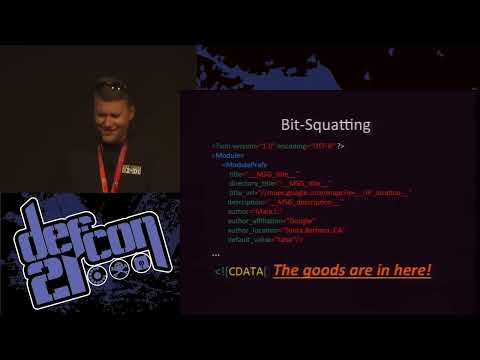
DEFCON 21 - DNS May Be Hazardous to Your Health - Robert Stucke
20K views • 13 years ago
Robert Stucke (bobhex)
A DEFCON 21 talk by Robert Stucke on DNS errors caused by single-bit flips, which lead to requests for misspelled domains. It shows real-world data on bitsquatting.
 10:45
The Making of: ROM City Rampage (Retro City Rampage)
399K views • 13 years ago
VblankEntertainment
Making-of video about ROM City Rampage, the NES version of Retro City Rampage, covering how the game's core was crunched to run on real 8-bit hardware and how NES games are made.
Topic match · Demoscene & retrocomputing 1:07:26
Alan Kay - Normal Considered Harmful
60K views • 14 years ago
powerfuloutlet
Alan Kay's 2009 UIUC talk arguing that computing is more a pop culture than a science and that ignoring history and fundamentals leads to inferior solutions. He touches on the history of interactive environments and what the web should have been.
 42:13
Clojure is Not Afraid of the GPU - Dragan Djuric
7K views • 9 years ago
ClojureTV
Dragan Djuric presents Clojure libraries for GPU and numerical computing, including ClojureCL, ClojureCUDA and Neanderthal. He shows how a dynamic REPL workflow can be combined with low-level hardware acceleration for machine learning and data science.
 1:01:15
25c3: The Ultimate Commodore 64 Talk
160K views • 15 years ago
Christiaan008
Michael Steil's 25C3 talk covers the Commodore 64's architecture, quirks and demoscene tricks in about an hour. It aims to convey everything about the machine in a compact, nostalgic tour.
Topic match · Demoscene & retrocomputing 51:57
27c3: Reverse Engineering the MOS 6502 CPU (en)
477K views • 15 years ago
Christiaan008
Michael Steil's 27c3 talk on reverse engineering the MOS 6502 from die shots into a transistor-level simulation, as in the Visual6502 project. It covers going from chip package to a digital model.
Topic match · Demoscene & retrocomputing 31:18
Quantum Expert Insight: Peter Shor
607K views • 5 years ago
Qiskit
Peter Shor tells the story of how he discovered Shor's Algorithm, from his early mathematics days to the quantum factoring breakthrough. It was recorded at MIT at the Physics of Computation conference.
Topic match · Quantum computing 42:38
VCF East: Xerox Star vs. Apple Lisa
41K views • 5 years ago
Vintage Computer Federation
Jason Perkins's talk at Vintage Computer Festival East 2020 compares the user interface of the Xerox Star with that of the Apple Lisa. It covers editing documents, the Star's mouse and a Q&A.
Topic match · Demoscene & retrocomputing 38:22
Kim Nilsson - Cracking MtGox
47K views • 9 years ago
TheBitcoinArmy
Kim Nilsson presents his investigation into how Mt. Gox was hacked and mismanaged, tracing the finances and the missing bitcoins. It was given at the 2017 Breaking Bitcoin meetup.
 1:37:45
Alan Kay: Doing with Images Makes Symbols (Full Version)
44K views • 11 years ago
Kenneth Friedman
A full upload of Alan Kay's 1987 talk, with demos of several Smalltalk-era software systems and ideas about visual, kinesthetic and symbolic reasoning. It includes a Smalltalk program written by a 12-year-old and footage of the Rand tablet.
 51:07
Alan Kay, 2015: Power of Simplicity
145K views • 11 years ago
Kenneth Friedman
Alan Kay's 2015 talk on the power of simplicity, arguing that systems become simpler by building on more sophisticated fundamental building blocks and that big research horizons drove invention at Xerox PARC. It ranges across computing, tools and scaling software.
 17:53
How to Achieve Your Most Ambitious Goals | Stephen Duneier | TEDxTucson
16M views • 9 years ago
TEDx Talks
Stephen Duneier describes a decision-making approach that took him from struggling with simple tasks to achieving ambitious goals. The talk centers on breaking goals into small marginal adjustments.
 49:48
2023 LLVM Dev Mtg - Mojo 🔥: A system programming language for heterogenous computing
61K views • 2 years ago
LLVM
A 2023 LLVM Developers' Meeting keynote by Abdul Dakkak, Chris Lattner and Jeff Niu introducing Mojo, a Python-family systems language built on MLIR and LLVM for heterogeneous computing.
 1:20:30
7 Habits For Effective Text Editing 2.0
330K views • 19 years ago
Google
Vim author Bram Moolenaar's 2007 Google Tech Talk on habits for efficient text editing: find inefficiencies in your own editing, then learn the Vim commands that fix them.
 23:32
Industrial Strength High Performance RISC V Processors For Energy Efficient Computing
8K views • 8 years ago
RISC-V International
David Ditzel of Esperanto Technologies presents their massively parallel, energy-efficient RISC-V processors at the 7th RISC-V Workshop in 2017. It covers the high-performance many-core design aimed at machine learning.
 15:25
The surprising habits of original thinkers | Adam Grant | TED
12M views • 10 years ago
TED
Adam Grant's TED talk on the habits of original thinkers, including procrastination and embracing failure. He argues the greatest originals fail the most because they try the most.
 12:04
How we fit an NES game into 40 Kilobytes
3.7M views • 8 years ago
Morphcat Games
Morphcat Games explains how they fit Micro Mages, a full-featured NES game, into 40 kilobytes. It covers compression of sprites and level layouts and other space-saving tricks.
Topic match · Demoscene & retrocomputing 32:56
Bret Victor The Future of Programming
305K views • 13 years ago
Joey Reid
Bret Victor's DBX 2013 talk, delivered in the guise of a 1973 IBM engineer with an overhead projector. It surveys forgotten ideas from 1960s and early 70s computing and warns against assuming you know what you're doing.
 1:15:09
Cliff Click @ VMSS16: Bits of Advice For the VM Writer
4K views • 10 years ago
softdevteamuk
Cliff Click, author of HotSpot's JIT compiler, shares hard-won advice for people writing virtual machines at the VMSS16 workshop. Topics include interpreters, JITs and performance lessons.
 49:36
Joe Armstrong - Keynote: The Forgotten Ideas in Computer Science - Code BEAM SF 2018
40K views • 8 years ago
Code Sync
Erlang co-creator Joe Armstrong's Code BEAM SF 2018 keynote revisits good ideas from the history of computing that were dropped, and asks which should be revived. It also touches on Erlang and Elixir.
 57:05
Keynote: Begin...End?
9K views • 5 years ago
David Beazley
David Beazley's PyData Global 2021 keynote, an oral history of early scientific Python. He tells how Python ended up running on a Connection Machine supercomputer at Los Alamos.
 40:05
"Uptime 15,364 days - The Computers of Voyager" by Aaron Cummings
349K views • 7 years ago
Strange Loop Conference
A Strange Loop 2019 talk by Aaron Cummings on the computing systems aboard Voyager 1 and 2, which control the spacecraft and record and return data decades after launch in 1977.
 17:49
How to Land the Space Shuttle... from Space
12.6M views • 10 years ago
Bret
Bret Copeland, in an astronaut costume, gives an energetic talk on how the Space Shuttle landed from orbit, including reentry and the unpowered glide. It includes real-time landing footage with HUD and audio.
 47:57
Here I Stand, at Age 80
25K views • 9 years ago
TheTedNelson
Ted Nelson, the originator of hypertext and Project Xanadu, gives a personal account at age 80 of his ideals, his career, and how a poor career plan led to discoveries and adventures. It works as an alternative history of personal computing and hypertext.
 42:45
RustConf 2017 - Closing Keynote: Safe Systems Software and the Future of Computing by Joe Duffy
2K views • 9 years ago
Confreaks
Joe Duffy's RustConf 2017 closing keynote on his experience at Microsoft building Midori, an operating system written in a Rust-like safe systems language. He covers the technical and cultural challenges of applying those lessons to Windows.
 20:38
Alan Kay: A powerful idea about teaching ideas
51K views • 18 years ago
TED
Alan Kay's TED talk on teaching ideas, in which he argues the world is not what it seems and shows children learning through programming and building their own lessons with Etoys/Squeak.
 52:59
Introducing Nx - José Valim | Lambda Days 2021
26K views • 5 years ago
Code Sync
Jose Valim introduces Nx, the project bringing numerical computing to Elixir, covering multi-dimensional tensors, automatic differentiation and JIT compilation to CPU and GPU.