aws lambda
 59:13
AWS re:Invent 2018: [REPEAT 1] A Serverless Journey: AWS Lambda Under the Hood (SRV409-R1)
72K views • 7 years ago
Amazon Web Services
An AWS re:Invent 2018 session in which Holly Mesrobian and Marc Brooker explain how AWS Lambda is built, including its sandboxing, isolation and scaling architecture. It covers what happens under the hood when serverless code runs.
 3:26:34
David Beazley - Lambda Calculus from the Ground Up - PyCon 2019
52K views • 7 years ago
PyCon 2019
David Beazley's PyCon 2019 tutorial derives the lambda calculus from the ground up in Python, using only single-argument functions. He builds booleans, numerals and more with no other language features.
 1:05:06
AWS re:Invent 2018: Powering Next-Gen EC2 Instances: Deep Dive into the Nitro System (CMP303-R1)
57K views • 7 years ago
Amazon Web Services
An AWS re:Invent 2018 session diving into the Nitro system, a set of hardware offload and security building blocks behind next-generation EC2 instances. It covers the design and architecture and how Nitro enables new instance types.
 42:26
AWS re:Invent 2015 | (NET403) Another Day, Another Billion Packets
55K views • 11 years ago
Amazon Web Services
Eric Brandwine's AWS re:Invent 2015 session on how Amazon VPC networking works. It covers the problems the design solved, why traditional approaches do not scale, and the mechanisms used for customer isolation and VPC endpoints.
 47:51
AWS re:Invent 2014: AWS Innovation at Scale with James Hamilton (SPOT301)
70K views • 11 years ago
Amazon Web Services
James Hamilton, AWS VP and distinguished engineer, gives an insider view of the innovations behind the AWS cloud at re:Invent 2014. He covers custom hardware, networking, regions and availability zones, and infrastructure at scale.
 55:44
AWS re:Invent 2018: How AWS Minimizes the Blast Radius of Failures (ARC338)
37K views • 7 years ago
Amazon Web Services
An AWS re:Invent 2018 talk on how AWS limits the blast radius of failures. It covers design techniques such as cell-based architecture and shuffle sharding.
 46:15
AWS re:Invent 2014 | (SPOT302) Under the Covers of AWS: Its Core Distributed Systems
10K views • 11 years ago
Amazon Web Services
An AWS re:Invent 2014 talk on the core distributed systems primitives behind AWS and Amazon.com, such as consensus, key-value stores and transactional logging. It describes how AWS builds large services from a few common building blocks.
 40:50
Ruby Manor 3 - Programming with Nothing by Tom Stuart
13K views • 14 years ago
Confreaks
Tom Stuart's Ruby Manor 3 talk builds FizzBuzz using nothing but Ruby lambdas, working through Church encodings of numbers, booleans and data structures. It is a hands-on introduction to lambda calculus.
 40:51
Geoffrey West on COMPLEXITY
23K views • 15 years ago
FQxI
Physicist Geoffrey West speaks at an FQXi conference on time about complexity and scaling laws. He covers how metabolism, growth and lifespan scale across organisms and how the same mathematics applies to cities and companies.
 56:58
Philip Wadler - Propositions as Types (Lambda Days 2016)
20K views • 10 years ago
Erlang Solutions
Philip Wadler's Lambda Days talk on propositions as types, the link between logic and computation that underlies theorem provers and programming language design.
 56:55
AWS re:Invent 2017: How Netflix Tunes Amazon EC2 Instances for Performance (CMP325)
18K views • 8 years ago
Amazon Web Services
A Netflix performance engineer presents how Netflix tunes EC2 instances, covering instance type choice, Xen modes, SR-IOV and kernel tuning. The goal is near bare-metal performance in the cloud.
 0:09
The Laws of Mathematics are commendable
13K views • 9 years ago
Jack Larkin
A clip of Australian Prime Minister Malcolm Turnbull saying the laws of Australia prevail over the laws of mathematics, regarding encryption. The audio is quiet in the second half.
 17:22
AWS re:Invent 2020: Working backwards: Amazon’s approach to innovation
80K views • 5 years ago
AWS Events
An AWS re:Invent session explaining Amazon's Working Backwards process, where teams start from customer needs and write a press release and FAQ (PR-FAQ) before building. It covers the five customer questions that frame the process.
 43:37
Lambda World 2018 - What FP can learn from Smalltalk by Aditya Siram
25K views • 7 years ago
Lambda World
Aditya Siram argues that functional programming has much to learn from Smalltalk's interactivity, using Pharo and Squeak to show live, visual, explorable programming environments.
 42:24
"Swift as C++ Successor in FoundationDB" by Konrad Malawski (Strange Loop 2023)
20K views • 3 years ago
Strange Loop Conference
Konrad Malawski's Strange Loop 2023 talk shows how the FoundationDB team adopted Swift incrementally in a C++ codebase. It covers Swift's C++ interoperability, which let them move single functions or entire types over one at a time.
 1:12:14
Beyond functional programming: a taste of Verse. Simon Peyton Jones & Tim Sweeney | Lambda Days 2023
30K views • 3 years ago
Code Sync
A Lambda Days keynote by Simon Peyton Jones and Tim Sweeney introducing Verse, Epic's functional logic language for the metaverse. It covers existential variables, unification and expressions yielding multiple values.
 15:14
Velocity 2011: Jon Jenkins, "Velocity Culture"
52K views • 15 years ago
O'Reilly
Amazon's Jon Jenkins at Velocity 2011 on how operations can drive revenue and on Amazon's highly available, autonomous architectures. It includes details on deployment frequency and Amazon's move to AWS.
 53:22
Ruby Conf 12 - Y Not- Adventures in Functional Programming by Jim Weirich
65K views • 14 years ago
Confreaks
Jim Weirich's RubyConf 2012 talk derives the Y combinator step by step, live-coding in Ruby lambdas. It builds up an understanding of functional programming and lambda calculus from first principles.
 52:59
Introducing Nx - José Valim | Lambda Days 2021
26K views • 5 years ago
Code Sync
Jose Valim introduces Nx, the project bringing numerical computing to Elixir, covering multi-dimensional tensors, automatic differentiation and JIT compilation to CPU and GPU.
 1:03:14
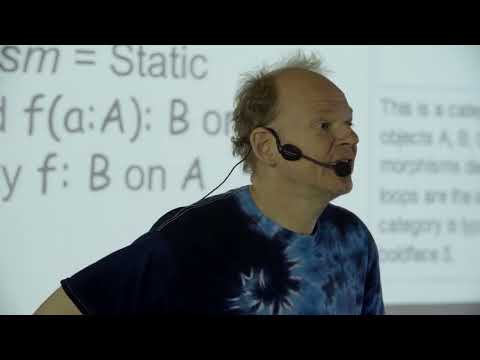
Category Theory, The essence of interface-based design - Erik Meijer
74K views • 11 years ago
FooCafe
Erik Meijer argues that category theory is the mathematicians' version of interface-based design. He shows that Java 8 lambdas and method references form a Cartesian closed category.
 28:31
Velocity 2010: James Hamilton, "Datacenter Infrastructure Innovation"
9K views • 16 years ago
O'Reilly
James Hamilton of AWS gives a Velocity 2010 keynote on datacenter infrastructure innovation, focused on power and cooling costs and a breakdown of where datacenter spending goes.
 29:12
DEF CON 26 CRYPTO AND PRIVACY VILLAGE - Scott Arciszewski - No Way JOSE! Designing Cryptography
7K views • 7 years ago
DEFCONConference
Scott Arciszewski's DEF CON 26 Crypto and Privacy Village talk critiquing the JOSE standards (JWT, JWS, JWE) and showing how to design cryptographic tokens more safely.
 4:22
Idaho Stop for Cyclists? Drivers Already Do It!
34K views • 5 years ago
Oh The Urbanity!
A short urbanism video presenting original observations of how drivers treat stop signs, to argue that cyclists rolling through them under an Idaho stop is no different. It filmed intersections in Ottawa.
 2:18
Steve Jobs' original vision for iOS web apps, WWDC 2007
5K views • 5 years ago
Bruce Lawson
A two-minute clip of Steve Jobs at WWDC 2007 introducing the plan for iPhone third-party apps as web apps built on Safari and Ajax. It shows the original vision before the native SDK and App Store.
 7:10
What People Get Wrong About Dense Urban Living
76K views • 4 years ago
Oh The Urbanity!
Oh The Urbanity! argues that most city dwellers live in dense residential neighbourhoods outside downtown, which can be calm and peaceful. It draws on older, denser parts of Toronto and Montreal.
 56:30
How to Invent the Future II - Stanford CS183F: Startup School
26K views • 9 years ago
Stanford Online
Part two of Alan Kay's Stanford Startup School lecture on inventing the future. He draws on his time at Xerox PARC and elsewhere to discuss how to think about new technology and what makes ideas useful.
 1:00:56
RailsConf 09: Robert Martin, "What Killed Smalltalk Could K
87K views • 17 years ago
O'Reilly
Robert Martin's RailsConf 2009 talk looks at why Smalltalk lost out despite its technical strengths. He draws lessons about language communities and arrogance that he argues could hurt Ruby too.
 34:55
"Outperforming Imperative with Pure Functional Languages" by Richard Feldman
98K views • 5 years ago
Strange Loop Conference
Richard Feldman explains how pure functional languages can match or beat imperative ones on performance. Compilers can turn immutable code into in-place mutation, avoiding naive copying. The talk draws on his work on the Roc language.
 37:07
Scale By The Bay 2018: Bryan Cantrill, Rust and Other Interesting Things
45K views • 7 years ago
FunctionalTV
Bryan Cantrill argues that programming languages and platforms reflect core values, and compares languages through that lens, with Rust as a main example. He draws on his experience with Solaris, DTrace and ZFS.
 51:46
Connections between physics and deep learning
67K views • 10 years ago
MITCBMM
Max Tegmark's MIT CBMM talk on why deep learning works so well. He argues that the laws of physics and the symmetries in physical data make it compressible into small neural networks, tying physics to network structure.
 53:55
A Narrative History of BSD, Dr. Kirk McKusick
30K views • 17 years ago
bsdconferences
Kirk McKusick gives a narrative history of BSD from its start at UC Berkeley in the late 1970s through the 1980s releases and the lawsuit that led to 4.4BSD-Lite in 1992. It is full of anecdotes from a key developer.
 31:46
Moxie Marlinspike, Next Generation Threats 2014
30K views • 11 years ago
Techworld Sverige
Moxie Marlinspike speaks at Next Generation Threats 2014 about the challenges of encrypted communication and how Signal addresses them. He also draws on American action movies as narrative for secure communications.
 41:19
Stuart Sierra - Components Just Enough Structure
36K views • 12 years ago
ClojureTV
Stuart Sierra presents the Component library for Clojure, a way to manage stateful services like database connections and thread pools without global mutable state. He draws on both functional and object-oriented principles.
 1:01:33
A Possible Future of Software Development
82K views • 18 years ago
Google TechTalks
Sean Parent of Adobe argues that object-oriented frameworks ultimately fail to deliver scalable, high quality software and proposes combining generic and declarative programming instead. It draws on Stepanov's Elements of Programming.
 15:28
The Braitenberg Vehicles
65K views • 10 years ago
Brian Douglas
Brian Douglas introduces Braitenberg vehicles, simple robots whose sensors are wired directly to motors yet show surprisingly lifelike behavior. He draws on Valentino Braitenberg's book Vehicles.
 38:36
"A Little Taste of Dependent Types" by David Christiansen
48K views • 8 years ago
Strange Loop Conference
David Christiansen gives a Strange Loop 2018 introduction to dependent types, where one language serves for both compile-time and run-time code and programs unite with proofs. It draws on his book The Little Typer.
 48:52
Jordan Hubbard - FreeBSD: The Next 10 Years
24K views • 11 years ago
iX
Jordan Hubbard, FreeBSD co-founder, discusses where FreeBSD might go over the next decade at MeetBSD California 2014. He draws on his Apple Unix experience, including bringing launchd-style init ideas to FreeBSD.
 37:49
Tudor Gîrba - Moldable development
26K views • 7 years ago
Curry On!
Tudor Girba's Curry On! 2019 talk on moldable development, the idea that developers should build custom tools and views for each software system they work on. It draws on the Pharo and Glamorous Toolkit environments.
 1:15:19
Types are like the Weather, Type Systems are like Weathermen - Matthias Felleisen
16K views • 10 years ago
ClojureTV
Matthias Felleisen's keynote uses weather prediction as an analogy for type systems, arguing they forecast problems so you can act on them. It draws on his experience developing Typed Racket.
 40:14
S1E8: Show And Tell: Efrit: When Steve Gives Claude Full Access To 50 Years of Emacs Capabilities
2K views • 1 year ago
Vibe Coding With Steve and Gene
Steve Yegge shows Efrit, a tool that gives Claude full control of Emacs, on the Vibe Coding with Steve and Gene show. Claude opens info pages, runs shells and even draws a Mandelbrot fractal in a buffer.