cache
 59:34
CppCon 2017: Matt Kulukundis “Designing a Fast, Efficient, Cache-friendly Hash Table, Step by Step”
137K views • 9 years ago
CppCon
Matt Kulukundis explains how Google designed SwissTable, a fast, cache-friendly hash table, step by step from std::unordered_map. The talk covers open addressing, SIMD probing and the tradeoffs of changing a fundamental data structure.
 59:21
A Crash Course in Modern Hardware by Cliff Click
21K views • 9 years ago
Devoxx
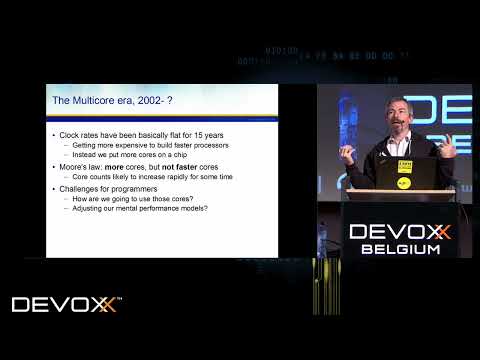
Cliff Click walks through a small performance example on a modern out-of-order CPU. He covers pipelining, ILP, CISC vs RISC, multicore, and why cache misses and the memory subsystem dominate performance.
Topic match · Computer architecture & CPUs 46:40
Andrew Kelley: A Practical Guide to Applying Data Oriented Design (DoD)
415K views • 2 years ago
ChimiChanga
Andrew Kelley, creator of Zig, presents practical data-oriented design techniques for shrinking memory footprint and making programs cache friendly. He ends with a case study of how these ideas sped up the Zig compiler.
Topic match · Software performance & optimization 55:42
CppCon 2019: Matt Godbolt “Path Tracing Three Ways: A Study of C++ Style”
77K views • 7 years ago
CppCon
Matt Godbolt builds a toy path tracer in C++ in three different styles and compares them on clarity, testability, compile time and run-time performance. The talk was given at CppCon 2019.
Topic match · Software performance & optimization 55:49
CppCon 2016: Chandler Carruth “High Performance Code 201: Hybrid Data Structures"
119K views • 10 years ago
CppCon
Chandler Carruth's CppCon 2016 talk on designing hybrid data structures for performance. He covers cache locality, working-set size and allocation overhead, and why standard C++ containers fall short.
Topic match · Software performance & optimization 59:11
How to Speed up a Python Program 114,000 times.
171K views • 13 years ago
InfoQ
David Schachter describes how he made a data-collection Python program run 114,000 times faster, drawing on decades of experience. The talk covers pipelining, cache effects and other optimization lessons.
Topic match · Software performance & optimization 44:05
FreeBSD optimizations used by Netflix serving at 800Gb/s - Drew Gallatin - EuroBSDcon 2022
28K views • 4 years ago
EuroBSDCon
Netflix engineer Drew Gallatin's EuroBSDcon 2022 talk quantifies the older FreeBSD optimizations that let Netflix serve web traffic at 800Gb/s, including TSO, LRO, VM page cache zones, asynchronous sendfile and unmapped mbufs.
Topic match · Software performance & optimization 31:17
[Minecraft Computer Engineering] - Quad-Core Redstone Computer v5.0 [12k sub special!]
3.6M views • 7 years ago
legomasta99
A showcase of the author's fifth-generation quad-core computer built entirely from Minecraft redstone, after two years of development. It features cache, a hardware stack, a GPU driving a 15x15 display, and serial I/O ports.
Topic match · Computer architecture & CPUs 49:55
How Python was Shaped by leaky Internals, Armin Ronacher, Flask framework
20K views • 10 years ago
Видео с мероприятий {speach!
Armin Ronacher, creator of Flask, explains how CPython's internals and C API leak into the language's semantics. Using examples like the complexity of the add operation, he shows why Python is hard to optimize or reimplement.
Topic match · Software performance & optimization 27:25
“Hello, world” from scratch on a 6502 — Part 1
5.9M views • 7 years ago
Ben Eater
Ben Eater starts a series building a working computer on breadboards around the 6502 microprocessor. In this first part he gets a 'hello world' running from scratch.
Topic match · Computer architecture & CPUs 47:52
Finding the Missing Memristor - R. Stanley Williams
133K views • 16 years ago
The Qualcomm Institute
R. Stanley Williams of HP Labs gives a keynote on the memristor, covering the physics, crossbar computation, and potential for memory and new computer architectures.
Topic match · Computer architecture & CPUs 42:15
"Performance Matters" by Emery Berger
502K views • 7 years ago
Strange Loop Conference
Emery Berger explains why performance is hard to measure and deliver on modern hardware, showing how code layout and alignment can swamp optimization effects. He presents Stabilizer for statistically sound evaluation and Coz, a causal profiler.
Topic match · Software performance & optimization 49:15
Erlang Factory 2014 - That's 'Billion' with a 'B': Scaling to the Next Level at WhatsApp
50K views • 12 years ago
Erlang Solutions
Rick Reed of WhatsApp explains at Erlang Factory 2014 how the service scaled to billions of messages with a very small engineering team. He covers the FreeBSD and Erlang stack, Mnesia usage, server counts and bottleneck work.
Topic match · Software performance & optimization 31:37
How Crash Bandicoot Hacked The Original Playstation | War Stories | Ars Technica
5.2M views • 6 years ago
Ars Technica
In Ars Technica's War Stories, Naughty Dog co-founder Andy Gavin explains how the team squeezed Crash Bandicoot onto the original PlayStation. They overwrote Sony library code in RAM, built custom animation compression, and streamed assets around slow seek times.
Topic match · Software performance & optimization 42:59
"How NOT to Measure Latency" by Gil Tene
119K views • 11 years ago
Strange Loop Conference
Gil Tene of Azul Systems explains common pitfalls in measuring latency and response time, including why averages mislead and the problem of coordinated omission. He introduces open source tools like HdrHistogram for better measurement and reporting.
Topic match · Software performance & optimization 40:13
"Programming a 144-computer chip to minimize power" - Chuck Moore (2013)
19K views • 5 years ago
Strange Loop Conference
Chuck Moore, inventor of Forth, presents GreenArrays' 144-core asynchronous chip at Strange Loop 2013. He explains how idle cores draw almost no power and how tight code minimizes energy use.
Topic match · Computer architecture & CPUs 44:29
Breaking the x86 Instruction Set
381K views • 9 years ago
Black Hat
Christopher Domas presents at Black Hat 2017 how page fault analysis and processor fuzzing can exhaustively search the x86 instruction set. The talk uncovers undocumented instructions and hardware bugs and shows limits of disassemblers.
Topic match · Computer architecture & CPUs 58:05
Guarding Against Physical Attacks: The Xbox One Story — Tony Chen, Microsoft
95K views • 7 years ago
Platform Security Summit
Microsoft's Tony Chen explains how the Xbox One was designed to resist physical attacks, including secure boot, encrypted memory, a security processor and a hypervisor. The goal was to make any hardware attack cost more than the price of many games.
Topic match · Computer architecture & CPUs 51:04
[EPILEPSY WARNING] How fast should an unoptimized terminal run?
193K views • 5 years ago
Molly Rocket
Casey Muratori shows how fast a terminal renderer can run, building a simple reference renderer that handles Unicode and colored text far quicker than Windows Terminal. He argues that common excuses for slow terminals do not hold up.
Topic match · Software performance & optimization 59:53
CppCon 2019: Chandler Carruth “There Are No Zero-cost Abstractions”
147K views • 7 years ago
CppCon
Chandler Carruth argues in a CppCon 2019 talk that C++ has no truly zero-cost abstractions. Using examples like unique_ptr, ABI constraints and compile-time costs, he shows that abstractions cost runtime, compile time or human effort.
Topic match · Software performance & optimization 35:12
Jake Archibald on the web browser event loop, setTimeout, micro tasks, requestAnimationFrame, ...
808K views • 8 years ago
JSConf
Jake Archibald's JSConf.Asia 2018 talk "In the Loop" explains the browser event loop, covering tasks, microtasks, requestAnimationFrame, and how rendering interleaves with JavaScript. It uses visual walkthroughs to show why code runs in surprising orders and why setTimeout fixes are unreliable.
Topic match · Software performance & optimization 34:15
How does a USB keyboard work?
3.8M views • 5 years ago
Ben Eater
Ben Eater explains how a USB keyboard communicates, covering the electrical interface, bit and packet encoding, packet contents, and a comparison with PS/2.
Topic match · Computer architecture & CPUs 27:13
Robust-first computing: Demon Horde Sort (full version)
14K views • 13 years ago
Dave Ackley
Dave Ackley demonstrates the Demon Horde Sort, an inherently robust sorting machine running in his Movable Feast Machine simulator. This is the uncut version with all details and side thoughts.
Topic match · Computer architecture & CPUs 20:29
Over 200,000 Servers in One Place! Visiting Hetzner in Falkenstein (Germany)
1.6M views • 5 years ago
der8auer EN
Overclocker der8auer tours Hetzner's Falkenstein data center in Germany, showing custom racks, own mainboards, passively cooled servers and ATX-style cases on shelves.
Topic match · Computer architecture & CPUs 34:55
"Outperforming Imperative with Pure Functional Languages" by Richard Feldman
98K views • 5 years ago
Strange Loop Conference
Richard Feldman explains how pure functional languages can match or beat imperative ones on performance. Compilers can turn immutable code into in-place mutation, avoiding naive copying. The talk draws on his work on the Roc language.
Topic match · Software performance & optimization 58:36
Advanced Topics in Programming Languages: A Lock-Free Hash Table
29K views • 14 years ago
GoogleTalksArchive
A 2007 Google Tech Talk in which Cliff Click of Azul Systems presents a lock-free concurrent hash table that scales to 768 CPUs. He explains why it is correct by reasoning in a different way than usual happens-before and memory-order arguments.
Topic match · Software performance & optimization 40:13
Zach Tellman - Everything Will Flow
27K views • 11 years ago
ClojureTV
Zach Tellman's Clojure West talk covers the basics of queueing theory and its practical use in systems, including backpressure, how queues break down under load, and pitfalls of naive core.async use.
Topic match · Software performance & optimization 21:42
Future Computers Will Be Radically Different (Analog Computing)
13.2M views • 4 years ago
Veritasium
Veritasium explains why analog computing may suit AI workloads, covering old analog computers, The Analog Thing and Mythic's analog chips that use flash memory for neural network inference. It argues digital hardware is hitting limits.
Topic match · Computer architecture & CPUs 32:07
Larry Hastings - Removing Python's GIL: The Gilectomy - PyCon 2016
49K views • 10 years ago
PyCon 2016
Larry Hastings explains what Python's GIL is, what problems it solves and how it works, and presents his Gilectomy project to remove it, including the performance and C-extension obstacles.
Topic match · Software performance & optimization 46:37
GPUs to Mars: Full-Scale Simulation of SpaceX's Mars Rocket Engine
126K views • 11 years ago
insideHPC Report
SpaceX engineers present at NVIDIA's GPU Technology Conference on a multi-physics code that simulates the full-scale Raptor methane engine. It covers GPU-based turbulent combustion modeling with adaptive grids and wavelet compression.
Topic match · Computer architecture & CPUs 22:41
"Clean" Code, Horrible Performance
1.2M views • 3 years ago
Molly Rocket
Casey Muratori shows how typical 'clean code' object-oriented patterns can cost large factors in performance. He benchmarks them against simpler data-oriented code.
Topic match · Software performance & optimization 35:33
How does Computer Memory Work? 💻🛠
5.5M views • 4 years ago
Branch Education
A 36-minute animated deep dive from Branch Education into how DRAM works. It shows how memory connects to the CPU and how billions of bits are stored in nanoscale capacitor cells. It also covers why DRAM sits between SSDs and the processor.
Topic match · Computer architecture & CPUs 52:45
The Road to PS5
16.8M views • 6 years ago
PlayStation
PS5 lead system architect Mark Cerny gives a deep dive into the PS5's architecture, covering its SSD, I/O, audio and design goals. He explains how removing bottlenecks shapes future games.
Topic match · Computer architecture & CPUs 35:42
Progressive Performance (Chrome Dev Summit 2016)
34K views • 9 years ago
Chrome for Developers
Alex Russell's Chrome Dev Summit 2016 talk on building web experiences that work on slow, flaky networks and low-power devices. It argues developers should focus on the performance of real-world mobile hardware rather than desktop machines.
Topic match · Software performance & optimization 46:10
Understanding the Python GIL
127K views • 14 years ago
David Beazley
David Beazley's PyCon 2010 talk explains how the Python Global Interpreter Lock works and shows experiments where multithreaded code runs slower, even on more cores, due to lock contention and context-switching overhead.
Topic match · Software performance & optimization 25:52
Halide Talk
53K views • 12 years ago
Andrew Adams
Andrew Adams, a Halide developer, presents the Halide language for image processing and tensor computation. The talk explains the separation of algorithm from schedule with illustrated examples of parallelism, locality and redundancy tradeoffs.
Topic match · Software performance & optimization 24:46
Building a 6800 CPU on an FPGA with nMigen (part 1)
27K views • 6 years ago
Robert Baruch
The first part of Robert Baruch's series on building a 6800 CPU on an FPGA with nMigen, a Python-based hardware description language. It introduces the HDL while implementing a simpler 6800 core.
Topic match · Computer architecture & CPUs 29:51
Refterm v2 - Resource usage, binary splat, glyph sizing, and more
68K views • 5 years ago
Molly Rocket
Casey Muratori follows up his refterm proof-of-concept, a GPU-based terminal renderer, with a second part covering memory usage, glyph sizing and correct Unicode and VT handling. It is built to show that a terminal can be fast and correct without heroic effort.
Topic match · Software performance & optimization 31:19
CppCon 2016: Nicholas Ormrod “The strange details of std::string at Facebook"
122K views • 10 years ago
CppCon
Nicholas Ormrod's CppCon 2016 talk on how Facebook optimizes std::string with its open-source replacement fbstring. It covers storage layout tradeoffs, small string optimization and memory allocation behavior.
Topic match · Software performance & optimization 57:39
CppCon 2016: Chandler Carruth “Garbage In, Garbage Out: Arguing about Undefined Behavior..."
94K views • 10 years ago
CppCon
Chandler Carruth's CppCon 2016 talk tries to defuse the heated debate over undefined behavior in C and C++. He explains from the compiler writer's perspective why UB exists and how it enables optimization.
Topic match · Software performance & optimization