call stack
 51:59
Learning from StackOverflow.com
139K views • 17 years ago
Google TechTalks
Joel Spolsky's 2009 Google Tech Talk on why StackOverflow was built, how it addresses the mess of searching for programming help, and the community design behind it. He also takes jabs at paywalled answer sites.
 26:41
Pranks Destroy Scam Callers- GlitterBomb Payback
120.3M views • 4 years ago
Mark Rober
Mark Rober and collaborators build glitter bomb traps and other pranks to fight phone scam call centers, and share evidence about the operations.
 55:39
Founders@Google Presents: The Cultural Anthropology of Stack Exchange
12K views • 14 years ago
Google TechTalks
Joel Spolsky's 2012 Google tech talk on the cultural anthropology of Stack Overflow and Stack Exchange. He explains how the software was designed to shape community norms and curation standards.
 26:53
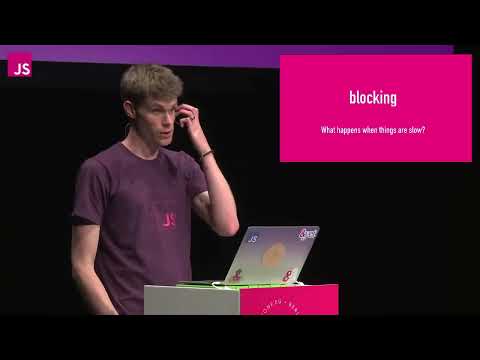
What the heck is the event loop anyway? | Philip Roberts | JSConf EU
3.8M views • 12 years ago
JSConf
Philip Roberts explains the JavaScript event loop, call stack, callbacks and asynchronous behavior with live visualizations using a tool he built. It demystifies terms like non-blocking and single-threaded.
 49:16
Call Between Alexey Navalny and FSB Officer Konstantin Kudryavtsev [English Subtitles]
395K views • 5 years ago
Bellingcat
Bellingcat's publication of the recorded call in which Alexey Navalny, posing as a security aide, gets FSB officer Konstantin Kudryavtsev to describe the operation to poison him. It has English subtitles.
 31:26
Joel Spolsky at Startup School 2012
35K views • 13 years ago
Y Combinator
Joel Spolsky, founder of Fog Creek Software and StackExchange, speaks at Y Combinator's Startup School in 2012. He shares his perspective on building startups.
 29:53
Pipe Organ (5-story instrument)
7.3M views • 7 years ago
Rob Scallon
Rob Scallon explores a five-story pipe organ, the largest in the Midwest, with organist John Sherer. The half-hour tour covers most of the instrument and how it works.
 40:13
"Programming a 144-computer chip to minimize power" - Chuck Moore (2013)
19K views • 5 years ago
Strange Loop Conference
Chuck Moore, inventor of Forth, presents GreenArrays' 144-core asynchronous chip at Strange Loop 2013. He explains how idle cores draw almost no power and how tight code minimizes energy use.
 21:36
Fractals are typically not self-similar
4.6M views • 9 years ago
3Blue1Brown
3Blue1Brown explains fractal dimension and shows why many fractals are not strictly self-similar. Self-similarity turns out to be a special case of the broader idea of fractional dimension.
 21:42
Future Computers Will Be Radically Different (Analog Computing)
13.2M views • 4 years ago
Veritasium
Veritasium explains why analog computing may suit AI workloads, covering old analog computers, The Analog Thing and Mythic's analog chips that use flash memory for neural network inference. It argues digital hardware is hitting limits.
 25:37
CUFP 2013: Julien Verlaguet, Facebook: Analyzing PHP statically
5K views • 13 years ago
CUFP 2013
Julien Verlaguet of Facebook describes applying static analysis and type inference to a very large PHP codebase, using OCaml. The work led to the Hack language.
 31:09
Bringing the Unix Philosophy to Big Data by Bryan Cantrill: FutureStack13
18K views • 12 years ago
New Relic
Bryan Cantrill presents Manta, an object store with in-situ compute that lets tools like grep, awk, and sed run map-reduce style over huge data. He frames it as bringing the Unix philosophy to big data.
 36:10
CppCon 2019: Emery Berger “Mesh: Automatically Compacting Your C++ Application's Memory”
15K views • 7 years ago
CppCon
Emery Berger's CppCon 2019 talk introducing Mesh, a drop-in malloc replacement that compacts memory in unmodified C and C++ programs. It tackles fragmentation by merging pages without changing pointers.
 27:24
VerizonMath Original Recording of Verizon Customer Service C
551K views • 12 years ago
Impulse Renegade
An original recording of a Verizon customer service call in which the rep fails to understand the difference between cents and dollars, known as Verizon Math.
 23:34
Why Democracy Is Mathematically Impossible
10.1M views • 2 years ago
Veritasium
Veritasium explains why no voting system can be perfectly fair, drawing on Arrow's theorem and the work of Eric Maskin. It looks at problems with systems like first-past-the-post and ranked-choice voting.
 44:13
Doctor Dissects the Wim Hof Method - Cold Hard Science Analysis
1.8M views • 7 years ago
Medlife Crisis
A cardiologist runs a detailed, skeptical review of the Wim Hof Method, covering the research on cold exposure and breathing techniques. It also teaches how to read scientific statistics critically.
 40:03
Google I/O 2013 - High Performance Audio
62K views • 13 years ago
Google for Developers
A Google I/O 2013 talk by Android audio engineers on why reliable, low-latency audio is hard on the platform. It covers problem areas across the stack, platform work underway and techniques apps can use.
 46:54
"Write a single library to handle all input devices, it'll be easy" they said...
21K views • 6 years ago
linux.conf.au
Peter Hutterer's linux.conf.au 2020 talk on creating libinput, the unified userspace input library, and the difficulties of handling the many quirks of input devices.
 47:34
RailsConf 2011: Aaron Patterson, "Double Dream Hands: So Intense!"
26K views • 15 years ago
O'Reilly
Aaron Patterson's RailsConf 2011 talk on Rails 3.1 performance, showing why deeper Rack middleware stacks slow Rails and how a shallower pipeline helps. It also touches on Rack API design.
 48:02
James Burke Legend Connections 1 The Trigger Effect
389K views • 4 years ago
Tim Callinan
The first episode of James Burke's Connections series, 'The Trigger Effect', explores how modern society depends on interlinked technological systems and how quickly it breaks down when they fail, starting with a power blackout.
 28:03
AT&T Archives: Similiarities of Wave Behavior (Bonus Edition)
473K views • 14 years ago
AT&T Tech Channel
A Bell Labs film in which Dr. J.N. Shive uses a mechanical wave machine to demonstrate reflection, standing waves, resonance and impedance matching. He includes some equations but relies mostly on real-world examples a layperson can follow.
 24:26
The Beauty of Bézier Curves
2.2M views • 5 years ago
Freya Holmér
Freya Holmer explains how Bezier curves work, from the helper-line construction to their uses in animation, text rendering and shapes. It uses visuals from her Unity Shapes plugin and was a SoME1 contest winner.
 23:53
D/A and A/D | Digital Show and Tell (Monty Montgomery @ xiph.org)
647K views • 13 years ago
FL Studio
Monty Montgomery of Xiph.org gives real-time demonstrations of sampling, quantization, bit depth and dither using real audio equipment, including both digital analysis tools and vintage analog bench gear. It shows that sampled audio is not stair-stepped and corrects common misconceptions about digital audio.
 52:07
What Bodies Think About: Bioelectric Computation Outside the Nervous System - NeurIPS 2018
103K views • 7 years ago
The Artificial Intelligence Channel
Michael Levin's NeurIPS 2018 talk on bioelectric computation outside the nervous system, showing how cell electrical networks shape development and regeneration. It covers morphological information processing in living tissue.
 44:10
Jan Willem Nijman - Vlambeer - "The art of screenshake" at INDIGO Classes 2013
386K views • 12 years ago
Dutch Game Garden
Vlambeer's Jan Willem Nijman shows how to make an action game feel great by stacking small effects like screenshake, recoil and particles onto a basic shooter. It was presented at INDIGO Classes 2013.
 54:11
Ed Catmull, Pixar: Keep Your Crises Small
217K views • 17 years ago
Stanford Graduate School of Business
Ed Catmull of Pixar speaks at Stanford's 2007 Entrepreneurship Conference on running a creative company. He argues for surfacing small problems early and building good teams, with stories like the Toy Story 2 crunch.
 42:15
"Performance Matters" by Emery Berger
502K views • 7 years ago
Strange Loop Conference
Emery Berger explains why performance is hard to measure and deliver on modern hardware, showing how code layout and alignment can swamp optimization effects. He presents Stabilizer for statistically sound evaluation and Coz, a causal profiler.
 24:46
Painting a Character with Maths
458K views • 5 years ago
Inigo Quilez
Inigo Quilez live-codes a cartoon character painting entirely from math, using signed distance fields in a Shadertoy shader. He explains each step of building the image from formulas.
 37:37
RailsConf 2016 - Turbolinks 5: I Can’t Believe It’s Not Native! by Sam Stephenson
61K views • 10 years ago
Confreaks
Sam Stephenson's RailsConf 2016 talk on Turbolinks 5, showing how small teams can ship fast Rails apps in the browser and hybrid iOS and Android apps sharing one set of web views.
 49:15
Erlang Factory 2014 - That's 'Billion' with a 'B': Scaling to the Next Level at WhatsApp
50K views • 12 years ago
Erlang Solutions
Rick Reed of WhatsApp explains at Erlang Factory 2014 how the service scaled to billions of messages with a very small engineering team. He covers the FreeBSD and Erlang stack, Mnesia usage, server counts and bottleneck work.
 28:23
The Fast Fourier Transform (FFT): Most Ingenious Algorithm Ever?
2.3M views • 5 years ago
Reducible
Reducible's visual walkthrough of the Fast Fourier Transform, motivated by polynomial multiplication. It shows how the FFT's key ideas can be discovered by asking the right questions.
 59:23
28c3: The Science of Insecurity
42K views • 14 years ago
28c3
Meredith Patterson and Sergey Bratus argue that networked software stays insecure because protocols and inputs are too complex to recognize safely. They propose using formal language theory and grammars to build secure, verifiable input handling.
 29:32
Pete Hunt: React: Rethinking best practices -- JSConf EU
548K views • 13 years ago
JSConf
Pete Hunt of Facebook and Instagram introduces React at JSConf EU 2013 and explains its design principles. He argues that separating templates from logic only separates technologies, not concerns, and makes the case for components.
 44:23
A Swift Introduction to Geometric Algebra
1.1M views • 6 years ago
sudgylacmoe
An animated introduction to geometric algebra, presented as a language that can describe most of physics. It was made with manim and covers multivectors and how they generalize familiar tools like cross products and quaternions.
 25:41
Compiling C to printable x86, to make an executable research paper
479K views • 9 years ago
suckerpinch
Tom7 explains how he built a SIGBOVIK 2017 paper made only of printable ASCII bytes that is also a valid DOS executable. He writes a C compiler targeting printable x86 without self-modifying code and solves the puzzles the constraint creates.
 46:19
Break Me00 The MoVfuscator Turning mov into a soul crushing RE nightmare Christopher Domas
81K views • 11 years ago
Adrian Crenshaw
Christopher Domas's Derbycon 2015 talk on the M/o/Vfuscator, a compiler that emits only x86 mov instructions, showing mov is Turing complete. It explains how a full machine is built from mov and why the output is a nightmare to reverse engineer.
 41:06
"Unison: a new distributed programming language" by Paul Chiusano
45K views • 7 years ago
Strange Loop Conference
Paul Chiusano's Strange Loop 2019 talk introduces Unison, an open-source functional language for distributed, elastic systems. It covers content-addressed code identified by hashes of the syntax tree, a codebase manager, and algebraic effects called abilities.
 37:31
Everything is a Remix (Original Series)
925K views • 10 years ago
Kirby Ferguson
Kirby Ferguson's video essay series arguing that creativity is built on copying, transforming and combining existing work. It covers music, film and technology, then turns to copyright and patents.
 36:20
Mastering the Vim Language
647K views • 11 years ago
thoughtbot
Chris Toomey of thoughtbot explains Vim as a language of commands, motions and text objects that combine into precise edits. He shows how to master the built-in pieces and extend them.
 51:40
Domain Modeling Made Functional - Scott Wlaschin
71K views • 9 years ago
NDC Conferences
Scott Wlaschin's NDC talk on using statically typed functional programming, F# in particular, to model a business domain. Types are used to represent the domain precisely and to encode business rules so that illegal states cannot be built, with the compiler acting as an instant unit test.