computational imaging
 11:02
Imaging at a trillion frames per second | Ramesh Raskar
3.2M views • 14 years ago
TED
Ramesh Raskar presents femto-photography, a technique that captures a trillion frames per second, fast enough to show light itself moving through a scene. He discusses possible uses such as cameras that see around corners or inside the body.
 1:01:40
Joscha: Computational Meta-Psychology
85K views • 10 years ago
media.ccc.de
Joscha Bach's 32C3 talk applies computational theories of mind to questions of meaning, emotion, and love, asking how computation can explain irrational-seeming human experience.
 5:10
Computational Design of Mechanical Characters
3.9M views • 13 years ago
DisneyResearchHub
A Disney Research SIGGRAPH 2013 demo of an interactive system that lets non-experts design animated mechanical characters. The user sketches motion curves and the system generates optimized mechanisms and gear trains for 3D printing.
 10:44
P vs. NP and the Computational Complexity Zoo
3.7M views • 12 years ago
hackerdashery
An 11-minute animated introduction to P vs. NP and the wider landscape of complexity classes, inspired by the Complexity Zoo wiki. It assumes no background in computer science.
 5:10
Dual Photography
24K views • 17 years ago
mm648230
The SIGGRAPH 2005 demo of dual photography from Stanford, which swaps the roles of projector and camera to render a scene from the light's point of view. It includes the reveal of a hidden playing card.
 41:07
KEYNOTE / Robert Erdmann
24K views • 5 years ago
PyCon US
Robert Erdmann, a materials scientist at the Rijksmuseum, gives a PyCon keynote on the ultra-high-resolution imaging of Rembrandt's Night Watch. He covers the automated gantry camera system, the Python software that drives it, and the large volumes of image data involved.
 16:51
How we can use light to see deep inside our bodies and brains | Mary Lou Jepsen
297K views • 8 years ago
TED
Inventor Mary Lou Jepsen demonstrates using red light and sound to see inside the body and brain, aiming at tumor detection and neural activity measurement, and potentially a cheaper wearable MRI replacement.
 23:32
The Solar Gravitational Lens will Map Exoplanets. Seriously.
582K views • 6 years ago
Launch Pad Astronomy
Explains the proposed NASA JPL plan to use the Sun as a gravitational lens, sending solar sail craft to its focal region to image an exoplanet's surface. It covers the distances involved, how imaging with the Sun would work and the mission design.
 1:15:21
Marc Levoy - Lectures on Digital Photography - Lecture 1 (21mar16).mp4
512K views • 10 years ago
Marc Levoy
The first lecture in an 18-part series on digital photography from Marc Levoy's Stanford CS 178 course, recorded at Google in 2016. The series covers how digital cameras work and computational photography, with slides and assignments available on the course site.
 1:00:52
Joscha: From Computation to Consciousness (31c3)
28K views • 11 years ago
Joscha Bach
Joscha Bach's 31c3 talk argues that the mind should be understood as an information-processing system and that even the physical universe can be seen as computational. It tours the philosophy underlying artificial intelligence and cognitive science.
 14:37
The most important lesson from 83,000 brain scans | Daniel Amen | TEDxOrangeCoast
24.4M views • 13 years ago
TEDx Talks
Psychiatrist Daniel Amen discusses lessons from 83,000 brain scans, arguing that brain activity patterns relate to psychological symptoms and that you can improve your brain.
 2:47
Visualizing video at the speed of light — one trillion frames per second
12M views • 14 years ago
Massachusetts Institute of Technology (MIT)
MIT Media Lab shows an imaging system capturing a trillion frames per second, fast enough to film light pulses travelling through objects in slow motion.
 21:15
The REAL Possibility of Mapping Alien Planets!
778K views • 4 years ago
PBS Space Time
PBS Space Time explains the proposal to use the Sun's gravity as a giant lens, sending a train of small light-sail spacecraft to the focal point roughly 550 AU out. It covers how such a telescope could image exoplanets in surprising detail and the engineering challenges involved.
 3:38:43
Stephen Wolfram: Complexity and the Fabric of Reality | Lex Fridman Podcast #234
4.8M views • 5 years ago
Lex Fridman
A long Lex Fridman interview with Stephen Wolfram on complexity, cellular automata, computational irreducibility and the Wolfram Physics Project.
 1:03
Neutron movie of coffee making
133K views • 14 years ago
Anders Kaestner
A short film made with cold neutron imaging at the Paul Scherrer Institut showing a moka pot brewing coffee, sped up four times. The neutron beam makes the water and steam inside the pot visible.
 1:02:13
35C3 - The Ghost in the Machine
79K views • 7 years ago
media.ccc.de
Joscha Bach's 35C3 talk offers an AI perspective on the soul, covering perception, mental representation, agency, consciousness and selfhood as things that can arise in a computational system like the brain.
 1:25:27
Neuroscience of Personality | Dario Nardi | Talks at Google
163K views • 15 years ago
Talks at Google
UCLA professor Dario Nardi presents brain-imaging research suggesting that different Myers-Briggs personality types use their brains in different ways. He discusses how each type can reach a state of creative flow. It is aimed at a general audience.
 11:13
What if you could only see the world in UV?
5.6M views • 8 years ago
Veritasium
Veritasium shows what the world looks like through a UV camera. It covers how pigments absorb UV, how fluorescence works, and how UV imaging reveals sunscreen effectiveness and skin damage.
 9:19
How to Understand What Black Holes Look Like
11M views • 7 years ago
Veritasium
Veritasium explains what a black hole should look like, using J.P. Luminet's 1979 work and a cardboard 3D model to show how light bends around it. It was made just as the first black hole image was released.
 1:41:27
Defcon 21 - Decapping Chips The Strike Easy Hard Way
69K views • 12 years ago
HackersOnBoard
A DEF CON 21 talk by Adam Laurie and Zac Franken on decapping chips, covering how to remove chip packaging and image the die to read out contents such as ROM.
 4:22
SIGBOVIK 2007: Generalized Super Mario Bros. is NP-Complete
84K views • 18 years ago
suckerpinch
Tom Murphy's satirical SIGBOVIK 2007 presentation, delivered under a pseudonym, proving that generalized Super Mario Bros. is NP-complete. It is a short, deadpan take on a complexity theory result.
 1:00:16
Clasp: Common Lisp using LLVM and C++ for Designing Molecules
9K views • 11 years ago
Google TechTalks
Christian Schafmeister's Google Tech Talk on Clasp and CANDO, a Common Lisp implementation on LLVM and C++ used to design molecules, including energy minimization and force-field calculations.
 4:23:39
Stephen Wolfram: Fundamental Theory of Physics, Life, and the Universe | Lex Fridman Podcast #124
501K views • 6 years ago
Lex Fridman
A roughly four-and-a-half-hour Lex Fridman podcast conversation with Stephen Wolfram about his Wolfram Physics Project and a fundamental theory of physics, computation, life and the universe.
 27:16
How Do Night Vision Goggles Work?
8.4M views • 3 years ago
Veritasium
Veritasium visits the US Navy's Crane facility to test top night vision goggles. It explains how image intensifier tubes and thermal or digital systems work and compares the generations of the technology.
 28:10
CANDO: A Compiled Programming Language for Computer-Aided Nanomaterial Design and Optimization
3K views • 10 years ago
European Lisp Symposium
Christian Schafmeister presents CANDO at the 2016 European Lisp Symposium. It is a compiled Lisp-based language for designing macromolecules and nanoscale materials, built on the Clasp implementation of Common Lisp.
 26:54
Chest Freezers; What they tell us about designing for X
2.9M views • 6 years ago
Technology Connections
Technology Connections explains how refrigerator and freezer design affects energy use, using chest freezers to show why top-opening designs and layout choices matter. It includes thermal-camera footage of cold air spilling out of upright units.
 13:06
Filming the Speed of Light at 10 Trillion FPS
42.1M views • 7 years ago
The Slow Mo Guys
The Slow Mo Guys visit a lab with a camera capable of filming at 10 trillion frames per second, fast enough to see light travel. They show the setup and the resulting footage.
 29:22
A laser pointer at 2 billion fps makes the speed of light look... kinda weird
6M views • 1 year ago
AlphaPhoenix
AlphaPhoenix shows off a new camera that films at two billion frames per second and uses it to film a laser pointer pulse. He investigates a strange quirk in how the speed of light appears on camera.
 11:47
!!Con 2017: HDR Photography in Microsoft Excel?! by Kevin Chen
119K views • 9 years ago
Confreaks
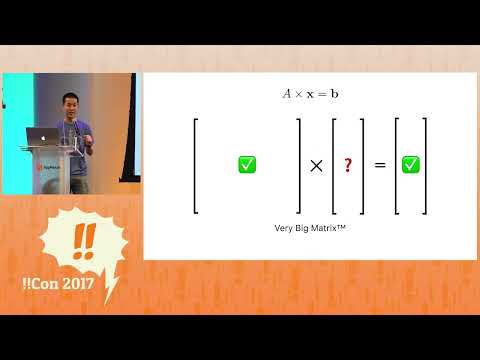
A short conference talk from !!Con 2017 in which Kevin Chen explains the HDR imaging algorithm from a foundational paper, framing it as a system of linear equations, and implements it in a Microsoft Excel spreadsheet. No prior image processing knowledge is needed.
 1:01:47
Four Solutions to a Trivial Problem - Guy Steele Jr.
36K views • 10 years ago
Google TechTalks
Guy Steele presents a small geometric problem and compares four computational approaches: a classic sequential solution and three parallel-friendly ones. Each is illustrated pictorially and with working code, weighing total work against time to solution.
 48:36
Matt Might - Winning the War on Error Solving the Halting Problem and Curing Cancer
9K views • 9 years ago
Curry On!
Matt Might's Curry On talk on ending errors in code, both software and the human genome. He covers conservative approximation of the halting problem via static analysis and a computational approach to precision medicine.
 12:04
Anagrams, but where you can break apart letters: "Anagraphs"
256K views • 8 years ago
suckerpinch
Tom Scott-style exploration by suckerpinch (Tom7) of generalized anagrams where letters can be broken into pieces, called anagraphs, with a whimsical computational approach.
 10:23
Andrew Sorensen Keynote: "The Concert Programmer" - OSCON 2014
157K views • 12 years ago
O'Reilly
Andrew Sorensen's OSCON 2014 keynote in which he live-codes generative music on stage using his Impromptu environment while narrating his computational and musical choices. It imagines concert programmers as a performing art.
 26:48
Algorithmic Redistricting: Elections made-to-order
584K views • 5 years ago
AlphaPhoenix
AlphaPhoenix uses Monte Carlo simulation and annealing-style methods to draw North Carolina congressional district maps, both gerrymandered and fair. He focuses on the fascinating computational problem rather than the politics.
 49:39
NeWS: A Networked and Extensible Window System, lecture by James Gosling
5K views • 10 years ago
Computer History Museum
A 1990 lecture by James Gosling on NeWS, Sun's networked window system in which clients send PostScript programs to the server for execution. It covers the high-level imaging model and compares NeWS with similar systems.
 23:37
Rotating Detonation Engine (RDE) -- Dynamics and Bifurcations
88K views • 6 years ago
Nathan Kutz
Nathan Kutz presents the spatio-temporal dynamics of rotating detonation rocket engines, including combustion fronts that behave like solitons. He shows a bifurcation analysis of a multiscale model that captures the main features.
 7:23
Exact Instructions Challenge - THIS is why my kids hate me. | Josh Darnit
3.9M views • 9 years ago
Josh Darnit
A family video in which kids write instructions for making a peanut butter and jelly sandwich and a parent follows them exactly as written, with comic results. It demonstrates how precise instructions must be.
 23:55
Matrioshka Brains: Star-Powered Computers
505K views • 10 years ago
Isaac Arthur
Isaac Arthur explains the Matrioshka Brain, a hypothetical computer or artificial mind powered by an entire star using nested shells. It covers how such megastructures relate to Dyson spheres and superintelligence.
 1:34
A Boy And His Atom: The World's Smallest Movie
28.2M views • 13 years ago
IBM
IBM's record-setting stop-motion film made by moving individual carbon monoxide molecules with a scanning tunneling microscope, illustrating atomic-scale memory research.
 3:20
Fairy Lights in Femtoseconds: Tangible Holographic Plasma (SIGGRAPH)
1.1M views • 11 years ago
Yoichi Ochiai
A SIGGRAPH demo from Yoichi Ochiai's group of aerial and volumetric graphics drawn by focused femtosecond lasers with computational holography. The plasma points can be touched.