computer history
 3:39
(1/4) Intro/History: Introducing a 100-year-old mechanical computer
476K views • 11 years ago
engineerguy
The first of four short videos from Bill Hammack (engineerguy) introducing and giving the history of a 100-year-old mechanical computer, Michelson's harmonic analyzer. The series goes on to explain Fourier synthesis, analysis and operation of the machine.
 18:57
Why the Soviet Computer Failed
4.2M views • 4 years ago
Asianometry
An Asianometry explainer on why the Soviet Union, once a leading computing power, fell far behind the US in computers by the 1980s. It traces the gap from the 1960s onward despite strong state support for science.
 12:23
Typesetters in the '80s - Computerphile
105K views • 12 years ago
Computerphile
Professor Brailsford of the University of Nottingham describes how the university set out to print its own mathematics exam papers in the 1980s. The story centers on getting a Mergenthaler Linotron 202 typesetter to work with their own software.
 15:09
Mouse Cursor History (and why I made my own)
3M views • 8 years ago
Posy
Posy gives a short history of the computer mouse cursor, from early straight pointers to the tilted arrow, comparing Apple and Windows designs. He then explains why he designed his own cursor set and offers it as a free download.
 20:13
The Most Powerful Computers You've Never Heard Of
13.7M views • 4 years ago
Veritasium
Veritasium traces analog computers from the Antikythera mechanism and Kelvin's tide-predicting machines to fire control and modern analog approaches. It explains how these machines computed continuously rather than digitally.
 14:03
The Computer Designed To Die In Microseconds
408K views • 3 years ago
Scott Manley
Scott Manley tells the story of a computerized telemetry system built to sit at the heart of a nuclear test device in place of the plutonium pit, designed to transmit data in the microseconds before it was destroyed.
 21:20
Cracking Enigma in 2021 - Computerphile
2.9M views • 5 years ago
Computerphile
Dr Mike Pound of Computerphile shows how a modern laptop can crack Enigma, using a ciphertext-only attack based on an older paper. He compares it with the tooling in CrypTool.
 11:11
The Agricultural Revolution: Crash Course World History #1
17.7M views • 14 years ago
CrashCourse
The first episode of Crash Course World History, in which John Green covers the shift from hunting and gathering to agriculture and how it shaped civilization. It is delivered fast and with jokes.
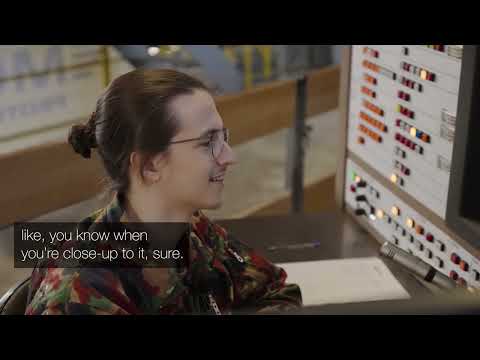 4:40
This 1970s tank simulator drives through a tiny world
12M views • 4 years ago
Tom Scott
Tom Scott visits the Swiss Military Museum to see the last surviving 1970s tank-driving simulator. It uses a real camera moving over a miniature model landscape rather than any computer graphics.
Topic match · History of computing 19:26
history of the entire world, i guess
185.5M views • 9 years ago
bill wurtz
A fast, absurdist 19-minute animated run through the history of the whole world, narrated and scored by Bill Wurtz in his distinctive style. It compresses millennia of events into jokes, songs and quick visuals.
 23:04
The Computer-free Automation of a Jukebox (Electromechanics)
1.3M views • 6 years ago
Technology Connections
Technology Connections takes apart a 1970 Wurlitzer 3400 jukebox to show how electromechanical relays and switches automated its behavior without a computer.
 10:13
The Problem with Time & Timezones - Computerphile
4.4M views • 12 years ago
Computerphile
Tom Scott explains for Computerphile why handling time and timezones in code is so hard, walking through a simple web app that computes how long ago something happened. It covers the quirks of timezones and calendars and ends in an exasperated rant.
 8:21
Why Electronic Voting is a BAD Idea - Computerphile
2.3M views • 11 years ago
Computerphile
Tom Scott explains for Computerphile why electronic voting is a bad idea, arguing that paper ballots are transparent, auditable and hard to tamper with at scale. He covers why moving voting to phones, tablets or computers undermines trust and verifiability.
 15:12
JPEG DCT, Discrete Cosine Transform (JPEG Pt2)- Computerphile
697K views • 11 years ago
Computerphile
Mike Pound explains the discrete cosine transform and how it underpins JPEG compression. It is part two of Computerphile's JPEG series.
 9:09
England: South Sea Bubble - The Sharp Mind of John Blunt - Extra History - Part 1
3.5M views • 11 years ago
Extra History
The first part of Extra History's animated miniseries on the South Sea Bubble. It explains how England's government debt led Robert Harley to turn to financier John Blunt, whose schemes began inflating artificial demand for shares.
 9:37
Characters, Symbols and the Unicode Miracle - Computerphile
2.1M views • 13 years ago
Computerphile
Tom Scott explains for Computerphile how Unicode and UTF-8 grew out of messy older character encodings to become the web's standard. It covers why the design works and how it handles worldwide text.
 17:40
3D Gaussian Splatting! - Computerphile
273K views • 2 years ago
Computerphile
A Computerphile video in which Dr Mike Pound and PhD student Lewis Stuart explain 3D Gaussian splatting, a quick technique that turns photos of a scene into a 3D model without much compute. It includes a demo and compares the approach to NeRFs.
 20:39
AI Language Models & Transformers - Computerphile
354K views • 7 years ago
Computerphile
Rob Miles explains on Computerphile how language models generate plausible text and how transformers improved on recurrent networks, with a look at what comes next.
 20:00
AI "Stop Button" Problem - Computerphile
1.4M views • 9 years ago
Computerphile
Rob Miles explains on Computerphile why implementing an off switch for a general AI is hard. A capable agent would resist being stopped because shutdown prevents it from achieving its goal.
 8:45
Chip & PIN Fraud Explained - Computerphile
851K views • 11 years ago
Computerphile
Computerphile interview with Prof. Ross Anderson on how Chip and PIN payment systems are being compromised, and the attacks researchers have seen.
 9:16
Floating Point Numbers - Computerphile
2.5M views • 12 years ago
Computerphile
Tom Scott explains for Computerphile how floating point numbers work, why moving the binary point is fast, and why it handles money badly.
 6:14
Turing & The Halting Problem - Computerphile
919K views • 12 years ago
Computerphile
A Computerphile video in which Mark Jago of the University of Nottingham explains Turing's halting problem and how it led to the blueprint for the modern computer.
 13:52
Ch(e)at GPT? - Computerphile
617K views • 3 years ago
Computerphile
Computerphile video in which Mike Pound explains a University of Maryland paper on watermarking LLM output. The method biases token choices so generated text can later be detected statistically.
 25:57
GPT3: An Even Bigger Language Model - Computerphile
446K views • 6 years ago
Computerphile
Rob Miles discusses GPT-3 on Computerphile, covering how scaling parameters kept improving results over GPT-2 and how the model nearly learned arithmetic without anyone knowing exactly how.
 28:43
Why build an entire computer on breadboards?
3.4M views • 6 years ago
Ben Eater
Ben Eater explains why he builds computers on breadboards, including testing their signal behavior on an oscilloscope. It is a companion to his 6502 breadboard computer series.
 24:57
The Man Who Accidentally Killed The Most People In History
43.5M views • 4 years ago
Veritasium
Veritasium tells the story of Thomas Midgley Jr., who introduced leaded gasoline and CFCs, and covers the science behind lead exposure and ozone damage. It also touches on isotope geochemistry used to uncover the history.
 21:42
Future Computers Will Be Radically Different (Analog Computing)
13.2M views • 4 years ago
Veritasium
Veritasium explains why analog computing may suit AI workloads, covering old analog computers, The Analog Thing and Mythic's analog chips that use flash memory for neural network inference. It argues digital hardware is hitting limits.
 12:35
The Mathematics of Quantum Computers | Infinite Series
718K views • 9 years ago
PBS Infinite Series
A PBS Infinite Series episode explaining the mathematics of quantum computers, including how qubits store complex numbers and how quantum computation differs from classical computation. Hosted by Kelsey Houston-Edwards.
 23:29
How Imaginary Numbers Were Invented
22.7M views • 5 years ago
Veritasium
Veritasium tells the history of how imaginary numbers arose from the quest for a general solution to the cubic equation, including the duels and secrecy among Renaissance mathematicians. It argues math had to give up the requirement that it mirror reality.
 7:09
A New History for Humanity – The Human Era
10.1M views • 9 years ago
Kurzgesagt – In a Nutshell
Kurzgesagt explains the Holocene or Human Era calendar, which adds 10,000 years to the current year to anchor dates to the start of human civilization. It argues this gives a more sensible frame for human history.
 18:28
w
3.7M views • 7 years ago
jan Misali
jan Misali traces the history of the letter W, including why it is called double u. The video is part of a series of deep dives into individual letters.
 17:52
Holy Post - Race in America
1.7M views • 6 years ago
Holy Post Media
Phil Vischer of VeggieTales and Holy Post gives an 18-minute history of racial injustice in America, covering why anger persists despite civil rights laws. It is told from an evangelical Christian perspective and adapted from a class he co-taught.
 58:53
Pounds, shillings, and pence: a history of English coinage
1.2M views • 5 years ago
Lindybeige
Lindybeige gives an hour-long history of English coinage and the problems of maintaining a trustworthy currency. It ends with an explanation of why the pounds, shillings and pence system worked so well.
 9:39
What Happened Before History? Human Origins
24.3M views • 10 years ago
Kurzgesagt – In a Nutshell
Kurzgesagt's animated overview of human origins and the vast prehistory before recorded history. It covers how modern humans emerged and spread.
 17:49
How Japan Learned Semiconductors
228K views • 4 years ago
Asianometry
Asianometry traces the 30-year rise and peak of Japan's semiconductor industry from the 1950s to the 1980s, covering how a postwar country gained competence in an emerging technology.
Topic match · History of computing 8:30
Deadly Truth of General AI? - Computerphile
941K views • 11 years ago
Computerphile
A Computerphile video in which Rob Miles warns against assuming a general AI will think like a human. He uses the thought experiment of a stamp-collecting AI to show how a goal-driven system could pursue its aim with dangerous results.
 8:16
Why Asimov's Laws of Robotics Don't Work - Computerphile
873K views • 11 years ago
Computerphile
Rob Miles explains for Computerphile why simple rule sets like Asimov's Three Laws cannot make robots and AI safe. Terms like harm and human are too ambiguous to specify precisely.
 35:33
How does Computer Memory Work? 💻🛠
5.5M views • 4 years ago
Branch Education
A 36-minute animated deep dive from Branch Education into how DRAM works. It shows how memory connects to the CPU and how billions of bits are stored in nanoscale capacitor cells. It also covers why DRAM sits between SSDs and the processor.
 33:16
Work.
1.7M views • 3 years ago
Historia Civilis
Historia Civilis traces the history of work and time discipline, comparing modern working hours with those of medieval peasants and the changes brought by clocks and industrialization. It draws on works such as Schor's The Overworked American.
 27:13
The Longest Year in Human History (46 B.C.E.)
7.4M views • 7 years ago
Historia Civilis
Historia Civilis tells the story of 46 BCE, the 445-day year in which Julius Caesar reformed the Roman calendar. It covers the political context, including the civil war, Cato and Cicero.