default mode network
 35:07
The Default Mode Network & End of Suffering - Gary Weber
94K views • 11 years ago
Non-Dual Couch
A dialogue with Gary Weber on the default mode network, meditation and non-dual awakening, with discussion of psychedelics, thought and time. It is part of the Non-Dual Couch series.
 8:25
Large Language Models from scratch
375K views • 4 years ago
Graphics in 5 Minutes
A short cartoon explaining how language models like ChatGPT work, from autocomplete and conditional probabilities to neural networks, gradient descent and backpropagation. It shows how networks act as universal function approximators.
 1:21:16
A New Way to look at Networking
52K views • 19 years ago
Google
Van Jacobson's 2006 Google Tech Talk argues that networking should be rethought around named data rather than host-to-host conversations. He contrasts the circuit and datagram views of the internet and sketches content-centric networking as a replacement for the location-centric TCP/IP model.
 17:08
Playing a Neural Network's version of GTA V: GAN Theft Auto
766K views • 5 years ago
sentdex
Sentdex demonstrates GAN Theft Auto, a GameGAN-based neural network that recreates GTA V so the network itself is the playable environment. He shows the results and releases the code.
 42:34
Hewitt, Meijer and Szyperski: The Actor Model (everything you wanted to know...)
131K views • 13 years ago
jasonofthel33t
A standing whiteboard conversation at Lang.NEXT 2012 among Carl Hewitt, Erik Meijer and Clemens Szyperski about the actor model. Hewitt, who originated the model, explains its foundations.
 46:57
Emacs Org-mode - a system for note-taking and project planning
331K views • 18 years ago
Google TechTalks
A 2008 Google Tech Talk by the creator of Org-mode, introducing the Emacs subsystem for plain-text note-taking and project planning. It covers outlines, TODO states, tags, dates and priorities, and later shows using Org-mode as a spreadsheet.
 1:23:16
Learn Low Poly Modeling in Blender 2.9 / 2.8
2.1M views • 6 years ago
Imphenzia
Imphenzia's 83-minute tutorial covers the low poly modeling techniques he learned over five years of Blender use, with timestamps from navigation and extrusion onward. It uses Blender 2.83 with default keys.
 22:43
Consistent Technical Documents Using Emacs and Org Mode
74K views • 6 years ago
spudlyo
A demo of writing technical documents in Emacs Org mode using org-babel, so that code blocks and generated content stay consistent when things change. The author shares the demo files and his dotfiles.
 4:34
This giant model stopped a terrible plan
10M views • 9 years ago
Tom Scott
Tom Scott tells how John Reber's plan to dam San Francisco Bay was disproved by the Army Corps of Engineers' giant hydraulic Bay Model in Sausalito. The model showed the plan would have been dangerously wrong.
 3:07
Neural Networks Demystified [Part 1: Data and Architecture]
838K views • 12 years ago
Welch Labs
The first of a short series by Welch Labs on building a complete neural network in Python. It introduces the data and the architecture of a simple network before later parts cover forward propagation, gradient descent, and backpropagation.
 1:21:20
A New Way to look at Networking
30K views • 19 years ago
Google TechTalks
Van Jacobson's 2006 Google Tech Talk argues for rethinking networking around named data rather than host-to-host connections. He gives the history and the unsolved problems of the current internet architecture.
 4:55
Miniatur Wunderland *** official video *** largest model railway / railroad of the world
27.8M views • 14 years ago
Miniatur Wunderland
The official tour video of Miniatur Wunderland in Hamburg, the world's largest model railway. It shows the 1,300 square meter layout with trains, aircraft, cars and ships moving around.
 56:21
Getting Started With Org Mode
293K views • 10 years ago
thoughtbot
Harry Schwartz gives a roughly hour-long tour of Emacs Org mode as an outliner, task manager, markup language and agenda tool. He demonstrates how he uses it for documents, presentations and todo lists.
 20:39
AI Language Models & Transformers - Computerphile
354K views • 7 years ago
Computerphile
Rob Miles explains on Computerphile how language models generate plausible text and how transformers improved on recurrent networks, with a look at what comes next.
 1:57:45
The spelled-out intro to language modeling: building makemore
1.3M views • 4 years ago
Andrej Karpathy
Andrej Karpathy builds a bigram character-level language model from scratch, introducing torch.Tensor and the framework of training, sampling and loss evaluation. It is the first step toward a GPT-style Transformer in his makemore series.
 1:59:29
Tutorial: New and Updated - Everything You Always Wanted to Know About Optical Networking
58K views • 9 years ago
NANOG
A two-hour NANOG tutorial by Richard Steenbergen aimed at network engineers, covering optical networking technologies. This is the updated 2017 edition of a recurring talk.
 5:50
You Need to Be Bored. Here's Why.
17.9M views • 1 year ago
Harvard Business Review
Harvard professor Arthur Brooks explains why boredom is useful rather than something to avoid. He describes how a wandering mind engages the brain's default mode network, which supports creativity and curiosity, and suggests it may protect against depression.
 0:29
Dial Up Modem Handshake Sound - Spectrogram
3.6M views • 13 years ago
Bitcore
A spectrogram visualization of the sounds in a dial-up modem handshake, with an annotated image explaining each noise. It shows how the handshake's tones map to the negotiation steps.
 9:11
How The Banks Bought Bitcoin | Lightning Network
184K views • 8 years ago
Decentralized Thought
A 2017 video arguing that banks and Blockstream steered Bitcoin toward the Lightning Network. It is partisan commentary from the Bitcoin Cash side of the scaling dispute.
 20:41
Cuba's Underground Gaming Network
1.5M views • 8 years ago
Cloth Map
Cloth Map documents Havana's SNET, a community-built private network that Cubans created because internet prices were high. It is used for gaming and sharing.
 1:29:53
Tesla Model 3: Inside & Out - Autoline After Hours 417
331K views • 8 years ago
Autoline Network
An Autoline After Hours episode with teardown expert Sandy Munro and a panel of auto journalists. It covers his Tesla Model 3 teardown, including the battery, drive modules, build quality and manufacturing automation.
 7:36
Tearing Into Tesla's Model 3
762K views • 8 years ago
Autoline Network
Autoline's John McElroy visits Sandy Munro's shop, where a Tesla Model 3 is being prepared for a teardown benchmarking study. Munro, with deep design and manufacturing experience, points out issues he dislikes about the car's build.
 2:25:52
The spelled-out intro to neural networks and backpropagation: building micrograd
4.4M views • 4 years ago
Andrej Karpathy
Andrej Karpathy's first Neural Networks: Zero to Hero lecture, which builds micrograd, a tiny autograd engine, from scratch in Python. It explains backpropagation and neural network training step by step, assuming only basic Python and some high-school calculus.
 1:29:06
CppCon 2015: Herb Sutter "Writing Good C++14... By Default"
193K views • 11 years ago
CppCon
Herb Sutter's CppCon 2015 plenary on writing safe, modern C++ by default using the C++ Core Guidelines. It includes a demo of lifetime-checking static analysis tooling.
 1:21:16
A New Way to look at Networking
26K views • 14 years ago
GoogleTalksArchive
Van Jacobson's 2006 Google Tech Talk on rethinking networking around named content instead of host-to-host conversations. He recounts packet-networking history and lays out the content-centric networking idea that later became NDN.
 47:15
Will AI outsmart human intelligence? - with 'Godfather of AI' Geoffrey Hinton
878K views • 1 year ago
The Royal Institution
Geoffrey Hinton's 2025 Royal Institution Discourse on what AI has learned from biological intelligence and how it might surpass it. He explains neural networks and argues that human language use resembles what backpropagation-trained networks do.
 8:14
The Lightning Network Explained (Litecoin/Bitcoin)
119K views • 9 years ago
Franklyn
An 8-minute explainer on the Lightning Network and how it relates to Segwit, Bitcoin and Litecoin. It covers how off-chain payment channels route payments to scale blockchain transactions.
 11:06
Microsoft is Forcing me to Buy MacBooks - Windows Modern Standby
4.3M views • 3 years ago
Linus Tech Tips
Linus Tech Tips explains how Windows Modern Standby causes laptops to drain battery while asleep, arguing it makes Windows laptops hard to recommend compared to MacBooks.
 7:06
Putting Google's Network to work for You
23K views • 12 years ago
Google for Developers
A seven-minute Google I/O 2014 talk by Simon Newton on how developers can make use of Google's global network. It describes the network's footprint and some of the services running on it.
 25:57
GPT3: An Even Bigger Language Model - Computerphile
446K views • 6 years ago
Computerphile
Rob Miles discusses GPT-3 on Computerphile, covering how scaling parameters kept improving results over GPT-2 and how the model nearly learned arithmetic without anyone knowing exactly how.
 1:14
Sound of the dialup modem explained
512K views • 13 years ago
bialasiczek
A short animation that pairs the sound of a dialup modem handshake with a graphic explaining what each phase of the sound means.
 40:04
ONS 2015: Wednesday Keynote - Amin Vahdat
32K views • 11 years ago
Open Networking Summit
Google's Amin Vahdat gives the ONS 2015 keynote on Google's datacenter networking, including its custom hardware, software-defined networking and very high bisection bandwidth.
 18:40
But what is a neural network? | Deep learning chapter 1
25.1M views • 9 years ago
3Blue1Brown
3Blue1Brown's first chapter on deep learning explains what neurons and layers are and the math underlying a basic neural network, using handwritten digit recognition with visual animations.
 51:40
Domain Modeling Made Functional - Scott Wlaschin
71K views • 9 years ago
NDC Conferences
Scott Wlaschin's NDC talk on using statically typed functional programming, F# in particular, to model a business domain. Types are used to represent the domain precisely and to encode business rules so that illegal states cannot be built, with the compiler acting as an instant unit test.
 21:16
Emacs + org-mode + python in reproducible research; SciPy 2013 Presentation
50K views • 13 years ago
Enthought
John Kitchin shows how Emacs org-mode with Python lets researchers combine narrative, math, figures and executable code in one document. It exports to LaTeX, HTML and PDF, and he used it for papers and e-books.
 1:49:07
I Shot You First: Networking the Gameplay of Halo: Reach
58K views • 8 years ago
GDC Festival of Gaming
Bungie's David Aldridge explains the networking programming behind Halo: Reach in a 2011 GDC session. It covers how gameplay stays in sync online, including forecasting and state reconciliation.
 40:12
Immediate-Mode Graphical User Interfaces - 2005
150K views • 10 years ago
Casey Muratori
Casey Muratori's 2005 video introducing immediate-mode GUIs as an alternative to retained widget toolkits. He explains the motivation and shows minimal-state button logic.
 34:10
Anders Hejlsberg on Modern Compiler Construction
25K views • 9 years ago
Kasper
Anders Hejlsberg whiteboards how compilers are taught versus how modern ones are actually built. He explains the shift to compilers as services with incremental, error-tolerant, IDE-oriented design, as in Roslyn and TypeScript.
 39:43
Do we need Attention? - Linear RNNs and State Space Models (SSMs) for NLP
35K views • 3 years ago
Sasha Rush
Sasha Rush surveys linear RNNs and state space models as replacements for attention in transformer-style models, in a talk for MLSys. It covers the foundational preliminaries and predates Mamba.
 59:21
A Crash Course in Modern Hardware by Cliff Click
21K views • 9 years ago
Devoxx
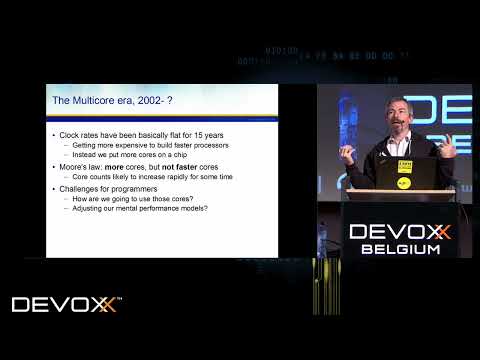
Cliff Click walks through a small performance example on a modern out-of-order CPU. He covers pipelining, ILP, CISC vs RISC, multicore, and why cache misses and the memory subsystem dominate performance.