image editing
 7:37
Satoshi Kon - Editing Space & Time
4M views • 12 years ago
Every Frame a Painting
A video essay from Every Frame a Painting on animator Satoshi Kon and his editing style, which distorts and warps space and time. It draws on his four features and one TV series.
 8:09
Google Earth’s Incredible 3D Imagery, Explained
3.1M views • 9 years ago
Nat and Friends
A short explainer from Nat and Friends on where Google Earth's 3D imagery comes from, how it is stitched together, and how often it is updated. It describes aircraft carrying camera rigs and photogrammetry that turns the photos into 3D models.
 37:20
But how do AI images and videos actually work? | Guest video by Welch Labs
2.2M views • 1 year ago
3Blue1Brown
A guest video by Welch Labs on 3Blue1Brown explaining how text-to-image and video models work. It covers CLIP, shared embedding spaces, diffusion models (DDPM, DDIM), conditioning, guidance and negative prompts.
 20:55
Why ChatGPT Can't Draw a Full Glass of Wine
6.3M views • 1 year ago
Alex O'Connor
Alex O'Connor shows that ChatGPT cannot draw a wine glass filled to the brim, and ties the failure to David Hume's missing shade of blue. It asks what the failure says about how image models learn.
 18:25
How Star Wars was saved in the edit
3.2M views • 8 years ago
RocketJump
A video essay on how the editors of Star Wars: A New Hope recut and rearranged the footage to rescue the film. It walks through specific changes that improved pacing and drama.
 30:53
I Saved a PNG Image To A Bird
2.1M views • 1 year ago
Benn Jordan
Benn Jordan's video about storing a PNG image in a living bird, a starling that learns to reproduce encoded sounds. It mixes ornithology, audio engineering, and data encoding.
 16:04
Genetic Engineering Will Change Everything Forever – CRISPR
30.8M views • 10 years ago
Kurzgesagt – In a Nutshell
Kurzgesagt's animated explainer on CRISPR gene editing, covering how the technology works and what it could mean for curing disease, designer babies and aging. It frames genetic engineering as an irreversible change coming to humanity.
 27:16
How Do Night Vision Goggles Work?
8.4M views • 3 years ago
Veritasium
Veritasium visits the US Navy's Crane facility to test top night vision goggles. It explains how image intensifier tubes and thermal or digital systems work and compares the generations of the technology.
 4:14
Computer Color is Broken
4.3M views • 11 years ago
minutephysics
MinutePhysics explains that computers store brightness nonlinearly, so blurring and blending colors in raw RGB gives wrong, dark results. It shows why mixed colors, such as in gradients, look off.
 8:42
Michael Bay - What is Bayhem?
3.3M views • 12 years ago
Every Frame a Painting
An Every Frame a Painting video essay on Michael Bay's style, 'Bayhem', covering his camera movement, composition, color and editing. It argues that even if you dislike his films, they teach something about visual perception.
 8:00
Edgar Wright - How to Do Visual Comedy
11.4M views • 12 years ago
Every Frame a Painting
An Every Frame a Painting video essay analysing how Edgar Wright creates visual comedy through framing, camera movement, editing, sound effects and music.
 4:42
Why Your Webcam Still SUCKS!
552K views • 6 years ago
Techquickie
A short Techquickie explainer on why laptop webcams are much worse than phone cameras. It covers sensor size, image processing, and the interface differences between laptops and phones, with input from a Logitech engineer.
 9:04
Jackie Chan - How to Do Action Comedy
25.4M views • 11 years ago
Every Frame a Painting
Every Frame a Painting analyzes how Jackie Chan stages action comedy, with nine principles such as starting from a disadvantage, using the environment, clear shots, and keeping action and reaction in the same frame.
 15:12
JPEG DCT, Discrete Cosine Transform (JPEG Pt2)- Computerphile
697K views • 11 years ago
Computerphile
Mike Pound explains the discrete cosine transform and how it underpins JPEG compression. It is part two of Computerphile's JPEG series.
 9:19
How to Understand What Black Holes Look Like
11M views • 7 years ago
Veritasium
Veritasium explains what a black hole should look like, using J.P. Luminet's 1979 work and a cardboard 3D model to show how light bends around it. It was made just as the first black hole image was released.
 4:17
The Hubble Ultra Deep Field in 3D
9.6M views • 17 years ago
Deep Astronomy
A short video built around an animation of the roughly 10,000 galaxies in the Hubble Ultra Deep Field, placed at their measured redshift distances. It gives a brief history of deep field images and ends with a 3D fly-through.
 23:32
The Solar Gravitational Lens will Map Exoplanets. Seriously.
582K views • 6 years ago
Launch Pad Astronomy
Explains the proposed NASA JPL plan to use the Sun as a gravitational lens, sending solar sail craft to its focal region to image an exoplanet's surface. It covers the distances involved, how imaging with the Sun would work and the mission design.
 12:04
Why Being Delusional is a Superpower
15.2M views • 6 years ago
Veritasium
Veritasium examines the role of luck in success, with simulations and examples showing how small advantages and chance can compound. It argues that top outcomes are disproportionately luck-driven while still crediting effort.
 21:15
The REAL Possibility of Mapping Alien Planets!
778K views • 4 years ago
PBS Space Time
PBS Space Time explains the proposal to use the Sun's gravity as a giant lens, sending a train of small light-sail spacecraft to the focal point roughly 550 AU out. It covers how such a telescope could image exoplanets in surprising detail and the engineering challenges involved.
 18:18
Hilbert's Curve: Is infinite math useful?
2.4M views • 9 years ago
3Blue1Brown
3Blue1Brown explains space-filling curves and the Hilbert curve, and how infinite mathematical constructions connect to finite, practical approximations. It touches on mapping between dimensions and sensory ideas.
 13:39
How is this Website so fast!?
2.4M views • 2 years ago
Wes Bos
Wes Bos breaks down the techniques behind the McMaster-Carr website's speed: server-rendered HTML, prefetching, CDN and service worker caching, preloading, critical CSS and fixed-size images. He also notes its old-school jQuery and YUI JavaScript.
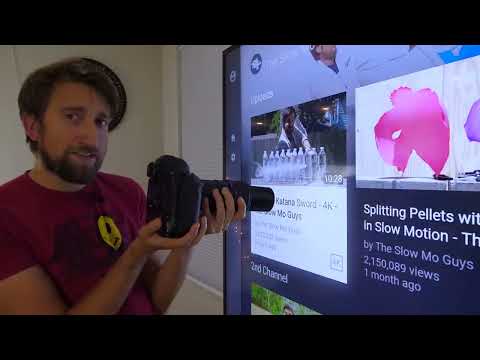 11:39
How a TV Works in Slow Motion - The Slow Mo Guys
45.7M views • 8 years ago
The Slow Mo Guys
The Slow Mo Guys film a TV and screens with a high-speed camera to show how displays build an image. The footage includes CRT-style scanning and how pixels light up over time.
 4:17
AI Learns Noise Filtering For Photorealistic Videos | Two Minute Papers #215
65K views • 8 years ago
Two Minute Papers
A Two Minute Papers episode on NVIDIA's recurrent denoising autoencoder, which cleans up noisy Monte Carlo path-traced image sequences. It shows how a neural network can produce usable renders from very few samples.
 38:26
Racing the Beam Explained - Atari 2600 CPU vs. CRT Television
400K views • 5 years ago
Retro Game Mechanics Explained
Retro Game Mechanics Explained shows how the Atari 2600 draws images with almost no video memory, by having the CPU race the CRT beam line by line. It walks through the techniques in detail.
 16:47
Lines of Light: How Analog Television Works
1.5M views • 9 years ago
Technology Connections
Technology Connections explains how analog television produced moving images without computers, covering scanning, CRTs and standards like NTSC and PAL. It is part of a series on analog TV.