information processing
 53:46
Dasher: information-efficient text entry
7K views • 19 years ago
Google TechTalks
David MacKay's 2007 Google Tech Talk presents Dasher, a text-entry system driven by continuous gestures and a language model, reaching about 35 words per minute with one finger and 25 hands-free. It explains the information-theory reasoning behind the design.
 23:51
Web 2.0 Expo NY: Clay Shirky (shirky.com) It's Not Information Overload. It's Filter Failure.
55K views • 18 years ago
O'Reilly
Clay Shirky argues at Web 2.0 Expo NY that the problem online is not information overload but filter failure. He says the real challenge is building better ways to filter and organize what we see.
 1:01:45
Information, Evolution, and intelligent Design - With Daniel Dennett
586K views • 11 years ago
The Royal Institution
Daniel Dennett gives a Royal Institution talk toward a unified theory of information, tying together evolution, learning and engineering. He argues that design can arise bottom-up through small steps without a designer.
 1:26:11
Succinct Data Structures
9K views • 12 years ago
Edward Kmett
Edward Kmett's 2013 talk at Prezi in Budapest on succinct data structures, which store data in close to the information-theoretic minimum space while supporting fast queries. It ties together the research and walks through his Haskell succinct library.
Topic match · Information theory & signal processing 1:03:40
David Kriesel: Traue keinem Scan, den du nicht selbst gefälscht hast
7M views • 11 years ago
media.ccc.de
David Kriesel's 31C3 talk, in German, on the discovery that Xerox scanner-copiers silently replace digits and letters in scanned documents. He explains how the bug stayed unnoticed in the wild for years.
Topic match · Information theory & signal processing 1:12:05
The Boring Company Information Session
448K views • 8 years ago
The Boring Company
A long information session where The Boring Company presents its vision for Loop, an underground high-speed transit system, and the traffic problems it aims to solve. It includes discussion of faster tunnel boring and electrification.
 1:03:44
CppCon 2015: Timur Doumler “C++ in the Audio Industry”
131K views • 11 years ago
CppCon
Timur Doumler's CppCon 2015 talk on how C++ is used in the audio industry. It covers the patterns and tools audio developers rely on, including handling real-time constraints.
Topic match · Information theory & signal processing 52:59
David Kriesel: Lies, damned lies and scans
58K views • 11 years ago
Free and Open Source Software Conference (FrOSCon) e.V.
David Kriesel's FrOSCon talk on how Xerox scancopiers, due to JBIG2 compression, silently replaced digits in scanned documents. He walks through how he discovered the bug and why it is so dangerous.
Topic match · Information theory & signal processing 57:21
An Observation on Generalization
210K views • 3 years ago
Simons Institute for the Theory of Computing
Ilya Sutskever gives a Simons Institute talk on why neural networks generalize, framing learning as finding short descriptions, like compression. It was part of the Large Language Models and Transformers program.
Topic match · Information theory & signal processing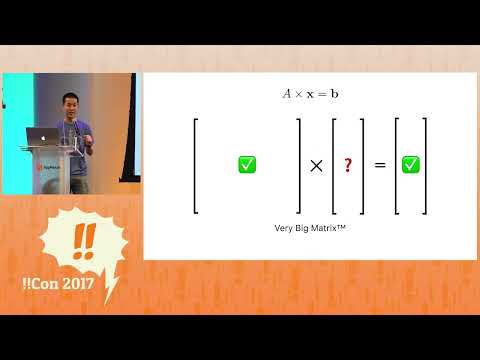 11:47
!!Con 2017: HDR Photography in Microsoft Excel?! by Kevin Chen
119K views • 9 years ago
Confreaks
A short conference talk from !!Con 2017 in which Kevin Chen explains the HDR imaging algorithm from a foundational paper, framing it as a system of linear equations, and implements it in a Microsoft Excel spreadsheet. No prior image processing knowledge is needed.
 25:52
Halide Talk
53K views • 12 years ago
Andrew Adams
Andrew Adams, a Halide developer, presents the Halide language for image processing and tensor computation. The talk explains the separation of algorithm from schedule with illustrated examples of parallelism, locality and redundancy tradeoffs.
 46:27
Sensor Fusion on Android Devices: A Revolution in Motion Processing
517K views • 16 years ago
Google TechTalks
David Sachs of InvenSense explains how gyroscopes, accelerometers and compasses work on their own and together, demonstrated on a modified Android handset. He covers sensor fusion algorithms and why rotation math such as Euler angles matters.
 17:01
Your Brain Hallucinates Your Conscious Reality | Anil Seth | TED
12M views • 9 years ago
TED
Neuroscientist Anil Seth argues in this TED talk that perception is a controlled hallucination: the brain constantly predicts the world and our shared agreement is what we call reality. He also touches on the construction of the self.
 31:06
Jim Keller - Moore's Law in the age of AI Chips
33K views • 6 years ago
Matroid
Jim Keller's talk at the 2020 Scaled Machine Learning conference on Moore's Law in the age of AI chips. He compares scalar, vector and GPU-style parallel approaches to computation.
 52:07
What Bodies Think About: Bioelectric Computation Outside the Nervous System - NeurIPS 2018
103K views • 7 years ago
The Artificial Intelligence Channel
Michael Levin's NeurIPS 2018 talk on bioelectric computation outside the nervous system, showing how cell electrical networks shape development and regeneration. It covers morphological information processing in living tissue.
 47:43
"Turning the database inside out with Apache Samza" by Martin Kleppmann
205K views • 12 years ago
Strange Loop Conference
Martin Kleppmann argues that databases are global shared mutable state and proposes treating them as an ever-growing log of immutable facts. Derived data such as caches, indexes and views is then built by stream processors like Apache Samza. The talk draws on Kafka and LinkedIn's experience with commit logs.
 24:44
ADL's Never Is Now 2019 | ADL International Leadership Award Presented to Sacha Baron Cohen
2.3M views • 6 years ago
Anti-Defamation League
Sacha Baron Cohen's speech accepting the ADL International Leadership Award, in which he criticizes social media companies for amplifying hate and propaganda. He argues that freedom of speech is not freedom of reach.
 1:00:52
Joscha: From Computation to Consciousness (31c3)
28K views • 11 years ago
Joscha Bach
Joscha Bach's 31c3 talk argues that the mind should be understood as an information-processing system and that even the physical universe can be seen as computational. It tours the philosophy underlying artificial intelligence and cognitive science.
 1:02:09
Seymour Cray's Only Surviving Talk: "Cray-1 Introduction" (1976, LANL)
59K views • 16 years ago
UC Berkeley Events
Seymour Cray's only surviving recorded talk, introducing the Cray-1 supercomputer in 1976. He describes the machine's design, including its vector architecture and cooling through the frame.
 31:44
The Value of Values with Rich Hickey
145K views • 14 years ago
InfoQ
Rich Hickey's JaxConf 2012 keynote examines what values are and why immutable values matter as information systems grow more complex and data gets bigger. It contrasts places with values and builds the case for immutability.
 59:56
AWS re:Invent 2018: Amazon DynamoDB Deep Dive: Advanced Design Patterns for DynamoDB (DAT401)
468K views • 7 years ago
Amazon Web Services
Rick Houlihan's AWS re:Invent 2018 deep dive on advanced DynamoDB design patterns. It covers index overloading, GSI sharding, composite keys, graph processing and transactions.
 22:56
We're building a dystopia just to make people click on ads | Zeynep Tufekci
771K views • 8 years ago
TED
Technosociologist Zeynep Tufekci argues that the machine-learning systems used to serve ads also decide what political and social information people see. She explains how opaque algorithms can nudge, segment and manipulate users, and warns that the real danger is powerful people using AI to control populations.
 39:33
Bret Victor - Media for Thinking the Unthinkable
33K views • 11 years ago
Colin McDonnell
Bret Victor's 2013 MIT Media Lab talk argues that the media we think with determine which thoughts are possible. He demos new representations for scientific papers, circuits, filters and signal processing.
 52:52
Google Developers Day US - Theorizing from Data
27K views • 19 years ago
GoogleDeveloperDay
Peter Norvig's 2007 Google talk on theorizing from data, covering what huge datasets can do for language understanding, translation, information extraction and inference. It argues that more data often beats cleverer models.
 59:34
There is No Algorithm for Truth - with Tom Scott
2.7M views • 7 years ago
The Royal Institution
Tom Scott's Royal Institution discourse on science communication in the age of social media, how recommendation algorithms shape popularity, and why view counts can matter more than truth. It includes a segment on parasocial relationships.
 9:05
Beware online "filter bubbles" | Eli Pariser
1.7M views • 15 years ago
TED
Eli Pariser's TED talk argues that personalized web services trap users in filter bubbles, limiting exposure to challenging information. He says this is bad for individuals and for democracy.
 59:13
AWS re:Invent 2019: [REPEAT 1] Amazon DynamoDB deep dive: Advanced design patterns (DAT403-R1)
115K views • 6 years ago
AWS Events
An AWS re:Invent 2019 session for advanced DynamoDB users on design patterns used by large customers, including Amazon retail. It covers GSI sharding, index overloading, graph processing, composite keys and transactional workflows.
 15:20
The thrilling potential of SixthSense technology | Pranav Mistry
5.5M views • 16 years ago
TED
Pranav Mistry demos SixthSense, a wearable device that projects information onto the physical world and lets people interact with data through gestures. He also shows a paper "laptop" and says he will open-source the software.
 58:42
Inbox Zero
511K views • 19 years ago
Google TechTalks
Merlin Mann's 2007 Google Tech Talk on Inbox Zero, covering Getting Things Done, why an empty inbox matters, and strategies for handling high-volume email. It is a talk on attention and processing mail rather than on emptying it for its own sake.
 33:32
Condition Systems in an Exceptional Language - Chris Houser
16K views • 10 years ago
ClojureTV
Chris Houser's Clojure/conj talk on why Clojure's exceptions destroy information as the stack unwinds, unlike Common Lisp's condition system, which can resume from the error site. He surveys the existing libraries that approximate conditions, explains why they don't compose with each other, and considers what a better design would look like.
 1:00:10
USA's Leading Dissident Voice | Noam Chomsky | Talks at Google
500K views • 9 years ago
Talks at Google
Noam Chomsky speaks at Google Cambridge in 2017 about his political development and the control of information and media. It is a wide-ranging talk with audience discussion.