large action model
 4:55
Miniatur Wunderland *** official video *** largest model railway / railroad of the world
27.8M views • 14 years ago
Miniatur Wunderland
The official tour video of Miniatur Wunderland in Hamburg, the world's largest model railway. It shows the 1,300 square meter layout with trains, aircraft, cars and ships moving around.
 8:25
Large Language Models from scratch
375K views • 4 years ago
Graphics in 5 Minutes
A short cartoon explaining how language models like ChatGPT work, from autocomplete and conditional probabilities to neural networks, gradient descent and backpropagation. It shows how networks act as universal function approximators.
 59:48
[1hr Talk] Intro to Large Language Models
4.3M views • 2 years ago
Andrej Karpathy
Andrej Karpathy gives a one-hour general-audience introduction to large language models, covering what they are, how they are trained, comparisons to operating systems, and security challenges such as jailbreaks.
 59:53
CppCon 2019: Chandler Carruth “There Are No Zero-cost Abstractions”
147K views • 7 years ago
CppCon
Chandler Carruth argues in a CppCon 2019 talk that C++ has no truly zero-cost abstractions. Using examples like unique_ptr, ABI constraints and compile-time costs, he shows that abstractions cost runtime, compile time or human effort.
 42:34
Hewitt, Meijer and Szyperski: The Actor Model (everything you wanted to know...)
131K views • 13 years ago
jasonofthel33t
A standing whiteboard conversation at Lang.NEXT 2012 among Carl Hewitt, Erik Meijer and Clemens Szyperski about the actor model. Hewitt, who originated the model, explains its foundations.
 35:32
Cheng Lou - On the Spectrum of Abstraction at react-europe 2016
63K views • 10 years ago
ReactEurope
Cheng Lou's react-europe 2016 talk lays out a mental framework for thinking about abstraction levels in JavaScript tooling, from Angular and Grunt to Webpack and React. It uses that framework to reason about the cost of abstractions and how to choose between competing solutions.
 4:34
This giant model stopped a terrible plan
10M views • 9 years ago
Tom Scott
Tom Scott tells how John Reber's plan to dam San Francisco Bay was disproved by the Army Corps of Engineers' giant hydraulic Bay Model in Sausalito. The model showed the plan would have been dangerously wrong.
 13:29
Infinite fractions and the most irrational number
658K views • 10 years ago
Mathologer
Mathologer uses continued fractions to show why the golden ratio is the most irrational number, comparing it with root 2, e and pi and pointing to where this shows up in nature.
 26:27
GitHub Actions Feels Bad
118K views • 2 years ago
fasterthanlime
A fasterthanlime video essay arguing that GitHub Actions is a poorly designed system, with a history of personal computing and CI, and a look at how it works behind the scenes. It is sponsored by Brilliant.
 17:11
$30,000,000 AI Is Hiding a Scam
4.9M views • 2 years ago
Coffeezilla
Coffeezilla investigates the company behind the Rabbit R1 AI gadget, alleging a shady history as a crypto and NFT startup and questioning its large action model claims.
 1:23:16
Learn Low Poly Modeling in Blender 2.9 / 2.8
2.1M views • 6 years ago
Imphenzia
Imphenzia's 83-minute tutorial covers the low poly modeling techniques he learned over five years of Blender use, with timestamps from navigation and extrusion onward. It uses Blender 2.83 with default keys.
 20:39
AI Language Models & Transformers - Computerphile
354K views • 7 years ago
Computerphile
Rob Miles explains on Computerphile how language models generate plausible text and how transformers improved on recurrent networks, with a look at what comes next.
 41:08
"Transactions: myths, surprises and opportunities" by Martin Kleppmann
84K views • 11 years ago
Strange Loop Conference
Martin Kleppmann's Strange Loop talk on database transactions, covering why they were dropped by NoSQL, their reputation for being slow, and newer algorithms that make serializable transactions perform and scale. It touches on consistency, linearizability and the CAP theorem.
 25:57
GPT3: An Even Bigger Language Model - Computerphile
446K views • 6 years ago
Computerphile
Rob Miles discusses GPT-3 on Computerphile, covering how scaling parameters kept improving results over GPT-2 and how the model nearly learned arithmetic without anyone knowing exactly how.
 9:04
Jackie Chan - How to Do Action Comedy
25.4M views • 11 years ago
Every Frame a Painting
Every Frame a Painting analyzes how Jackie Chan stages action comedy, with nine principles such as starting from a disadvantage, using the environment, clear shots, and keeping action and reaction in the same frame.
 51:40
Domain Modeling Made Functional - Scott Wlaschin
71K views • 9 years ago
NDC Conferences
Scott Wlaschin's NDC talk on using statically typed functional programming, F# in particular, to model a business domain. Types are used to represent the domain precisely and to encode business rules so that illegal states cannot be built, with the compiler acting as an instant unit test.
 40:27
"Finding bugs without running or even looking at code" by Jay Parlar
42K views • 7 years ago
Strange Loop Conference
Jay Parlar's Strange Loop talk shows how model checkers such as Alloy can find complex bugs in a system's design without running or reading any code. He walks through modeling architectures and checking every possible sequence of operations, including a real security bug and a UI feature-interaction bug.
 1:29:53
Tesla Model 3: Inside & Out - Autoline After Hours 417
331K views • 8 years ago
Autoline Network
An Autoline After Hours episode with teardown expert Sandy Munro and a panel of auto journalists. It covers his Tesla Model 3 teardown, including the battery, drive modules, build quality and manufacturing automation.
 39:43
Do we need Attention? - Linear RNNs and State Space Models (SSMs) for NLP
35K views • 3 years ago
Sasha Rush
Sasha Rush surveys linear RNNs and state space models as replacements for attention in transformer-style models, in a talk for MLSys. It covers the foundational preliminaries and predates Mamba.
 1:57:45
The spelled-out intro to language modeling: building makemore
1.3M views • 4 years ago
Andrej Karpathy
Andrej Karpathy builds a bigram character-level language model from scratch, introducing torch.Tensor and the framework of training, sampling and loss evaluation. It is the first step toward a GPT-style Transformer in his makemore series.
 7:42
Extremely Large Numbers 1 - Introduction
20K views • 11 years ago
Giroux Studios
The first video in a series on extremely large numbers, introducing the topic with examples. Later parts go deep into the fast-growing hierarchy.
 6:26
Games Should Not Cost $60 Anymore - Inflation, Microtransactions, and Publishing - Extra Credits
678K views • 8 years ago
Extra Credits
Extra Credits explains from a game developer's perspective why AAA games have stayed at $60 despite inflation, and how that pressure drives DLC, microtransactions and loot boxes.
 12:08
Tesla Model 3's motor - The Brilliant Engineering behind it
8M views • 5 years ago
Sabin Civil Engineering
An engineering explainer on why Tesla abandoned the induction motor for the Model 3 and used an IPM-SynRM design. It covers the reluctance torque and permanent magnet principles behind the choice.
 16:04
Jonathan Diegelman - Modeling Spacecraft Separation Dynamics in Julia
12K views • 5 years ago
The Julia Programming Language
A JuliaCon talk by a NASA Launch Services Program engineer on modeling spacecraft separation dynamics in Julia. He describes replacing a Simulink-based workflow for checking launch vehicle separation requirements with Julia and ModelingToolkit, with large speedups and much shorter code.
 7:36
Tearing Into Tesla's Model 3
762K views • 8 years ago
Autoline Network
Autoline's John McElroy visits Sandy Munro's shop, where a Tesla Model 3 is being prepared for a teardown benchmarking study. Munro, with deep design and manufacturing experience, points out issues he dislikes about the car's build.
 25:06
"Making Impossible States Impossible" by Richard Feldman
63K views • 10 years ago
elm-conf
Richard Feldman's elm-conf talk on designing models so that bugs from impossible application states cannot occur, using Elm's compiler and types. It demonstrates techniques for making invalid states unrepresentable.
 1:31:13
A Hackers' Guide to Language Models
580K views • 3 years ago
Jeremy Howard
Jeremy Howard's 90-minute practical tour of language models. It covers how they work, GPT-4's capabilities and limits, using the OpenAI API, code writing, data analysis and fine-tuning.
 1:06:44
01 - Course Introduction & Relational Model (CMU Databases Systems / Fall 2019)
248K views • 7 years ago
CMU Database Group
The first lecture of Andy Pavlo's CMU 15-445 Intro to Database Systems (Fall 2019), covering course introduction and the relational model.
 50:49
Domain Modeling Made Functional - Scott Wlaschin - KanDDDinsky 2019
74K views • 6 years ago
KanDDDinsky
Scott Wlaschin shows how statically typed functional languages, using F# examples, can model a business domain so that invalid states cannot be represented. The type system acts almost like an instant unit test at compile time.
 17:52
Training AI Without Writing A Reward Function, with Reward Modelling
259K views • 6 years ago
Robert Miles AI Safety
Robert Miles explains reward modelling, in which an AI learns what humans want from their preference comparisons instead of a hand-written reward function. He walks through the 2017 paper on deep reinforcement learning from human preferences.
 25:01
Dan Abramov The wet codebase
27K views • 5 years ago
eswarnichtsmehrfrei
Dan Abramov's talk on the wet codebase, using visualizations to show how removing all duplication too early produces wrong abstractions that are hard to unwind.
 1:06:45
Let's #TalkConcurrency Panel Discussion with Sir Tony Hoare, Joe Armstrong, and Carl Hewitt
13K views • 7 years ago
Erlang Solutions
A panel with Tony Hoare, Joe Armstrong and Carl Hewitt, hosted by Francesco Cesarini, on the history and future of concurrency. The three creators of CSP, Erlang and the actor model discuss their differing approaches.
 1:08:34
Who Killed Captain Alex: Uganda's First Action Movie (English Subtitles & Video Joker) - Wakaliwood
10.6M views • 11 years ago
Official Wakaliwood
Who Killed Captain Alex is Uganda's first action movie, made for under $200 by Nabwana IGG in Wakaliga. This version has English subtitles and a video joker (VJ Emmie) providing running commentary.
 29:51
Keynote: What is a Component (and Why)? - Luke Wagner, Distinguished Engineer, Fastly
7K views • 3 years ago
The Linux Foundation
Luke Wagner of Fastly explains what a WebAssembly component is, how it relates to familiar concepts, and what the Component Model enables. It emphasizes security, composability and modularity.
 35:33
Visualising software architecture with the C4 model - Simon Brown, Agile on the Beach 2019
553K views • 7 years ago
Agile on the Beach
Simon Brown's Agile on the Beach 2019 talk presents the C4 model, a lightweight approach to diagramming software architecture with a shared vocabulary and simple notation.
 5:00
Touché: Enhancing Touch Interaction on Humans, Screens, Liquids, and Everyday Objects
887K views • 14 years ago
DisneyResearchHub
Disney Research presents Touche, a swept frequency capacitive sensing technique that recognizes complex hand and body configurations, and adds touch sensitivity to humans, liquids and everyday objects.
 16:43
The Equation That Explains (Nearly) Everything!
1.6M views • 4 years ago
PBS Space Time
PBS Space Time explains the Standard Model Lagrangian, the single equation encapsulating the particle physics theory, and visualizes what its terms mean.
 1:00:16
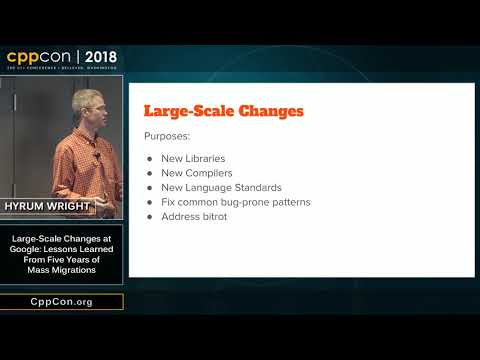
CppCon 2018:H. Wright “Large-Scale Changes at Google: Lessons Learned From 5 Yrs of Mass Migrations”
16K views • 7 years ago
CppCon
Hyrum Wright shares lessons from five years of mass code migrations in Google's huge C++ codebase. He covers why to migrate, how hard it really is, and how Google updates core libraries and their users continually.
 7:26
Teletype Model 19 - Part 1: A Teletype Arrives for Restoration
33K views • 8 years ago
CuriousMarc
CuriousMarc inspects a newly arrived Teletype Model 19, an early military unit built around a Model 15 keyboard and printer, after an initial rough cleaning. It is the first part of a restoration series and touches on 5-bit Baudot code.
 43:30
Are we stuck with the same Desktop UX forever? | Ubuntu Summit 25.10
509K views • 11 months ago
Canonical Ubuntu
Scott Jenson, a veteran UX designer formerly at Apple and Google, argues that the 'UX/UI' split pits programmers against designers and narrows ambition in open source. He makes the case that desktop UX has stagnated and that open source projects could lead experimentation beyond current interaction models.