lens
 23:32
The Solar Gravitational Lens will Map Exoplanets. Seriously.
582K views • 6 years ago
Launch Pad Astronomy
Explains the proposed NASA JPL plan to use the Sun as a gravitational lens, sending solar sail craft to its focal region to image an exoplanet's surface. It covers the distances involved, how imaging with the Sun would work and the mission design.
 21:15
The REAL Possibility of Mapping Alien Planets!
778K views • 4 years ago
PBS Space Time
PBS Space Time explains the proposal to use the Sun's gravity as a giant lens, sending a train of small light-sail spacecraft to the focal point roughly 550 AU out. It covers how such a telescope could image exoplanets in surprising detail and the engineering challenges involved.
 29:52
Turning Earth Into a Telescope | The Terrascope
613K views • 7 years ago
Cool Worlds
David Kipping presents his proposed Terrascope, a telescope that uses Earth's atmosphere as a lens to achieve enormous magnification. He covers the history of telescopes and his path to the idea, plus Sol-scope and Jupiter-scope variants.
 18:31
Fourier Optics used for Optical Pattern Recognition
103K views • 6 years ago
Huygens Optics
Huygens Optics explains the Fourier transform and shows how a lens performs one optically. A DLP projector is used as a Fourier filter to do simple pattern recognition on lithographic character patterns.
 9:19
How to Understand What Black Holes Look Like
11M views • 7 years ago
Veritasium
Veritasium explains what a black hole should look like, using J.P. Luminet's 1979 work and a cardboard 3D model to show how light bends around it. It was made just as the first black hole image was released.
 17:17
The Longest-Running Evolution Experiment
7M views • 5 years ago
Veritasium
Veritasium visits Richard Lenski's lab to explain the decades-long E. coli evolution experiment, which asks how repeatable evolution is and shows bacteria evolving to use a new food source.
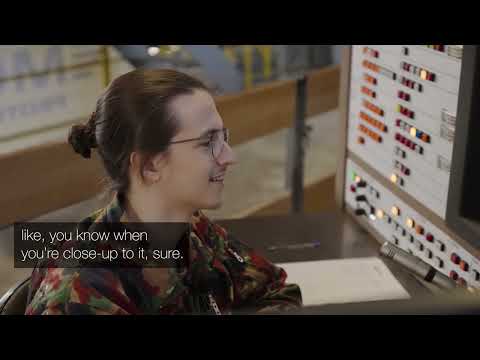 4:40
This 1970s tank simulator drives through a tiny world
12M views • 4 years ago
Tom Scott
Tom Scott visits the Swiss Military Museum to see the last surviving 1970s tank-driving simulator. It uses a real camera moving over a miniature model landscape rather than any computer graphics.
Topic match · VR, AR & spatial computing 21:25
Gimbal UFO - A New Analysis
208K views • 4 years ago
Mick West
Mick West analyzes the Navy's Gimbal UFO video and gives four checkable observations suggesting it is an infrared glare that appears to rotate because the camera rotates while tracking. He argues the object is likely a hot craft hidden behind the glare.
 12:21
What If Dark Matter Is Just Black Holes?
988K views • 5 years ago
PBS Space Time
PBS Space Time asks whether dark matter could be made of primordial black holes. It walks through the observational constraints that limit this idea.
 11:32
The Internet is Worse Than Ever – Now What?
9.1M views • 2 years ago
Kurzgesagt – In a Nutshell
A Kurzgesagt video arguing that social media's problem is information flooding and tribal polarization. It suggests a return to smaller online communities and more in-person interaction.
 11:33
Light Waves Visualized using Photon Sieves.
69K views • 6 years ago
Huygens Optics
Huygens Optics shows how DIY photon sieves shape a laser's wave front, explaining how they differ from zone plates and how aperture count affects the focal point, with time-resolved visualizations of the diffraction.
 5:51
Corruption is Legal in America
2.3M views • 11 years ago
RepresentUs
A short RepresentUs explainer arguing that US politics is shaped by money, citing the Gilens and Page Princeton study on how little average citizens influence policy.
 13:56
Understanding the Russian mindset
994K views • 12 years ago
CaspianReport
CaspianReport explainer arguing that Russia's geography, especially its vast size and indefensible Moscow core, shapes its political behavior. It frames Russian security thinking through the lens of geographic determinism.