linear algebra
 9:52
Vectors | Chapter 1, Essence of linear algebra
13M views • 10 years ago
3Blue1Brown
The first chapter of 3Blue1Brown's Essence of Linear Algebra series, introducing vectors with animated geometric visuals. It begins a series that builds intuition for linear algebra from the basics.
 5:09
Essence of linear algebra preview
2.8M views • 10 years ago
3Blue1Brown
A five-minute preview of 3Blue1Brown's Essence of Linear Algebra series, which uses animation to build geometric intuition for topics from a standard linear algebra course.
 39:49
Lec 1 | MIT 18.06 Linear Algebra, Spring 2005
4.9M views • 17 years ago
MIT OpenCourseWare
The first lecture of Gilbert Strang's MIT 18.06 Linear Algebra course, covering the geometry of linear equations. It opens a full 35-lecture university course.
 17:16
Eigenvectors and eigenvalues | Chapter 14, Essence of linear algebra
6.4M views • 10 years ago
3Blue1Brown
3Blue1Brown's chapter on eigenvectors and eigenvalues in the Essence of Linear Algebra series. It builds a visual intuition for what they mean, why an eigenbasis is useful, and ends with a puzzle.
 10:03
The determinant | Chapter 6, Essence of linear algebra
5M views • 10 years ago
3Blue1Brown
A 10-minute 3Blue1Brown chapter explaining the determinant as the factor by which a linear transformation scales area or volume. It builds the idea geometrically with animations before any formulas.
 1:37:22
Siggraph2019 Geometric Algebra
87K views • 7 years ago
Bivector
A SIGGRAPH 2019 course on geometric algebra. Charles Gunn gives an intro, then Steven De Keninck gives a programmer-focused course with live examples in ganja.js.
 44:23
A Swift Introduction to Geometric Algebra
1.1M views • 6 years ago
sudgylacmoe
An animated introduction to geometric algebra, presented as a language that can describe most of physics. It was made with manim and covers multivectors and how they generalize familiar tools like cross products and quaternions.
 1:20:33
Lecture 1 | Convex Optimization I (Stanford)
753K views • 18 years ago
Stanford
The introductory lecture of Stephen Boyd's Stanford Convex Optimization I course (EE 364A). It outlines convex sets, functions and problems, and the course's coverage of least-squares, linear and semidefinite programming, duality and interior-point methods.
Topic match · Pure mathematics 1:03:34
Simon Peyton Jones - Linear Haskell: practical linearity in a higher-order polymorphic language
19K views • 8 years ago
Curry On!
Simon Peyton Jones presents linear types for Haskell, showing how practical linearity can fit into a higher-order polymorphic language. The talk covers motivations such as resource handling and relates the ideas to Rust.
 1:04:35
The Algebra of Algebraic Data Types
27K views • 13 years ago
London Haskell
A London Haskell talk on the algebra of algebraic data types, showing how sum and product types behave like arithmetic. It frames types as numbers obeying algebraic laws.
 51:16
Why can't you multiply vectors?
524K views • 3 years ago
Freya Holmér
Freya Holmer's Dutch Game Day 2023 talk asking why vectors can't be multiplied, building from complex numbers to a single axiom and arriving at geometric algebra, quaternions and multivectors.
Topic match · Pure mathematics 19:12
Taking Vector Transposes Seriously | Jiahao Chen | JuliaCon 2017
7K views • 9 years ago
The Julia Programming Language
Jiahao Chen's JuliaCon 2017 talk argues that vector transposes should be taken seriously in type systems and linear algebra libraries. It explains why treating vectors as matrices causes trouble in languages.
Topic match · Pure mathematics 30:55
[JSConfUS 2013] Steven Wittens: Making WebGL Dance
56K views • 13 years ago
JSConf
Steven Wittens' JSConf US 2013 talk on drawing with WebGL, using animated visuals to walk through vectors, matrices and the rendering pipeline. Despite the title, it works as a visual primer on the linear algebra behind 3D graphics.
Topic match · Pure mathematics 1:28:23
Quantum Computing for Computer Scientists
2.2M views • 8 years ago
Microsoft Research
An 88-minute Microsoft Research talk that explains how quantum computers beat classical ones using basic linear algebra, qubits, superposition and gates. It works through the Deutsch oracle problem and ends with entanglement, teleportation and a live demo.
 46:06
Lower Latency Graph Queries in Cypher with Redis GraphRoi Lipman, Redis LabsTim Davis, Texas A&M U
3K views • 8 years ago
Redis
Redis Labs and Tim Davis present RedisGraph, which uses GraphBLAS to treat graph queries in Cypher as sparse linear algebra for lower latency.
 5:56
Special Topics - The Kalman Filter (1 of 55) What is a Kalman Filter?
660K views • 11 years ago
Michel van Biezen
The first video in a 55-part series by Michel van Biezen that introduces the Kalman filter and builds from the rationale through algebraic examples to the full matrix treatment. The videos are short, blackboard-style lectures.
Topic match · Pure mathematics 1:06:08
Scaling the Linear Sync Engine
37K views • 3 years ago
Linear
A Linear engineer talks about scaling the company's sync engine, which keeps client data local and synchronized. It follows an earlier talk on the same system.
 39:43
Do we need Attention? - Linear RNNs and State Space Models (SSMs) for NLP
35K views • 3 years ago
Sasha Rush
Sasha Rush surveys linear RNNs and state space models as replacements for attention in transformer-style models, in a talk for MLSys. It covers the foundational preliminaries and predates Mamba.
 30:41
Linear Book Scanner
408K views • 13 years ago
Google TechTalks
Google engineer Dany Qumsiyeh presents a prototype automatic, non-destructive book scanner that turns pages and captures high-resolution images, built in Google's workshops. The talk includes a live demo and a short technical overview.
 23:29
How Imaginary Numbers Were Invented
22.7M views • 5 years ago
Veritasium
Veritasium tells the history of how imaginary numbers arose from the quest for a general solution to the cubic equation, including the duels and secrecy among Renaissance mathematicians. It argues math had to give up the requirement that it mirror reality.
Topic match · Pure mathematics 45:55
Turning Waves Into Particles
194K views • 1 year ago
Huygens Optics
Huygens Optics explores the idea that space is a non-linear elastic medium, and uses simulations to show how wave energy might be confined locally into particle-like objects. It touches on inertia, the Schwinger limit and the vacuum as a medium.
 6:39
Conventional Keyboards Are STAGGERINGLY STUPID!
209K views • 6 years ago
Ben Vallack
Ben Vallack compares finger movement on a staggered keyboard with an ortholinear grid keyboard, using an Anne Pro 2 and a ZSA Planck EZ. He argues the stagger forces awkward finger motion.
 1:35
XRS-2200 Linear Aerospike Engine Test fire at NASA Stennis Space Center (SSC)
1.5M views • 14 years ago
Barrel Roll
A short test firing of the XRS-2200 linear aerospike engine at NASA Stennis Space Center, which was designed for the cancelled X-33 VentureStar. The engine is shown at roughly 80 percent of max thrust.
 21:58
Group theory, abstraction, and the 196,883-dimensional monster
3.8M views • 6 years ago
3Blue1Brown
3Blue1Brown introduces group theory and abstract groups, then builds toward classification of finite simple groups and the enormous Monster group with its 196,883 dimensions.
Topic match · Pure mathematics 32:55
Neom - The Line - The Rise and Fall of Saudi Arabia's Linear City.
3.2M views • 2 years ago
Patrick Boyle
Patrick Boyle's deadpan account of Saudi Arabia's Neom and The Line megaproject, a planned 170 km linear city that has been scaled back to a fraction of its size. He covers the feasibility problems and the financing.
 1:16:07
React Helsinki February 2020
42K views • 6 years ago
Fraktio
React Helsinki meetup recording featuring a talk on lessons with Apollo GraphQL and Linear co-founder Tuomas Artman on real-time sync for web apps. The sync talk explains Linear's local-first architecture.
 22:22
Some light quantum mechanics (with minutephysics)
2.2M views • 9 years ago
3Blue1Brown
3Blue1Brown, in collaboration with minutephysics, introduces the math of superposition and quantum states using polarized light. It builds up the quantum behavior of photons as a simple counting and probability problem.
 14:27
All the Numbers - Numberphile
1.8M views • 7 years ago
Numberphile
Matt Parker talks Numberphile through the different kinds of numbers: algebraic, transcendental, computable, normal, and beyond. It shows how few numbers we can actually name or describe.
Topic match · Pure mathematics 40:39
Category Theory in Life - Eugenia Cheng
113K views • 9 years ago
Lambda World
Eugenia Cheng gives the opening keynote at Lambda World 2017, presenting category theory as very abstract algebra whose abstraction gives it broad applicability. She applies it to everyday questions including privilege and prejudice.
Topic match · Pure mathematics 41:06
"Unison: a new distributed programming language" by Paul Chiusano
45K views • 7 years ago
Strange Loop Conference
Paul Chiusano's Strange Loop 2019 talk introduces Unison, an open-source functional language for distributed, elastic systems. It covers content-addressed code identified by hashes of the syntax tree, a codebase manager, and algebraic effects called abilities.
 11:47
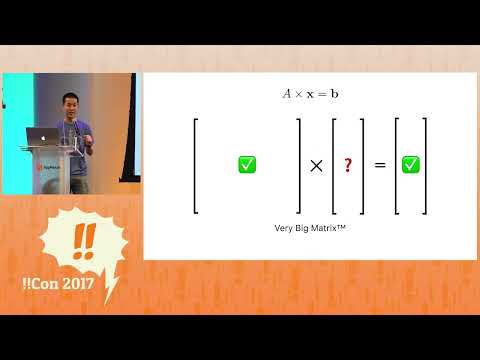
!!Con 2017: HDR Photography in Microsoft Excel?! by Kevin Chen
119K views • 9 years ago
Confreaks
A short conference talk from !!Con 2017 in which Kevin Chen explains the HDR imaging algorithm from a foundational paper, framing it as a system of linear equations, and implements it in a Microsoft Excel spreadsheet. No prior image processing knowledge is needed.
 41:08
"Transactions: myths, surprises and opportunities" by Martin Kleppmann
84K views • 11 years ago
Strange Loop Conference
Martin Kleppmann's Strange Loop talk on database transactions, covering why they were dropped by NoSQL, their reputation for being slow, and newer algorithms that make serializable transactions perform and scale. It touches on consistency, linearizability and the CAP theorem.
 40:19
Physics in Clojure - Colin Smith
13K views • 9 years ago
ClojureTV
Colin Smith introduces Structure and Interpretation of Classical Mechanics and his Clojure port, sicmutils. He shows how higher-order functions and a symbolic algebra system can represent Lagrangian mechanics.
 55:02
GradIEEEnt half decent: The hidden power of imprecise lines
391K views • 3 years ago
suckerpinch
Tom 7 (suckerpinch) delivers a long, comedic digression on gradient descent and floating-point imprecision. He shows how rounding behavior can supply the nonlinearity needed to build a neural network.
 4:21
An elevator that actually goes sideways
4.3M views • 9 years ago
Tom Scott
Tom Scott visits ThyssenKrupp's test tower in Rottweil to see the Multi, a rope-free elevator that uses linear motors to move cabins sideways as well as vertically.
 19:42
But what is the Fourier Transform? A visual introduction.
12.6M views • 8 years ago
3Blue1Brown
3Blue1Brown's animated visual introduction to the Fourier Transform, showing how a signal breaks into frequency components.
Topic match · Pure mathematics 9:18
The Most IMPORTANT Video You'll Ever See (part 1 of 8)
5.4M views • 19 years ago
wonderingmind42
Part 1 of a lecture by physicist Albert Bartlett on the exponential function and its consequences for population growth, resource use and energy. It argues that steady growth rates quickly lead to enormous quantities.
Topic match · Pure mathematics 17:05
The essence of calculus
11.9M views • 9 years ago
3Blue1Brown
The first video of 3Blue1Brown's Essence of Calculus series, which builds toward integrals, derivatives, and the fundamental theorem of calculus from a simple geometry question. It aims to make viewers feel they could have invented calculus themselves.
Topic match · Pure mathematics 46:46
Category Theory 1.1: Motivation and Philosophy
394K views • 10 years ago
Bartosz Milewski
The first lecture in Bartosz Milewski's category theory series for programmers. It covers the motivation and philosophy behind category theory and why composition matters for handling complexity.
Topic match · Pure mathematics 11:15
The hardest problem on the hardest test
16.5M views • 8 years ago
3Blue1Brown
3Blue1Brown walks through a very hard Putnam competition problem and its elegant solution, emphasizing the visual intuition and the thought process behind solving it.
Topic match · Pure mathematics