memory performance
 35:33
How does Computer Memory Work? 💻🛠
5.5M views • 4 years ago
Branch Education
A 36-minute animated deep dive from Branch Education into how DRAM works. It shows how memory connects to the CPU and how billions of bits are stored in nanoscale capacitor cells. It also covers why DRAM sits between SSDs and the processor.
 49:03
Apollo Core Rope Memory (Apollo Guidance Computer Part 30)
759K views • 3 years ago
CuriousMarc
CuriousMarc's Apollo Guidance Computer restoration series looks at core rope memory, the ROM that held the Moon landing programs. Mike Stewart builds a custom reader to recover lost AGC programs.
 1:38:57
Carbon Language Successor Strategy: From C++ Interop to Memory Safety - Chandler Carruth - CppNow 23
24K views • 3 years ago
CppNow
Chandler Carruth's CppNow 2023 talk describes Carbon as a successor language to C++ rather than a superset, focusing on C++ interop and a path to memory safety in large existing codebases. It explains why Carbon takes a different approach from Cpp2 and Circle.
 48:30
What's a Memory Allocator Anyway? - Benjamin Feng
89K views • 6 years ago
Zig SHOWTIME
A Zig SHOWTIME talk by Benjamin Feng on what a memory allocator is, followed by an interview. It covers allocation strategies and different allocator types in Zig.
 1:01:09
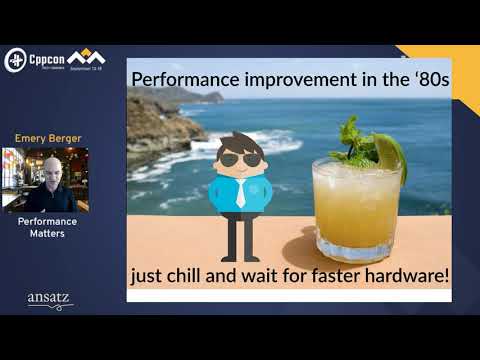
Plenary: Performance Matters - Emery Berger - CppCon 2020
32K views • 6 years ago
CppCon
Emery Berger's CppCon 2020 plenary on why performance is hard on modern hardware after the end of Dennard scaling. It covers benchmarking pitfalls and introduces new profiling tools for finding real bottlenecks.
 3:48
Magnus Carlsen's Mind-Blowing Memory! World Chess Champion tested
4.8M views • 5 years ago
chess24
Grandmaster David Howell tests Magnus Carlsen by showing him chess positions and asking which famous games they come from. Carlsen recognizes many almost instantly.
 22:41
"Clean" Code, Horrible Performance
1.2M views • 3 years ago
Molly Rocket
Casey Muratori shows how typical 'clean code' object-oriented patterns can cost large factors in performance. He benchmarks them against simpler data-oriented code.
 20:49
How Prince of Persia Defeated Apple II's Memory Limitations | War Stories | Ars Technica
1.5M views • 6 years ago
Ars Technica
In an Ars Technica War Stories episode, Prince of Persia creator Jordan Mechner describes how he made the game on the Apple II, fighting hardware memory limits and the platform's decline. It covers the rotoscoped animation and the engineering tricks involved.
 18:20
FIXING the ENTIRE SM64 Source Code (INSANE N64 performance)
3.2M views • 4 years ago
Kaze Emanuar
Kaze Emanuar explains how he rewrote and optimized the Super Mario 64 source code so it runs far faster on real N64 hardware. He covers performance bottlenecks and fixes in detail for his ROM hacks.
 2:50:14
Simple Code, High Performance
463K views • 5 years ago
Molly Rocket
Casey Muratori's University of Twente guest lecture is a case study in how straightforward code can cut thousands of lines and tens of seconds of runtime down to a few dozen lines running in under a second. It uses concrete examples to show why software is often an order of magnitude slower than it should be.
 1:04:48
"Performance (Really) Matters" with Emery Berger
7K views • 6 years ago
Association for Computing Machinery (ACM)
Emery Berger argues that performance is hard to measure and deliver on modern systems, showing how code layout and link order can swamp optimization effects. He presents tools that evaluate performance more reliably.
 29:51
Refterm v2 - Resource usage, binary splat, glyph sizing, and more
68K views • 5 years ago
Molly Rocket
Casey Muratori follows up his refterm proof-of-concept, a GPU-based terminal renderer, with a second part covering memory usage, glyph sizing and correct Unicode and VT handling. It is built to show that a terminal can be fast and correct without heroic effort.
 1:22:21
Introducing a Memory-Safe Successor Language in Large C++ Code Bases - John McCall - CppNow 2023
18K views • 3 years ago
CppNow
John McCall of Apple's Swift team presents at CppNow 2023 on introducing a memory-safe successor language into large C++ code bases. He argues incremental improvement of C++ hits hard limits and explains Swift's C++ interoperability for gradual migration.
 39:03
RustConf 2020 - Closing Keynote by Siân Griffin
10K views • 6 years ago
Rust Programming Language
RustConf 2020 closing keynote by Sian Griffin that dives into Pokemon Blue glitches, notably Missingno and arbitrary-code-execution tricks. It uses them to explain how memory unsafety works and how memory-safe languages like Rust prevent such bugs.
 11:03
Resident Evil Village PC DRM: Cracked Code Really Does Run Better - Confirmed
197K views • 5 years ago
Digital Foundry
Digital Foundry investigates why Resident Evil Village on PC runs worse with Capcom's Denuvo DRM than a cracked version. They benchmark and confirm performance and frame-pacing differences.
 38:20
Twitter and Visual Studio Rant
158K views • 6 years ago
Molly Rocket
Casey Muratori responds on-stream to a dismissive Twitter post by demonstrating how slow Visual Studio's startup and debugger watch window are, comparing it to much older software and machines. It is a long rant about software performance and bloat.
 29:47
The Truth about Rust/WebAssembly Performance
218K views • 3 years ago
Greg Johnston
Leptos creator Greg Johnston examines Rust/WebAssembly frontend frameworks against JavaScript frameworks using the JS framework benchmark. He argues that WASM is no longer too slow for DOM-heavy rendering.
 30:12
Casey Muratori | Smart-Pointers, RAII, ZII? Becoming an N+2 programmer
162K views • 2 years ago
xDahl
Casey Muratori argues against smart pointers and RAII, advocating grouped-element thinking, zero-is-initialization and stubs as better ways to structure memory and handle errors.
 40:34
Charlie Marsh: uv: An Extremely Fast Python Package Manager
107K views • 2 years ago
Jane Street
Charlie Marsh of Astral explains how uv, a Rust Python package manager, got so fast. He covers allocators, concurrency, zero-copy tricks and the challenges of Python packaging.
 48:04
"NTFS really isn't that bad" - Robert Collins (LCA 2020)
161K views • 6 years ago
linux.conf.au
Robert Collins explains why rustup installs were painfully slow on Windows and how changes to rustup and Windows cut install time from 3m30s to 14s. The talk covers NTFS, small files and the cost of antivirus hooks on file close.
 1:24:39
Mojo Lang - Tomorrow's High Performance Python? (with Chris Lattner)
64K views • 2 years ago
Developer Voices
Developer Voices interviews Chris Lattner about Mojo, a Python-compatible language aimed at CPU/GPU performance built on LLVM and MLIR. It covers performance features, the type system and why Mojo uses Python syntax.
 46:00
Scaling ZFS for NVMe - Allan Jude - EuroBSDcon 2022
14K views • 4 years ago
EuroBSDCon
Allan Jude of Klara presents work on making ZFS scale on fast NVMe storage, covering fixes to the TaskQueue interface and removal of bottlenecks. The talk was given at EuroBSDcon 2022 and describes raising write throughput from about 3 to over 7 GB/sec.
 18:41
Refterm Lecture Part 1 - Philosophies of Optimization
93K views • 5 years ago
Molly Rocket
Casey Muratori's first refterm lecture lays out philosophies of optimization, distinguishing optimization from non-pessimization, which means avoiding needless work. It uses his fast terminal renderer project to show how fast computers really are.
 51:04
[EPILEPSY WARNING] How fast should an unoptimized terminal run?
193K views • 5 years ago
Molly Rocket
Casey Muratori shows how fast a terminal renderer can run, building a simple reference renderer that handles Unicode and colored text far quicker than Windows Terminal. He argues that common excuses for slow terminals do not hold up.
 10:30
Dani DaOrtiz at Fool US 2022 (the act that Penn and Teller didn’t even try to figure out.)
3.6M views • 4 years ago
dani daortiz
A ten-minute card-magic act by Dani DaOrtiz performed on Penn & Teller: Fool Us in 2022. It is built on timing, misdirection and psychology, and the method defeated the show's hosts.
 14:27
The Biggest Myth In Education
15.5M views • 5 years ago
Veritasium
Veritasium debunks the idea of learning styles, such as being a visual learner, with an interview with Daniel Willingham and a memory experiment. It argues that a multimodal approach helps everyone.
 34:55
"Outperforming Imperative with Pure Functional Languages" by Richard Feldman
98K views • 5 years ago
Strange Loop Conference
Richard Feldman explains how pure functional languages can match or beat imperative ones on performance. Compilers can turn immutable code into in-place mutation, avoiding naive copying. The talk draws on his work on the Roc language.
 21:42
Future Computers Will Be Radically Different (Analog Computing)
13.2M views • 4 years ago
Veritasium
Veritasium explains why analog computing may suit AI workloads, covering old analog computers, The Analog Thing and Mythic's analog chips that use flash memory for neural network inference. It argues digital hardware is hitting limits.
 46:40
Andrew Kelley: A Practical Guide to Applying Data Oriented Design (DoD)
415K views • 2 years ago
ChimiChanga
Andrew Kelley, creator of Zig, presents practical data-oriented design techniques for shrinking memory footprint and making programs cache friendly. He ends with a case study of how these ideas sped up the Zig compiler.
 13:05
Vertical Bifacial Solar Panel Performance Results Part 1
937K views • 2 years ago
Projects With Everyday Dave
A hobbyist compares vertical bifacial solar panels against south-facing angled panels using winter production results. It tests whether the usual mounting approach is actually best.
 1:05:59
Modern C and What We Can Learn From It - Luca Sas [ ACCU 2021 ]
130K views • 5 years ago
ACCU Conference
Luca Sas's ACCU 2021 talk on Modern C, a style of C and C-like C++ aligned with data-oriented design. It covers centralized memory management, zero-is-initialization, error handling and API design.
 1:17:07
Alexis King - “Effects for Less” @ ZuriHac 2020
25K views • 6 years ago
Zürich Friends of Haskell
Alexis King's ZuriHac 2020 talk on how effect systems in Haskell can be implemented efficiently. It looks at the performance cost of effect libraries and how to reduce it.
 3:28:54
COLLAPSE of Personal Computing | Investigation Into the Destruction of Ownership
3.2M views • 5 months ago
Gamers Nexus
A roughly 3.5-hour Gamers Nexus investigation into rising PC component prices, driven largely by AI data-center demand for memory and other hardware. It draws on interviews with industry figures to argue that personal computing and ownership are being eroded.
 47:51
Brandt Bucher – A JIT Compiler for CPython
14K views • 2 years ago
encukou
Brandt Bucher presents his prototype JIT compiler for CPython at the 2023 Core Developer Sprint. He explains the copy-and-patch approach, the implementation and its performance.
 1:01:31
TypeScript is being ported to Go | interview with Anders Hejlsberg
102K views • 1 year ago
Michigan TypeScript
An interview with Anders Hejlsberg, lead architect of TypeScript, about porting the TypeScript compiler to Go. He covers the 10x type-checking speedup, lower memory use, and why Go was chosen.
 23:03
The Universe is Hostile to Computers
26.5M views • 5 years ago
Veritasium
Veritasium explains how cosmic rays and other particles flip bits in computer memory, with examples including a Belgian election count error, plane incidents and game glitches. It is inspired by a RadioLab episode on bit flips.
 1:35:12
Modernizing Compiler Design for Carbon Toolchain - Chandler Carruth - CppNow 2023
71K views • 3 years ago
CppNow
Chandler Carruth's CppNow 2023 talk on modernizing compiler design for the Carbon toolchain, using data-oriented design and modern hardware assumptions. It covers lexing, parsing and compact data structures aimed at compiler performance.
 28:47
Someone improved my code by 40,832,277,770%
3.1M views • 4 years ago
Stand-up Maths
Matt Parker follows the community effort to speed up his slow Wordle-solving code, which ended up running hundreds of millions of times faster. He walks through the techniques contributors used.
 40:20
Why We Run FreeBSD current at Netflix – Drew Gallatin
21K views • 2 years ago
OpenFest Bulgaria
Netflix engineer Drew Gallatin explains why the company runs FreeBSD-current on its CDN. He describes the team, how they track upstream, their contributions and performance milestones, and a bug causing a 20% performance regression.
 21:52
英特尔Lunar Lake深度评测:轻薄本有救了!
198K views • 2 years ago
极客湾Geekerwan
Geekerwan's Chinese-language review of Intel's Lunar Lake lightweight laptop chip, covering performance, perf-per-watt curves and battery life benchmarks. It tests whether x86 can compete on efficiency.