英特尔Lunar Lake深度评测:轻薄本有救了!
极客湾Geekerwan1 HN recommender · recommended in 1 month, 2024-2025
198K views · 2 years ago · explainer · dated
Geekerwan's Chinese-language review of Intel's Lunar Lake lightweight laptop chip, covering performance, perf-per-watt curves and battery life benchmarks. It tests whether x86 can compete on efficiency.
HN uses it as a benchmark source in debates over whether x86 can match Apple Silicon efficiency, particularly the Lunar Lake vs M3 comparison.
 26:13
The Smartphone CPU Review You NEED to Watch!
Geekerwan
345K views • 4 years ago
 49:00
Apple Event — November 10, 2020
Apple
13.6M views • 5 years ago
 23:32
Industrial Strength High Performance RISC V Processors For Energy Efficient Computing
RISC-V International
8K views • 8 years ago
 1:10:03
Stanford Seminar - Generalized Reversible Computing and the Unconventional Computing Landscape
Stanford Online
16K views • 9 years ago
 14:05
Userbenchmark - the April Fools that never ends
2kliksphilip
2.5M views • 5 years ago
 28:39
AMD Ryzen Eco Mode Deep-Dive & Benchmarks on R9 7950X (Zen 4)
Gamers Nexus
422K views • 4 years ago
 2:50:14
Simple Code, High Performance
Molly Rocket
463K views • 5 years ago
 11:42
AMD's most important product ever - Ryzen 9 4900HS
Linus Tech Tips
2.4M views • 6 years ago
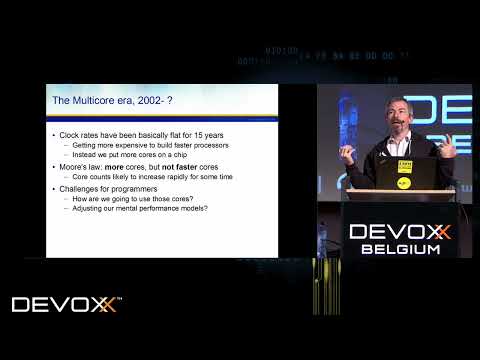 59:21
A Crash Course in Modern Hardware by Cliff Click
Devoxx
21K views • 9 years ago
 46:36
Sophie Wilson - The Future of Microprocessors
Erlang Solutions
57K views • 9 years ago
 14:30
I have some things to say - Core i9 & X299
Linus Tech Tips
2.8M views • 9 years ago
 1:00:34
Chuck Moore's Fireside Chat 2011
GreenArraysInc
6K views • 14 years ago
 1:26:02
Stanford Seminar - The Soul of a New Machine: Rethinking the Computer
Stanford Online
76K views • 6 years ago
 40:13
"Programming a 144-computer chip to minimize power" - Chuck Moore (2013)
Strange Loop Conference
19K views • 5 years ago
 1:04:53
Jim Keller: Moore’s Law is Not Dead
UC Berkeley EECS
77K views • 7 years ago
 1:37:12
[7] Jim Keller, Silicon Wizard 🧙♂️
TechTechPotato
67K views • 5 years ago
 1:19:38
John Hennessy and David Patterson 2017 ACM A.M. Turing Award Lecture
Association for Computing Machinery (ACM)
150K views • 8 years ago
 1:16:58
code::dive conference 2014 - Scott Meyers: Cpu Caches and Why You Care
NOKIA Technology Center Wrocław
231K views • 11 years ago
 37:47
Experiences Building Edge TPU with Chisel
Chisel
11K views • 7 years ago
 19:25
New computers don't speed up old code
Matthias random stuff
187K views • 1 year ago
7 comments from Hacker News
I suspect the throttling behavior has to more do with the power settings used during testing or OEM tuning on specific models. ▶ this video In this video, they show the perf/watt curves at 8:30. And they show the on-battery vs on-wall performance at 18:35 across a wide variety of benchmarks, not just Geekbench. They used a Lenovo YOGA Air 15 on Window 11's "Balanced" power plan for their tests. The narrator specifically noted the Macbook-like on-battery performance.
It's not the ISA. Modern Macbooks are power-efficient because they have: - RAM on package - PMIC power delivery - Better power management by OS Geekerwan investigated this a while ago, see: link link ▶ this video Intel and AMD have implemented these improvements with Lunar Lake and Strix Halo. You can buy an x86 laptop with Macbook-like efficiency right now if you know which SoCs to pick. edit: Correction. I looked at the die image of Strix Halo and thought it looked like it had on-package RAM. It does not. It doesn't use PMIC either. Lunar Lake is the only Apple M-series competitor on x86 at the moment.
It is likely the hardware effiency of their chips. Apple SoCs running industry-standard benchmarks still run very cool, yet still show dominant performance. The OS efficiency helps, but even under extreme stress tests like SPEC, the Apple SoCs dominate in perf & power. See Lunar Lake on TSMC N3B, 4+4, on-package DRAM versus the M3 on TSMC N3B, 4+4, on-package DRAM: ▶ this video The 258V (TSMC N3B) has a worse perf / W 1T curve than the Apple M1 (TSMC N5).
This seems mostly misinformed. 1) Apple Silicon outperforms all laptop CPUs in the same power envelope on 1T on industry-standard tests: it's not predominantly due to "optimizing their software stack". SPECint, SPECfp, Geekbench, Cinebench, etc. all show major improvements. 2) x86 also heavily relies on micro-ops to greatly improve performance. This is not a "penalty" in any sense. 3) x86 is now six-wide, eight-wide, or nine-wide (with asterisks) for decode width on all major Intel & AMD cores. The myth of x86 being stuck on four-wide has been long disproven. 4) Large buffers, L1, L2, L3, caches, etc. are not exclusive to any CPU microarchitecture. Anyone can increase them—the question is, how much does your core benefit from larger cache features? 5) Ryzen AI Max 300 (Strix Halo) gets nowhere near Apple on 1T perf / W and still loses on 1T perf. Strix Halo uses slower CPUs versus the beastly 9950X below: Fanless iPad M4 P-core SPEC2017 int, fp, geomean: 10.61, 15.58, 12.85 AMD 9950X (Zen5) SPEC2017 int, fp, geomean: 10.14, 15.18, 12.41 Intel 285K (Lion Cove) SPEC2017 int, fp, geomean: 9.81, 12.44, 11.05 Source: link , ▶ this video The 9950X & 285K eat 20W+ per core for that 1T perf; the M4 uses ~7W. Apple has a node advantage, but no node on Earth gives you 50% less power. There is no contest.
There is an M-series competitor from Intel that was released last year, codename Lunar Lake. Here's a video about it. Skip to 4:55 for battery life benchmarks. ▶ this video
No, it’s the other way around. Intel has generally caught up in idle power draw but is still severely behind in performance per watt. link ▶ this video
M3 on the same N3B node is 2-3x more efficient than Lunar Lake. M3 is also straight up faster. Qualcomm’s X Elite matches or exceeds Intel Lunar Lake on an older N4P node in efficiency and speed. Sources: link ▶ this video