memory performance
 35:33
How does Computer Memory Work? 💻🛠
5.5M views • 4 years ago
Branch Education
A 36-minute animated deep dive from Branch Education into how DRAM works. It shows how memory connects to the CPU and how billions of bits are stored in nanoscale capacitor cells. It also covers why DRAM sits between SSDs and the processor.
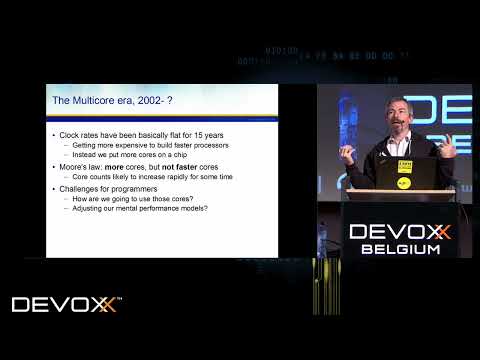 59:21
A Crash Course in Modern Hardware by Cliff Click
21K views • 10 years ago
Devoxx
Cliff Click walks through a small performance example on a modern out-of-order CPU. He covers pipelining, ILP, CISC vs RISC, multicore, and why cache misses and the memory subsystem dominate performance.
 49:03
Apollo Core Rope Memory (Apollo Guidance Computer Part 30)
759K views • 3 years ago
CuriousMarc
CuriousMarc's Apollo Guidance Computer restoration series looks at core rope memory, the ROM that held the Moon landing programs. Mike Stewart builds a custom reader to recover lost AGC programs.
 36:10
CppCon 2019: Emery Berger “Mesh: Automatically Compacting Your C++ Application's Memory”
15K views • 7 years ago
CppCon
Emery Berger's CppCon 2019 talk introducing Mesh, a drop-in malloc replacement that compacts memory in unmodified C and C++ programs. It tackles fragmentation by merging pages without changing pointers.
 48:01
The Man With The Seven Second Memory
13.1M views • 10 years ago
Real Stories
A documentary on Clive Wearing, a renowned musician whose brain was damaged by a virus in 1985, leaving him with a memory spanning only about seven seconds. It follows his life and condition.
 56:55
AWS re:Invent 2017: How Netflix Tunes Amazon EC2 Instances for Performance (CMP325)
18K views • 8 years ago
Amazon Web Services
A Netflix performance engineer presents how Netflix tunes EC2 instances, covering instance type choice, Xen modes, SR-IOV and kernel tuning. The goal is near bare-metal performance in the cloud.
 42:15
"Performance Matters" by Emery Berger
502K views • 7 years ago
Strange Loop Conference
Emery Berger explains why performance is hard to measure and deliver on modern hardware, showing how code layout and alignment can swamp optimization effects. He presents Stabilizer for statistically sound evaluation and Coz, a causal profiler.
 48:30
What's a Memory Allocator Anyway? - Benjamin Feng
89K views • 6 years ago
Zig SHOWTIME
A Zig SHOWTIME talk by Benjamin Feng on what a memory allocator is, followed by an interview. It covers allocation strategies and different allocator types in Zig.
 22:41
"Clean" Code, Horrible Performance
1.2M views • 3 years ago
Molly Rocket
Casey Muratori shows how typical 'clean code' object-oriented patterns can cost large factors in performance. He benchmarks them against simpler data-oriented code.
 20:49
How Prince of Persia Defeated Apple II's Memory Limitations | War Stories | Ars Technica
1.5M views • 6 years ago
Ars Technica
In an Ars Technica War Stories episode, Prince of Persia creator Jordan Mechner describes how he made the game on the Apple II, fighting hardware memory limits and the platform's decline. It covers the rotoscoped animation and the engineering tricks involved.
 35:42
Progressive Performance (Chrome Dev Summit 2016)
34K views • 10 years ago
Chrome for Developers
Alex Russell's Chrome Dev Summit 2016 talk on building web experiences that work on slow, flaky networks and low-power devices. It argues developers should focus on the performance of real-world mobile hardware rather than desktop machines.
 29:51
Refterm v2 - Resource usage, binary splat, glyph sizing, and more
68K views • 5 years ago
Molly Rocket
Casey Muratori follows up his refterm proof-of-concept, a GPU-based terminal renderer, with a second part covering memory usage, glyph sizing and correct Unicode and VT handling. It is built to show that a terminal can be fast and correct without heroic effort.
 56:23
Speed Up Your JavaScript
136K views • 17 years ago
Google TechTalks
A 2009 Google Tech Talk by Nicholas Zakas on the hidden performance pitfalls of JavaScript. It covers what is fast and slow in the language and how to avoid common bottlenecks.
 39:03
RustConf 2020 - Closing Keynote by Siân Griffin
10K views • 6 years ago
Rust Programming Language
RustConf 2020 closing keynote by Sian Griffin that dives into Pokemon Blue glitches, notably Missingno and arbitrary-code-execution tricks. It uses them to explain how memory unsafety works and how memory-safe languages like Rust prevent such bugs.
 20:37
The riddle of experience vs. memory | Daniel Kahneman
1.5M views • 16 years ago
TED
In this TED talk, Nobel laureate Daniel Kahneman distinguishes the experiencing self from the remembering self, using examples such as vacations and colonoscopies. He explains how the two perceive happiness differently and what that means for economics, policy and self-awareness.
 56:49
Escape from the Heap: Low-Level Programming in Common Lisp
17K views • 10 years ago
Arthur Gleckler
Ahmon Dancy of Franz Inc explains low-level programming in Common Lisp, including off-heap data structures used in AllegroGraph to manage memory outside the garbage collector.
 55:49
CppCon 2016: Chandler Carruth “High Performance Code 201: Hybrid Data Structures"
119K views • 10 years ago
CppCon
Chandler Carruth's CppCon 2016 talk on designing hybrid data structures for performance. He covers cache locality, working-set size and allocation overhead, and why standard C++ containers fall short.
 38:20
Twitter and Visual Studio Rant
158K views • 6 years ago
Molly Rocket
Casey Muratori responds on-stream to a dismissive Twitter post by demonstrating how slow Visual Studio's startup and debugger watch window are, comparing it to much older software and machines. It is a long rant about software performance and bloat.
 40:18
"Compacting the Uncompactable" by Bobby Powers
29K views • 7 years ago
Strange Loop Conference
Bobby Powers presents Mesh, a drop-in malloc replacement that eliminates memory fragmentation in unmodified C/C++ programs by compacting memory. The talk covers how it works despite C's fixed object addresses, and its benefits for programs like Redis.
 30:37
High-performance Tree Wrangling, the APL Way // Aaron Hsu // Dyalog '18
6K views • 7 years ago
Dyalog User Meetings
Aaron Hsu shows how to manipulate and transform tree data in APL using arrays and inverted tables instead of pointers. He claims much smaller code, better performance and easier parallelisation.
 31:01
How I Upgraded My iPhone Memory 800% - in Shenzhen, China
7.1M views • 8 years ago
Strange Parts
Scotty Allen of Strange Parts travels through Shenzhen's Huaqiangbei markets and learns to upgrade an iPhone 6s from 16GB to 128GB by swapping its flash chip. It is part 3 of his custom iPhone series and shows the difficulty of the hands-on repair work.
 29:47
The Truth about Rust/WebAssembly Performance
218K views • 3 years ago
Greg Johnston
Leptos creator Greg Johnston examines Rust/WebAssembly frontend frameworks against JavaScript frameworks using the JS framework benchmark. He argues that WASM is no longer too slow for DOM-heavy rendering.
 30:12
Casey Muratori | Smart-Pointers, RAII, ZII? Becoming an N+2 programmer
162K views • 2 years ago
xDahl
Casey Muratori argues against smart pointers and RAII, advocating grouped-element thinking, zero-is-initialization and stubs as better ways to structure memory and handle errors.
 45:05
Servo Architecture: Safety and Performance
12K views • 9 years ago
linux conf au 2017 - Hobart, Australia
Jack Moffitt presents the architecture of Servo, Mozilla's experimental browser engine written in Rust, focusing on parallelism across cores, GPUs and SIMD and the safety properties gained from Rust.
 40:34
Charlie Marsh: uv: An Extremely Fast Python Package Manager
107K views • 2 years ago
Jane Street
Charlie Marsh of Astral explains how uv, a Rust Python package manager, got so fast. He covers allocators, concurrency, zero-copy tricks and the challenges of Python packaging.
 26:34
Shared memory parallelism in Julia | Kiran Pamnany | Cambridge Julia Meetup (May 2018)
7K views • 8 years ago
The Julia Programming Language
Kiran Pamnany's Cambridge Julia Meetup talk on Julia's shared memory parallelism and its new task scheduler. It argues that fork-join and work-stealing models nest poorly and presents depth-first scheduling for composable parallelism.
 48:04
"NTFS really isn't that bad" - Robert Collins (LCA 2020)
161K views • 6 years ago
linux.conf.au
Robert Collins explains why rustup installs were painfully slow on Windows and how changes to rustup and Windows cut install time from 3m30s to 14s. The talk covers NTFS, small files and the cost of antivirus hooks on file close.
 49:16
XFS: Recent and Future Adventures in Filesystem Scalability - Dave Chinner
29K views • 14 years ago
Linux.conf.au 2012 -- Ballarat, Australia
Dave Chinner's linux.conf.au 2012 talk on XFS scalability, covering pain points with large numbers of files and complex metadata, and the work to fix XFS metadata performance.
 55:42
CppCon 2019: Matt Godbolt “Path Tracing Three Ways: A Study of C++ Style”
77K views • 7 years ago
CppCon
Matt Godbolt builds a toy path tracer in C++ in three different styles and compares them on clarity, testability, compile time and run-time performance. The talk was given at CppCon 2019.
 23:32
Industrial Strength High Performance RISC V Processors For Energy Efficient Computing
8K views • 8 years ago
RISC-V International
David Ditzel of Esperanto Technologies presents their massively parallel, energy-efficient RISC-V processors at the 7th RISC-V Workshop in 2017. It covers the high-performance many-core design aimed at machine learning.
 47:34
RailsConf 2011: Aaron Patterson, "Double Dream Hands: So Intense!"
26K views • 15 years ago
O'Reilly
Aaron Patterson's RailsConf 2011 talk on Rails 3.1 performance, showing why deeper Rack middleware stacks slow Rails and how a shallower pipeline helps. It also touches on Rack API design.
 46:00
Scaling ZFS for NVMe - Allan Jude - EuroBSDcon 2022
14K views • 4 years ago
EuroBSDCon
Allan Jude of Klara presents work on making ZFS scale on fast NVMe storage, covering fixes to the TaskQueue interface and removal of bottlenecks. The talk was given at EuroBSDcon 2022 and describes raising write throughput from about 3 to over 7 GB/sec.
 45:49
Breaking the 1000ms Time to Glass Mobile Barrier
104K views • 13 years ago
InfoQ
Ilya Grigorik of Google's Make the Web Fast team explains how to build a mobile site that appears on screen within one second. He covers the network and rendering constraints on mobile.
 47:52
Finding the Missing Memristor - R. Stanley Williams
133K views • 16 years ago
The Qualcomm Institute
R. Stanley Williams of HP Labs gives a keynote on the memristor, covering the physics, crossbar computation, and potential for memory and new computer architectures.
 59:56
Marty Lobdell - Study Less Study Smart
25.5M views • 15 years ago
Pierce College District WA
Psychology professor Marty Lobdell gives a one-hour lecture on how to study effectively, covering short focused sessions with breaks, study environment, note-taking and memory techniques. It was aimed at students who cram without improving.
 51:04
[EPILEPSY WARNING] How fast should an unoptimized terminal run?
193K views • 5 years ago
Molly Rocket
Casey Muratori shows how fast a terminal renderer can run, building a simple reference renderer that handles Unicode and colored text far quicker than Windows Terminal. He argues that common excuses for slow terminals do not hold up.
 21:04
Apollo Guidance Computer Part 1: Restoring the computer that put man on the Moon
588K views • 7 years ago
CuriousMarc
The first episode of CuriousMarc's series restoring a real Apollo Guidance Computer, led by AGC expert Mike Stewart. They set up a makeshift lab in a Houston hotel room to open up a rare machine owned by a private collector.
 34:55
"Outperforming Imperative with Pure Functional Languages" by Richard Feldman
98K views • 5 years ago
Strange Loop Conference
Richard Feldman explains how pure functional languages can match or beat imperative ones on performance. Compilers can turn immutable code into in-place mutation, avoiding naive copying. The talk draws on his work on the Roc language.
 21:42
Future Computers Will Be Radically Different (Analog Computing)
13.2M views • 4 years ago
Veritasium
Veritasium explains why analog computing may suit AI workloads, covering old analog computers, The Analog Thing and Mythic's analog chips that use flash memory for neural network inference. It argues digital hardware is hitting limits.
 46:40
Andrew Kelley: A Practical Guide to Applying Data Oriented Design (DoD)
415K views • 2 years ago
ChimiChanga
Andrew Kelley, creator of Zig, presents practical data-oriented design techniques for shrinking memory footprint and making programs cache friendly. He ends with a case study of how these ideas sped up the Zig compiler.