parallel processing
 1:19:57
Simon Peyton Jones: Data Parallel Haskell
28K views • 16 years ago
nuACM
Simon Peyton Jones explains nested data parallelism and Data Parallel Haskell, an approach to exploiting multicore and distributed hardware while keeping a simple single-control-flow programming model.
 31:23
Concurrency is not Parallelism by Rob Pike
191K views • 10 years ago
gnbitcom
Rob Pike's Go talk distinguishing concurrency, the structuring of independent processes, from parallelism, their simultaneous execution. It uses Go channels and goroutines to illustrate.
 1:09:38
"How to Think about Parallel Programming: Not!" - Guy L. Steele Jr. (Strange Loop 2010)
9K views • 5 years ago
Strange Loop Conference
Guy Steele's Strange Loop 2010 talk argues that programmers should not have to think about parallelism, and that languages should support algorithms built on independence and divide-and-conquer. He also recounts fitting a program onto a single punch card.
 26:34
Shared memory parallelism in Julia | Kiran Pamnany | Cambridge Julia Meetup (May 2018)
7K views • 8 years ago
The Julia Programming Language
Kiran Pamnany's Cambridge Julia Meetup talk on Julia's shared memory parallelism and its new task scheduler. It argues that fork-join and work-stealing models nest poorly and presents depth-first scheduling for composable parallelism.
 43:29
Servo: Building a Parallel Browser
23K views • 11 years ago
Linux.conf.au 2015 -- Auckland, New Zealand
Jack Moffitt presents Servo, an experimental browser engine written in Rust and designed to be parallel at every level, using multiple cores, the GPU, fork-join concurrency and SIMD. The talk covers motivations, architecture and plans for the project.
 31:06
Jim Keller - Moore's Law in the age of AI Chips
33K views • 6 years ago
Matroid
Jim Keller's talk at the 2020 Scaled Machine Learning conference on Moore's Law in the age of AI chips. He compares scalar, vector and GPU-style parallel approaches to computation.
 1:01:47
Four Solutions to a Trivial Problem - Guy Steele Jr.
36K views • 10 years ago
Google TechTalks
Guy Steele presents a small geometric problem and compares four computational approaches: a classic sequential solution and three parallel-friendly ones. Each is illustrated pictorially and with working code, weighing total work against time to solution.
 1:11:41
Lecture 1 | Natural Language Processing with Deep Learning
820K views • 9 years ago
Stanford University School of Engineering
The first lecture of Stanford's Natural Language Processing with Deep Learning course, taught by Chris Manning and Richard Socher. It introduces NLP and word vectors, including SVD, skip-gram, CBOW, negative sampling and word2vec.
 58:08
Parallelism, Concurrency, and Asynchrony in Perl 6 / Jonathan Worthington
6K views • 11 years ago
yapcasia
Jonathan Worthington's YAPC Asia 2015 talk on parallelism, concurrency and asynchrony in Perl 6. It covers the language's concurrency features.
 1:07:09
Dennis Gustafsson – Parallelizing the physics solver – BSC 2025
77K views • 1 year ago
Better Software Conference
Dennis Gustafsson, creator of Teardown, presents how he parallelized the physics solver for an upcoming game, followed by a Q&A. The talk was given at the Better Software Conference 2025.
 1:06:26
Over the Shoulder 1 - Text Preprocessing in Forth
25K views • 12 years ago
Andreas Wagner
Samuel Falvo II live-codes a text preprocessor and blog engine in Forth over about an hour. It shows Forth's dictionary being snapshotted and restored in place of mutation, and how a small Forth system gets real work done.
 25:52
Halide Talk
53K views • 12 years ago
Andrew Adams
Andrew Adams, a Halide developer, presents the Halide language for image processing and tensor computation. The talk explains the separation of algorithm from schedule with illustrated examples of parallelism, locality and redundancy tradeoffs.
 38:23
100 car batteries wired in parallel!
11.2M views • 3 years ago
styropyro
Styropyro wires 100 car batteries in parallel to produce more current than a lightning bolt and tests what happens when it is shorted. The experiments, done with other YouTubers, show spectacular effects of extreme current.
 24:39
SM64 - Watch for Rolling Rocks - 0.5x A Presses (Commentated) [OUTDATED]
5.5M views • 10 years ago
pannenkoek2012
Pannenkoek2012's commentated tool-assisted Super Mario 64 run collecting the Watch for Rolling Rocks star with half an A press, using parallel universes and QPU movement. The video is marked outdated in favor of a newer version.
 2:03:12
Co-dfns Live Stream: Compiler Design and Architecture
21K views • 9 years ago
Aaron Hsu (arcfide)
A two-hour live stream in which Aaron Hsu explains the architecture, design history and aesthetic of Co-dfns, his parallel APL compiler. He walks through the code and the reasoning behind its dense style.
 11:47
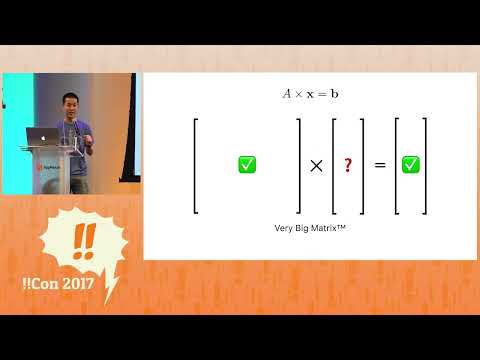
!!Con 2017: HDR Photography in Microsoft Excel?! by Kevin Chen
119K views • 9 years ago
Confreaks
A short conference talk from !!Con 2017 in which Kevin Chen explains the HDR imaging algorithm from a foundational paper, framing it as a system of linear equations, and implements it in a Microsoft Excel spreadsheet. No prior image processing knowledge is needed.
 45:05
Servo Architecture: Safety and Performance
12K views • 9 years ago
linux conf au 2017 - Hobart, Australia
Jack Moffitt presents the architecture of Servo, Mozilla's experimental browser engine written in Rust, focusing on parallelism across cores, GPUs and SIMD and the safety properties gained from Rust.
 12:31
The Superheterodyne Radio: No really, that's its name
987K views • 7 years ago
Technology Connections
Technology Connections explains why the superheterodyne radio has its name and how mixing frequencies lets it tune stations well. It walks through the underlying wave phenomena and algebra and why the design solved a hard tuning problem.
 46:27
Sensor Fusion on Android Devices: A Revolution in Motion Processing
517K views • 16 years ago
Google TechTalks
David Sachs of InvenSense explains how gyroscopes, accelerometers and compasses work on their own and together, demonstrated on a modified Android handset. He covers sensor fusion algorithms and why rotation math such as Euler angles matters.
 17:01
Your Brain Hallucinates Your Conscious Reality | Anil Seth | TED
12M views • 9 years ago
TED
Neuroscientist Anil Seth argues in this TED talk that perception is a controlled hallucination: the brain constantly predicts the world and our shared agreement is what we call reality. He also touches on the construction of the self.
 18:18
I Tried Turning Games Into Text
571K views • 2 years ago
Acerola
Acerola explores building a shader that turns games into ASCII art, walking through techniques such as brightness mapping and edge detection to see whether it looks good.
 20:00
Why Parallel Universes Are Probably Real
25.4M views • 6 years ago
Veritasium
Veritasium explains the many-worlds interpretation of quantum mechanics, drawing heavily on Sean Carroll's book. It walks through the Schrodinger equation and why wave collapse may be unnecessary if the universe keeps splitting.
 19:42
But what is the Fourier Transform? A visual introduction.
12.6M views • 8 years ago
3Blue1Brown
3Blue1Brown's animated visual introduction to the Fourier Transform, showing how a signal breaks into frequency components.
 47:43
"Turning the database inside out with Apache Samza" by Martin Kleppmann
205K views • 12 years ago
Strange Loop Conference
Martin Kleppmann argues that databases are global shared mutable state and proposes treating them as an ever-growing log of immutable facts. Derived data such as caches, indexes and views is then built by stream processors like Apache Samza. The talk draws on Kafka and LinkedIn's experience with commit logs.
 28:23
The Fast Fourier Transform (FFT): Most Ingenious Algorithm Ever?
2.3M views • 5 years ago
Reducible
Reducible's visual walkthrough of the Fast Fourier Transform, motivated by polynomial multiplication. It shows how the FFT's key ideas can be discovered by asking the right questions.
 1:15:47
Richard Feynman Computer Science Lecture - Hardware, Software and Heuristics
978K views • 14 years ago
Muon Ray
A lecture by Richard Feynman on how computers work, using the analogy of a filing clerk that becomes progressively dumber and faster. It also covers heuristics and how computers handle data and solve problems in finite time.
 18:07
The more general uncertainty principle, regarding Fourier transforms
2.3M views • 8 years ago
3Blue1Brown
3Blue1Brown shows how the uncertainty principle arises from Fourier transforms. A wave packet cannot be narrow in both position and frequency, so the principle is a property of waves rather than of measurement.
 4:14
Computer Color is Broken
4.3M views • 11 years ago
minutephysics
MinutePhysics explains that computers store brightness nonlinearly, so blurring and blending colors in raw RGB gives wrong, dark results. It shows why mixed colors, such as in gradients, look off.
 1:00:14
The Neuroscience of Consciousness – with Anil Seth
1.9M views • 9 years ago
The Royal Institution
Neuroscientist Anil Seth gives a Royal Institution lecture on the science of consciousness. He separates conscious level, content and self, and argues that experience arises from the brain's predictive inference.
 1:15:21
Marc Levoy - Lectures on Digital Photography - Lecture 1 (21mar16).mp4
512K views • 10 years ago
Marc Levoy
The first lecture in an 18-part series on digital photography from Marc Levoy's Stanford CS 178 course, recorded at Google in 2016. The series covers how digital cameras work and computational photography, with slides and assignments available on the course site.
 26:33
The Most Underrated Algorithm
10.8M views • 4 years ago
Veritasium
Veritasium tells the story of the Fast Fourier Transform, from its use in detecting nuclear tests to Cold War politics, and how it could have changed the arms race. It includes a short, intuitive explanation of what the Fourier transform does.
 1:02:09
Seymour Cray's Only Surviving Talk: "Cray-1 Introduction" (1976, LANL)
59K views • 16 years ago
UC Berkeley Events
Seymour Cray's only surviving recorded talk, introducing the Cray-1 supercomputer in 1976. He describes the machine's design, including its vector architecture and cooling through the frame.
 4:32
The Visual Microphone: Passive Recovery of Sound from Video
1.9M views • 12 years ago
Abe Davis's Research
MIT researchers show that sound can be recovered from silent video by analyzing tiny vibrations in objects such as a potato chip bag. It works even with consumer cameras by using rolling shutter.
 5:01
How It's Made - Canola Oil
4.5M views • 14 years ago
Panos Egglezos
A short 'How It's Made' television segment showing the industrial process of turning canola seed into cooking oil. It walks through pressing, solvent extraction and refining steps.
 1:00:28
Keynote. Fortress Features and Lessons Learned | Guy Steele | JuliaCon 2016
15K views • 10 years ago
The Julia Programming Language
Guy Steele's JuliaCon 2016 keynote on the Fortress language, its features and the lessons learned from the project.
 2:36
Jamie Oliver Shows School Kids How Chicken Nuggets are made
2.7M views • 16 years ago
Faffi H
Jamie Oliver shows school kids how chicken nuggets are made by blending skin and mechanically reclaimed meat, as part of his school lunch campaign. The kids react with disgust.
 52:07
What Bodies Think About: Bioelectric Computation Outside the Nervous System - NeurIPS 2018
103K views • 7 years ago
The Artificial Intelligence Channel
Michael Levin's NeurIPS 2018 talk on bioelectric computation outside the nervous system, showing how cell electrical networks shape development and regeneration. It covers morphological information processing in living tissue.
 59:56
AWS re:Invent 2018: Amazon DynamoDB Deep Dive: Advanced Design Patterns for DynamoDB (DAT401)
468K views • 7 years ago
Amazon Web Services
Rick Houlihan's AWS re:Invent 2018 deep dive on advanced DynamoDB design patterns. It covers index overloading, GSI sharding, composite keys, graph processing and transactions.
 45:55
Ruby Conf 12 - Boundaries by Gary Bernhardt
58K views • 13 years ago
Confreaks
Gary Bernhardt's RubyConf 2012 talk on testing in isolation without mocking everything. It goes through behavior versus data, mutation versus immutability, and how a functional core with an imperative shell yields natural isolation and parallelism.
 1:40:53
The Mother of All Demos, presented by Douglas Engelbart (1968)
1.2M views • 14 years ago
Marcel
The full recording of Douglas Engelbart's 1968 demonstration, which introduced the mouse, hypertext, video conferencing, word processing, and real-time collaborative editing. It runs about 100 minutes.