penrose
 19:19
Was Penrose Right? NEW EVIDENCE For Quantum Effects In The Brain
1.1M views • 2 years ago
PBS Space Time
PBS Space Time examines Roger Penrose's idea that consciousness arises from quantum processes in the brain, and reviews new evidence about microtubules. It ends with an estimate of what replicating consciousness would demand.
 19:59
What Happens at the Event Horizon? | Space Time | PBS Digital Studios
3.2M views • 9 years ago
PBS Space Time
PBS Space Time explains what happens as you approach and cross a black hole's event horizon, using Penrose diagrams and light cones as the tool for understanding spacetime there.
 18:30
What Happens After the Universe Ends?
2.3M views • 6 years ago
PBS Space Time
PBS Space Time explains Roger Penrose's conformal cyclic cosmology, in which the far future of our universe becomes the big bang of the next. It explores what could come after the universe ends.
 37:03
White holes and wormholes are probably real. Here's why.
37.8M views • 2 years ago
Veritasium
Veritasium explores what general relativity says about black holes, white holes and wormholes, with help from physicists Geraint Lewis and Juan Maldacena. It introduces Penrose diagrams and the idea that other universes may be implied.
 36:06
Civilizations at the End of Time: Black Hole Farming
934K views • 10 years ago
Isaac Arthur
An Isaac Arthur episode on civilizations in the dark, post-stellar universe, including black hole farming, accretion disks and the Penrose process as energy sources.
 21:12
The Infinite Pattern That Never Repeats
21.9M views • 6 years ago
Veritasium
Veritasium explains how Penrose tilings and quasicrystals overturned the belief that 5-fold symmetry and non-periodic crystals were impossible, including an interview with Paul Steinhardt.
 4:58
You Actually Share Your Brain With a Silent Stranger
20.2M views • 10 years ago
CGP Grey
CGP Grey explains split-brain patients, where severing the corpus callosum lets the two hemispheres act independently. He uses this to explore the idea of two minds in one head.
Topic match · Consciousness & cognition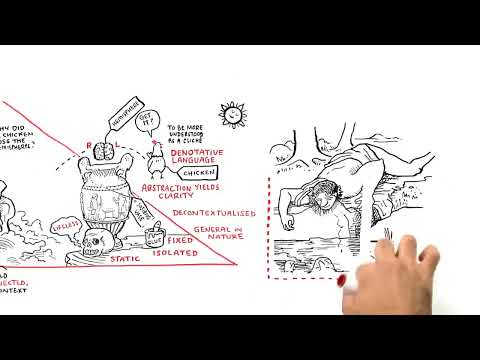 11:48
RSA ANIMATE: The Divided Brain
2.2M views • 15 years ago
Royal Society of Arts
An RSA Animate summary of Iain McGilchrist's lecture on the divided brain, arguing the brain's two hemispheres attend to the world differently and that this has shaped culture and society.
Topic match · Consciousness & cognition 15:28
The Braitenberg Vehicles
65K views • 10 years ago
Brian Douglas
Brian Douglas introduces Braitenberg vehicles, simple robots whose sensors are wired directly to motors yet show surprisingly lifelike behavior. He draws on Valentino Braitenberg's book Vehicles.
Topic match · Consciousness & cognition 30:02
The Future Of Reasoning
12.8M views • 5 years ago
Vsauce
Vsauce explores how human reasoning works, drawing on the social theory of reason and the extended mind thesis, made in partnership with Bill Gates around climate change.
Topic match · Consciousness & cognition 9:35
Is Your Red The Same as My Red?
34M views • 13 years ago
Vsauce
Vsauce explores qualia and whether different people experience colors the same way. It draws on color blindness, Mary's room, the explanatory gap and subjective experience.
Topic match · Consciousness & cognition 5:44
Why Teleportation Would Kill You
7.3M views • 10 years ago
CGP Grey
CGP Grey asks whether Star Trek-style teleportation would kill you and recreate a copy, working through the philosophy of identity and the Ship of Theseus. It is a short animated explainer.
Topic match · Consciousness & cognition 20:30
Does Superdeterminism save Quantum Mechanics? Or does it kill free will and destroy science?
989K views • 4 years ago
Sabine Hossenfelder
Sabine Hossenfelder explains superdeterminism as an interpretation of quantum mechanics, addressing common objections and misconceptions, including the worry that it kills free will or science. She ties it to Bell's theorem and hidden variables.
Topic match · Consciousness & cognition 5:25
Does the language you speak change how you think?
1.6M views • 3 years ago
Tom Scott
Tom Scott, with linguists Gretchen McCulloch and Molly Ruhl, examines whether the language you speak changes how you think. The short answer is mostly no, with caveats about the weak version of the Sapir-Whorf hypothesis.
Topic match · Consciousness & cognition