penrose
 23:00
Consciousness is Not a Computation (Roger Penrose) | AI Podcast Clips
2.3M views • 6 years ago
Lex Fridman
Clip from Lex Fridman's podcast with Roger Penrose in which Penrose argues that consciousness is not a computation. He discusses Godel-style arguments and the possible role of quantum effects in microtubules.
 1:27:57
Roger Penrose: Physics of Consciousness and the Infinite Universe | Lex Fridman Podcast #85
2.7M views • 6 years ago
Lex Fridman
Lex Fridman interviews physicist Roger Penrose on consciousness, the limits of computation, quantum mechanics and his cyclic cosmology. It covers his views on AI and the big bang.
 1:52:48
Sir Roger Penrose & Dr. Stuart Hameroff: CONSCIOUSNESS AND THE PHYSICS OF THE BRAIN
889K views • 6 years ago
The Qualcomm Institute
A 2020 UC San Diego event with Roger Penrose and Stuart Hameroff presenting their Orch OR theory that consciousness arises from quantum processes in brain microtubules, followed by a conversation with Roger Bingham.
 19:19
Was Penrose Right? NEW EVIDENCE For Quantum Effects In The Brain
1.1M views • 2 years ago
PBS Space Time
PBS Space Time examines Roger Penrose's idea that consciousness arises from quantum processes in the brain, and reviews new evidence about microtubules. It ends with an estimate of what replicating consciousness would demand.
 1:28:08
Sir Roger Penrose & William Lane Craig • The Universe: How did it get here & why are we part of it?
926K views • 7 years ago
Premier Unbelievable?
Physicist Roger Penrose and philosopher William Lane Craig discuss the origin of the universe on the Unbelievable? show. Topics include Penrose's three realms of reality, conformal cyclic cosmology and whether fine tuning points to a creator.
 19:59
What Happens at the Event Horizon? | Space Time | PBS Digital Studios
3.2M views • 9 years ago
PBS Space Time
PBS Space Time explains what happens as you approach and cross a black hole's event horizon, using Penrose diagrams and light cones as the tool for understanding spacetime there.
 18:30
What Happens After the Universe Ends?
2.3M views • 6 years ago
PBS Space Time
PBS Space Time explains Roger Penrose's conformal cyclic cosmology, in which the far future of our universe becomes the big bang of the next. It explores what could come after the universe ends.
 37:03
White holes and wormholes are probably real. Here's why.
37.8M views • 2 years ago
Veritasium
Veritasium explores what general relativity says about black holes, white holes and wormholes, with help from physicists Geraint Lewis and Juan Maldacena. It introduces Penrose diagrams and the idea that other universes may be implied.
 36:06
Civilizations at the End of Time: Black Hole Farming
934K views • 10 years ago
Isaac Arthur
An Isaac Arthur episode on civilizations in the dark, post-stellar universe, including black hole farming, accretion disks and the Penrose process as energy sources.
 21:12
The Infinite Pattern That Never Repeats
21.9M views • 6 years ago
Veritasium
Veritasium explains how Penrose tilings and quasicrystals overturned the belief that 5-fold symmetry and non-periodic crystals were impossible, including an interview with Paul Steinhardt.
 58:58
George Lakoff: Moral Politics
201K views • 18 years ago
University of California Television (UCTV)
Cognitive scientist George Lakoff lectures on how political debates are framed through language and metaphors tied to values, and on the moral worldviews behind progressive and conservative politics. It was given in 2005 at UC San Diego.
Topic match · Consciousness & cognition 52:07
What Bodies Think About: Bioelectric Computation Outside the Nervous System - NeurIPS 2018
103K views • 7 years ago
The Artificial Intelligence Channel
Michael Levin's NeurIPS 2018 talk on bioelectric computation outside the nervous system, showing how cell electrical networks shape development and regeneration. It covers morphological information processing in living tissue.
Topic match · Consciousness & cognition 1:08:37
Analogy as the Core of Cognition
600K views • 17 years ago
Stanford
Douglas Hofstadter's Stanford Presidential Lecture argues that analogy is the core of cognition, illustrating how concepts, categorization and thought arise from analogy-making.
Topic match · Consciousness & cognition 8:06
The Egg - A Short Story
36.5M views • 7 years ago
Kurzgesagt – In a Nutshell
Kurzgesagt animates Andy Weir's short story The Egg, in which a person learns that they are every human who has ever lived. It adds music and narration to the original text.
Topic match · Consciousness & cognition 59:16
Ep. 1 - Awakening from the Meaning Crisis - Introduction
844K views • 7 years ago
John Vervaeke’s Lectern
The first episode of John Vervaeke's lecture series on the modern meaning crisis, tracing its history through philosophy, cognitive science, religion and psychology. It introduces the series and its themes.
Topic match · Consciousness & cognition 4:58
You Actually Share Your Brain With a Silent Stranger
20.2M views • 10 years ago
CGP Grey
CGP Grey explains split-brain patients, where severing the corpus callosum lets the two hemispheres act independently. He uses this to explore the idea of two minds in one head.
Topic match · Consciousness & cognition 1:10:03
Debate Noam Chomsky & Michel Foucault - On human nature [Subtitled]
2.7M views • 13 years ago
withDefiance
The full 1971 Dutch television debate between Noam Chomsky and Michel Foucault on human nature, with subtitles. They discuss creativity, knowledge, power and politics.
Topic match · Consciousness & cognition 3:00:18
Joscha Bach: Artificial Consciousness and the Nature of Reality | Lex Fridman Podcast #101
2.2M views • 6 years ago
Lex Fridman
Lex Fridman has a three-hour conversation with Joscha Bach about artificial consciousness, the workings of the mind, intelligence and the possibly simulated nature of reality.
Topic match · Consciousness & cognition 1:00:14
The Neuroscience of Consciousness – with Anil Seth
1.9M views • 9 years ago
The Royal Institution
Neuroscientist Anil Seth gives a Royal Institution lecture on the science of consciousness. He separates conscious level, content and self, and argues that experience arises from the brain's predictive inference.
Topic match · Consciousness & cognition 6:24
Feynman: How to think 1 of 2 FUN TO IMAGINE 11
388K views • 17 years ago
Christopher Sykes
An excerpt from the 1983 BBC series Fun to Imagine in which Richard Feynman describes how he and a mathematician friend counted in their heads in different ways, one verbally and one visually. It shows that people can reach the same goal through quite different mental methods.
Topic match · Consciousness & cognition 1:16:22
If Brains are Computers, Who Designs the Software? - with Daniel Dennett
873K views • 9 years ago
The Royal Institution
Daniel Dennett's Royal Institution lecture on whether the brain is a computer and where its software comes from. He argues that minds are built by evolution and culture, with competence arising without comprehension.
Topic match · Consciousness & cognition 2:18:45
Michael Levin: Consciousness, Biology, Universal Mind, Emergence, Cancer Research
237K views • 2 years ago
Curt Jaimungal
Curt Jaimungal interviews biologist Michael Levin of Tufts about consciousness, bioelectricity, emergence, and cancer research. The conversation challenges reductionist views of life.
Topic match · Consciousness & cognition 53:33
Your Brain: Who's in Control? | Full Documentary | NOVA | PBS
11.6M views • 3 years ago
NOVA PBS Official
A NOVA documentary with neuroscientist Heather Berlin exploring the subconscious and what drives our decisions. It uses sleepwalking, anesthesia, improvised rap in an MRI and game theory to probe how much of the brain's work is hidden.
Topic match · Consciousness & cognition 8:39
Terence Mckenna - Culture is your operating system
848K views • 19 years ago
Dani Dögenigt
A short edited excerpt of Terence McKenna arguing that culture acts as an operating system for the mind, set to imagery and music. It touches on psychedelics and how they change thinking.
Topic match · Consciousness & cognition 18:41
Why our IQ levels are higher than our grandparents' | James Flynn
3.2M views • 13 years ago
TED
Moral philosopher James Flynn explains the Flynn effect, the steady rise of IQ scores across the 20th century. He argues the shift reflects a move toward abstract, hypothetical thinking as cognitively demanding professions grew.
Topic match · Consciousness & cognition 1:01:45
Information, Evolution, and intelligent Design - With Daniel Dennett
586K views • 11 years ago
The Royal Institution
Daniel Dennett gives a Royal Institution talk toward a unified theory of information, tying together evolution, learning and engineering. He argues that design can arise bottom-up through small steps without a designer.
Topic match · Consciousness & cognition 1:15:47
Couldn't Care Less. Cormac McCarthy in conversation with David Krakauer
582K views • 4 years ago
Karol Jałochowski
A 2017 documentary filmed at the Santa Fe Institute in which novelist Cormac McCarthy talks with SFI's David Krakauer. They discuss isolation, mathematics, character and the nature of the unconscious.
Topic match · Consciousness & cognition 20:12
My stroke of insight | Jill Bolte Taylor | TED
8.8M views • 18 years ago
TED
Neuroscientist Jill Bolte Taylor describes watching her own brain functions shut down during a massive stroke. She gives a first-person account of losing speech, motion and self-awareness.
Topic match · Consciousness & cognition 4:05:51
Lee Cronin: Origin of Life, Aliens, Complexity, and Consciousness | Lex Fridman Podcast #269
1.1M views • 4 years ago
Lex Fridman
Lex Fridman interviews University of Glasgow chemist Lee Cronin about the origin of life, aliens, complexity and consciousness. The conversation centers on Cronin's assembly theory.
Topic match · Consciousness & cognition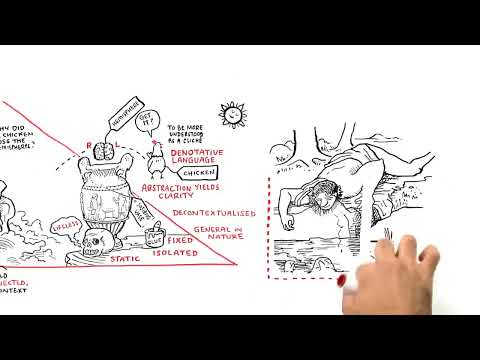 11:48
RSA ANIMATE: The Divided Brain
2.2M views • 15 years ago
Royal Society of Arts
An RSA Animate summary of Iain McGilchrist's lecture on the divided brain, arguing the brain's two hemispheres attend to the world differently and that this has shaped culture and society.
Topic match · Consciousness & cognition 1:02:13
35C3 - The Ghost in the Machine
79K views • 7 years ago
media.ccc.de
Joscha Bach's 35C3 talk offers an AI perspective on the soul, covering perception, mental representation, agency, consciousness and selfhood as things that can arise in a computational system like the brain.
Topic match · Consciousness & cognition 21:51
Do we see reality as it is? | Donald Hoffman | TED
3.1M views • 11 years ago
TED
Cognitive scientist Donald Hoffman argues in this TED talk that evolution shaped perception to track fitness rather than truth. He uses evolutionary simulations and the Australian jewel beetle as examples.
Topic match · Consciousness & cognition 49:35
How did consciousness evolve? - with Nicholas Humphrey
333K views • 3 years ago
The Royal Institution
A Royal Institution lecture in which Nicholas Humphrey presents his theory of phenomenal consciousness and its evolution. He draws on the book Sentience and discusses evidence for animal sentience.
Topic match · Consciousness & cognition 13:11
Jordan Peterson - Controversial Facts about IQ
2.2M views • 9 years ago
Bite-sized Philosophy
A clip of psychologist Jordan Peterson lecturing on intelligence and IQ, covering how it is defined and its correlation with academic and work success.
Topic match · Consciousness & cognition 1:00:52
Joscha: From Computation to Consciousness (31c3)
28K views • 11 years ago
Joscha Bach
Joscha Bach's 31c3 talk argues that the mind should be understood as an information-processing system and that even the physical universe can be seen as computational. It tours the philosophy underlying artificial intelligence and cognitive science.
Topic match · Consciousness & cognition 1:06:15
The Hyperbolic Geometry of DMT Experiences (@Harvard Science of Psychedelics Club)
1.4M views • 7 years ago
Qualia Research Institute
Andres Gomez Emilsson of the Qualia Research Institute presents a model of DMT experiences using hyperbolic geometry and dynamical systems theory. He describes how different intoxication levels correspond to changing curvature and information content of experience.
Topic match · Consciousness & cognition 1:31:54
Noam Chomsky - "The machine, the ghost, and the limits of understanding"
472K views • 14 years ago
Andy80o
Noam Chomsky's 2011 University of Oslo lecture on Newton's contributions to the study of mind. He argues Newton abandoned mechanical explanation and lowered the bar for scientific intelligibility, with consequences for the limits of human understanding. Q&A starts at 45:33.
Topic match · Consciousness & cognition 15:13
Free Energy Principle — Karl Friston
171K views • 9 years ago
Serious Science
Neuroscientist Karl Friston gives a 15-minute talk on the free energy principle, covering Markov blankets, Bayesian model evidence and global brain theories.
Topic match · Consciousness & cognition 35:07
The Default Mode Network & End of Suffering - Gary Weber
94K views • 11 years ago
Non-Dual Couch
A dialogue with Gary Weber on the default mode network, meditation and non-dual awakening, with discussion of psychedelics, thought and time. It is part of the Non-Dual Couch series.
Topic match · Consciousness & cognition 1:01:40
Joscha: Computational Meta-Psychology
85K views • 10 years ago
media.ccc.de
Joscha Bach's 32C3 talk applies computational theories of mind to questions of meaning, emotion, and love, asking how computation can explain irrational-seeming human experience.
Topic match · Consciousness & cognition