perception
 1:25
Hazard perception test 2026: official DVSA guide
2.7M views • 11 years ago
Driver and Vehicle Standards Agency
The UK DVSA's one-minute guide to the hazard perception part of the driving theory test, covering when to click and how to score well.
 21:51
Do we see reality as it is? | Donald Hoffman | TED
3.1M views • 11 years ago
TED
Cognitive scientist Donald Hoffman argues in this TED talk that evolution shaped perception to track fitness rather than truth. He uses evolutionary simulations and the Australian jewel beetle as examples.
Topic match · Consciousness & cognition 2:12
McGurk effect - Auditory Illusion - BBC Horizon Clip
745K views • 10 years ago
sixesfullofnines
A two-minute BBC Horizon clip demonstrating the McGurk effect, where what you see of a speaker's mouth changes the sound you hear.
Topic match · Neuroscience & the brain 7:41
Why Life Seems to Speed Up as We Age
8M views • 10 years ago
Veritasium
Veritasium explores why time seems to speed up as we age, covering chronoception and several competing explanations beyond the common proportional-theory argument.
Topic match · Neuroscience & the brain 9:35
Is Your Red The Same as My Red?
34M views • 13 years ago
Vsauce
Vsauce explores qualia and whether different people experience colors the same way. It draws on color blindness, Mary's room, the explanatory gap and subjective experience.
Topic match · Consciousness & cognition 17:01
Your Brain Hallucinates Your Conscious Reality | Anil Seth | TED
12M views • 9 years ago
TED
Neuroscientist Anil Seth argues in this TED talk that perception is a controlled hallucination: the brain constantly predicts the world and our shared agreement is what we call reality. He also touches on the construction of the self.
Topic match · Consciousness & cognition 1:22
selective attention test
34.1M views • 16 years ago
Daniel Simons
The original invisible gorilla awareness test by Daniel Simons and Christopher Chabris, in which viewers count basketball passes and often miss a gorilla crossing the scene. It demonstrates inattentional blindness.
Topic match · Neuroscience & the brain 14:28
How Google's Self-Driving Car Works
647K views • 15 years ago
IEEE Spectrum
Part 2 of the IROS 2011 keynote by Sebastian Thrun and Chris Urmson on Google's self-driving car. It shows how the car perceives its surroundings with a lidar point cloud and recognizes traffic lights and pedestrians. The audio is poor because it was recorded on a pocket camcorder.
Topic match · Self-driving & autonomous vehicles 3:26
Try this bizarre audio illusion! 👁️👂😮 - BBC
5.8M views • 16 years ago
BBC
A BBC Horizon clip demonstrating the McGurk effect, where the same audio sounds like different syllables depending on the mouth movements you see. It shows that people integrate visual speech information into what they hear.
Topic match · Neuroscience & the brain 35:31
Autonomous Car - what goes into sensing for autonomous driving?
40K views • 10 years ago
Mobileye
Mobileye co-founder and CTO Amnon Shashua explains what goes into sensing for autonomous driving and whether end-to-end deep learning can work for it. He argues for decomposing the problem.
Topic match · Self-driving & autonomous vehicles 15:30
Chris Urmson: How a driverless car sees the road
886K views • 11 years ago
TED
Chris Urmson, head of Google's self-driving car program, shows footage of how the car perceives the road and decides what to do. Examples include cyclist hand signals, school buses, police officers and complex intersections.
Topic match · Self-driving & autonomous vehicles 1:15
Watch How This Blind Man Uses Echo Location To Ride a Bike
402K views • 10 years ago
Inside Edition
A short Inside Edition segment on Daniel Kish, a blind man who uses tongue clicks as human sonar to ride a bicycle through city traffic. He explains that he hears the reflections of the sounds off objects.
Topic match · Neuroscience & the brain 1:02:13
35C3 - The Ghost in the Machine
79K views • 7 years ago
media.ccc.de
Joscha Bach's 35C3 talk offers an AI perspective on the soul, covering perception, mental representation, agency, consciousness and selfhood as things that can arise in a computational system like the brain.
Topic match · Consciousness & cognition 19:09
A Better Default Colormap for Matplotlib | SciPy 2015 | Nathaniel Smith and Stéfan van der Walt
177K views • 11 years ago
Enthought
SciPy 2015 talk by Nathaniel Smith and Stefan van der Walt on choosing a new default colormap for Matplotlib. It covers why Jet misleads, how perceptual color spaces work, and how viridis was designed.
 8:41
Invisibility Training for Motorcyclists
1.8M views • 8 years ago
FortNine
FortNine's tongue-in-cheek guide to why drivers fail to see motorcyclists and how riders can make themselves more visible. It touches on perception psychology, including the role of saccades.
 57:15
1. Introduction to Human Behavioral Biology
20.5M views • 15 years ago
Stanford
The opening lecture of Robert Sapolsky's Stanford course on Human Behavioral Biology, explaining the course premise and how to avoid categorical thinking. It starts a roughly 25-lecture series on how biology, genes, hormones and environment shape behavior.
Topic match · Neuroscience & the brain 52:07
What Bodies Think About: Bioelectric Computation Outside the Nervous System - NeurIPS 2018
103K views • 7 years ago
The Artificial Intelligence Channel
Michael Levin's NeurIPS 2018 talk on bioelectric computation outside the nervous system, showing how cell electrical networks shape development and regeneration. It covers morphological information processing in living tissue.
Topic match · Neuroscience & the brain 16:29
The great porn experiment | Gary Wilson | TEDxGlasgow
17.8M views • 14 years ago
TEDx Talks
Gary Wilson's TEDxGlasgow talk argues that internet pornography hyperstimulates the brain's reward system and can cause symptoms that reverse when people stop. TED notes that several claims are not supported by respected academic studies.
Topic match · Neuroscience & the brain 1:55:33
Joe Rogan Experience #1109 - Matthew Walker
9.9M views • 8 years ago
PowerfulJRE
Joe Rogan interviews Matthew Walker, Berkeley neuroscience professor and author of Why We Sleep. They discuss what sleep does for the brain and body, the effects of sleep deprivation, and sleep myths.
Topic match · Neuroscience & the brain 48:10
Bay Area Vision Meeting: Unsupervised Feature Learning and Deep Learning
123K views • 15 years ago
Google TechTalks
Andrew Ng presents unsupervised feature learning and deep learning, showing how algorithms can learn representations from unlabeled data instead of hand-designed features. He gives examples in vision and audio, including visualizations of features learned by successive layers.
Topic match · Computer vision, speech & NLP 8:06
The Egg - A Short Story
36.5M views • 7 years ago
Kurzgesagt – In a Nutshell
Kurzgesagt animates Andy Weir's short story The Egg, in which a person learns that they are every human who has ever lived. It adds music and narration to the original text.
Topic match · Consciousness & cognition 52:22
Google Self-Driving Car Project | SXSW Interactive 2016
144K views • 10 years ago
SXSW
Chris Urmson's SXSW 2016 talk on Google's self-driving car project, covering 1.3 million self-driven miles and the gap between hype and reality. It shows sensor visualizations and playbacks of hard situations the cars met, and discusses failures such as the low-speed bus collision.
Topic match · Self-driving & autonomous vehicles 59:16
Ep. 1 - Awakening from the Meaning Crisis - Introduction
844K views • 7 years ago
John Vervaeke’s Lectern
The first episode of John Vervaeke's lecture series on the modern meaning crisis, tracing its history through philosophy, cognitive science, religion and psychology. It introduces the series and its themes.
Topic match · Consciousness & cognition 4:58
You Actually Share Your Brain With a Silent Stranger
20.2M views • 10 years ago
CGP Grey
CGP Grey explains split-brain patients, where severing the corpus callosum lets the two hemispheres act independently. He uses this to explore the idea of two minds in one head.
Topic match · Neuroscience & the brain 41:18
"Voice Driven Development: Who needs a keyboard anyway?" by Emily Shea
35K views • 7 years ago
Strange Loop Conference
Emily Shea explains how repetitive strain injury pushed her to program by voice using speech recognition (Talon), and gives a live coding demo. She argues voice-driven development can be pain-free, efficient and enjoyable.
Topic match · Computer vision, speech & NLP 1:10:03
Debate Noam Chomsky & Michel Foucault - On human nature [Subtitled]
2.7M views • 13 years ago
withDefiance
The full 1971 Dutch television debate between Noam Chomsky and Michel Foucault on human nature, with subtitles. They discuss creativity, knowledge, power and politics.
Topic match · Consciousness & cognition 2:35:53
Tensorflow and deep learning - without a PhD by Martin Görner
610K views • 10 years ago
Devoxx
Martin Gorner's Devoxx talk introduces deep learning with TensorFlow, walking through neural networks for MNIST, how to choose an architecture and how to diagnose networks that fail to train.
Topic match · Computer vision, speech & NLP 1:27:44
"Why Zebras Don't Get Ulcers: Stress and Health" by Dr. Robert Sapolsky
1.1M views • 9 years ago
Beckman Institute at Illinois
Robert Sapolsky's lecture on how the body's stress response, evolved for short-term physical emergencies, harms long-term health when triggered by psychological stressors. It was given as the inaugural Fenton-Rhodes Lecture.
Topic match · Neuroscience & the brain 15:12
JPEG DCT, Discrete Cosine Transform (JPEG Pt2)- Computerphile
697K views • 11 years ago
Computerphile
Mike Pound explains the discrete cosine transform and how it underpins JPEG compression. It is part two of Computerphile's JPEG series.
Topic match · Computer vision, speech & NLP 1:00:19
Brains, Sex, and Machine Learning
152K views • 14 years ago
Google TechTalks
Geoffrey Hinton's Google Tech Talk linking machine learning to biology, explaining dropout as a form of model averaging and why sexual reproduction and stochastic spiking neurons may prevent overfitting.
Topic match · Neuroscience & the brain 1:59:37
George Hotz: Comma.ai, OpenPilot, and Autonomous Vehicles | Lex Fridman Podcast #31
875K views • 7 years ago
Lex Fridman
Lex Fridman's two-hour podcast with George Hotz, founder of Comma.ai, covering openpilot, autonomous driving and Hotz's views on AI and technology.
Topic match · Self-driving & autonomous vehicles 4:30
Traffic Has a Perfect Solution. Humans Are the Problem.
44.6M views • 10 years ago
CGP Grey
CGP Grey explains how traffic jams come from human driving behavior such as tailgating and reaction delays, and how leaving gaps and smoothing speed would reduce congestion. It also touches on self-driving cars.
Topic match · Self-driving & autonomous vehicles 10:18
Why You Should Put YOUR MASK On First (My Brain Without Oxygen) - Smarter Every Day 157
11.6M views • 10 years ago
SmarterEveryDay
Destin Sandlin of Smarter Every Day undergoes hypoxia training and experiences his own impaired thinking as oxygen is withdrawn. The video shows how quickly and unnoticeably oxygen deprivation degrades judgment, illustrating why you put your own mask on first.
Topic match · Neuroscience & the brain 1:00:14
The Neuroscience of Consciousness – with Anil Seth
1.9M views • 9 years ago
The Royal Institution
Neuroscientist Anil Seth gives a Royal Institution lecture on the science of consciousness. He separates conscious level, content and self, and argues that experience arises from the brain's predictive inference.
Topic match · Consciousness & cognition 16:40
Massive-scale online collaboration | Luis von Ahn
315K views • 14 years ago
TED
Luis von Ahn, creator of CAPTCHA and reCAPTCHA, explains how small contributions from many people online can digitize books. He then introduces Duolingo as a way to translate the web while people learn languages.
Topic match · Computer vision, speech & NLP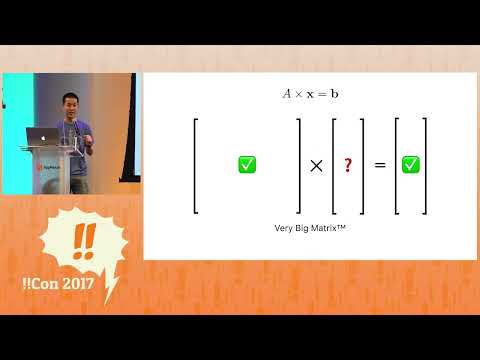 11:47
!!Con 2017: HDR Photography in Microsoft Excel?! by Kevin Chen
119K views • 9 years ago
Confreaks
A short conference talk from !!Con 2017 in which Kevin Chen explains the HDR imaging algorithm from a foundational paper, framing it as a system of linear equations, and implements it in a Microsoft Excel spreadsheet. No prior image processing knowledge is needed.
Topic match · Computer vision, speech & NLP 28:48
LSTM is dead. Long Live Transformers!
540K views • 6 years ago
Seattle Applied Deep Learning
Leo Dirac explains how transformer models have replaced LSTMs in NLP. He gives background from bag of words through RNNs and LSTMs, then a technical deep dive into multi-headed self-attention and positional encoding, with sample code.
Topic match · Computer vision, speech & NLP 1:16:22
If Brains are Computers, Who Designs the Software? - with Daniel Dennett
873K views • 9 years ago
The Royal Institution
Daniel Dennett's Royal Institution lecture on whether the brain is a computer and where its software comes from. He argues that minds are built by evolution and culture, with competence arising without comprehension.
Topic match · Consciousness & cognition 4:04
The effects of DBS on the motor symptoms of Parkinson's Disease
2.4M views • 13 years ago
Andrew Johnson
Andrew, diagnosed with early onset Parkinson's at 35, shows how deep brain stimulation surgery has controlled his motor symptoms. The short video shows his tremors with the stimulator off and on.
Topic match · Neuroscience & the brain 53:24
Breakthrough with Healing Chronic Pain | Howard Schubiner | Talks at Google
500K views • 8 years ago
Talks at Google
Dr. Howard Schubiner presents his research that much chronic pain comes from learned neural pathways rather than structural damage, and outlines a treatment approach based on that view.
Topic match · Neuroscience & the brain