physics visualization
 14:34
Visualization of Quantum Physics (Quantum Mechanics)
2.8M views • 9 years ago
udiprod
An animated visualization of basic quantum mechanics using a free particle, with simulations based on the actual equations. It covers waves, particles, and how measurement collapses the wavefunction.
 1:47
The Counterintuitive Physics of Turning a Bike
855K views • 11 years ago
minutephysics
A two-minute minutephysics video explaining why turning a bicycle requires first steering briefly the other way. It covers counter-steering and balance with slow-motion footage and 3D animation.
 7:23
How Trees Bend the Laws of Physics
5M views • 14 years ago
Veritasium
Veritasium explains how trees lift water from roots to the top of tall trunks, using transpiration pull and the negative pressure that liquid water can sustain. It explains why trees do not need pumps or valves.
 13:41
The Physics of Life (ft. It's Okay to be Smart & PBS Eons!)
771K views • 8 years ago
PBS Space Time
PBS Space Time, together with It's Okay to be Smart and PBS Eons, asks how a universe drifting toward disorder produced something as complex as life. It presents the idea that the laws of physics, through thermodynamics, may actually favor the emergence of life.
 6:26
Slow Motion Flipping Cat Physics | Smarter Every Day 58
11.3M views • 14 years ago
SmarterEveryDay
Destin of Smarter Every Day films a cat falling in high-speed slow motion to show how cats right themselves in midair, and introduces the physics behind it.
 5:26
Neural Network Learns The Physics of Fluids and Smoke | Two Minute Papers #118
209K views • 9 years ago
Two Minute Papers
Two Minute Papers covers a paper on speeding up fluid and smoke simulation with convolutional networks. It contrasts the approach with earlier regression forest methods.
 3:12
Why is the Solar System Flat?
9.5M views • 12 years ago
minutephysics
A minutephysics explainer on why the planets orbit in a flat plane. It shows how conserved angular momentum flattens a collapsing cloud of matter into a disk.
 4:20
Why It's Impossible to Tune a Piano
4.1M views • 11 years ago
minutephysics
A minutephysics video explaining why a piano cannot be perfectly tuned, comparing equal temperament with just intonation and the math of harmonics.
 3:34
Complete Solution To The Twins Paradox
2.3M views • 10 years ago
minutephysics
A minutephysics explainer on the twins paradox in special relativity. It shows why the traveling twin ends up younger and how acceleration resolves the paradox.
 3:57
How Do Bikes Stay Up?
1.7M views • 11 years ago
minutephysics
A short minutephysics video explaining why bicycles stay upright. It looks at gyroscopic precession, head angle and centre of mass, and shows that bikes self-steer toward the direction they lean.
 12:32
Protecting Privacy with MATH (Collab with the Census)
451K views • 7 years ago
minutephysics
minutephysics, in collaboration with the US Census Bureau, explains differential privacy and why the 2020 census adds noise to protect individuals' data. It walks through how statistics can leak private information.
 6:22
The Unreasonable Efficiency of Black Holes
4.5M views • 8 years ago
minutephysics
Minutephysics compares how efficiently different processes convert mass to energy per E=mc^2, from fire and fission to fusion, antimatter and black holes, which can convert a large fraction of mass to energy.
 3:13
Hitting the Sun is HARD
3M views • 10 years ago
minutephysics
A three-minute minutephysics video on the orbital mechanics of why crashing into the Sun takes far more energy than leaving the solar system.
 11:57
We all move at the Speed of Light
1.4M views • 8 years ago
ScienceClic English
ScienceClic explains why nothing can go faster than light by treating motion through space and time together, so everything moves at the speed of light through spacetime. It uses animated visuals to cover relativity basics in 12 minutes.
 22:22
Some light quantum mechanics (with minutephysics)
2.2M views • 9 years ago
3Blue1Brown
3Blue1Brown, in collaboration with minutephysics, introduces the math of superposition and quantum states using polarized light. It builds up the quantum behavior of photons as a simple counting and probability problem.
 6:08
Immigration, World Poverty and Gumballs
6.8M views • 16 years ago
NumbersUSA
Roy Beck's short gumball presentation using World Bank and Census data to argue that letting people immigrate to the US cannot solve world poverty because the numbers are so large. It is made by NumbersUSA, an immigration-restriction advocacy group.
 25:13
Thinking outside the 10-dimensional box
3.2M views • 9 years ago
3Blue1Brown
3Blue1Brown visualizes high-dimensional spheres to explain a surprising puzzle about how a sphere fits in a box as dimensions grow. It builds geometric intuition for counterintuitive properties of high-dimensional space.
 22:11
But what is the Riemann zeta function? Visualizing analytic continuation
5.4M views • 9 years ago
3Blue1Brown
3Blue1Brown visualizes the Riemann zeta function and the analytic continuation that extends it beyond where its series converges, building toward the Riemann hypothesis.
 10:31
Wendelstein 7-X – from concept to reality
497K views • 12 years ago
Max-Planck-Institut für Plasmaphysik
A CAD-based animation from the Max Planck Institute for Plasma Physics showing how the Wendelstein 7-X stellarator is configured and what its fusion research aims to achieve. It runs about 11 minutes.
 10:48
The True Nature of Matter and Mass | Space Time | PBS Digital Studios
1.8M views • 10 years ago
PBS Space Time
A PBS Space Time episode asking what matter, mass, and energy really are, starting with inertial versus gravitational mass and what mass-energy equivalence means.
 8:55
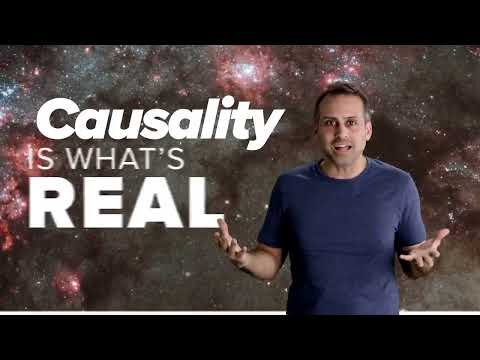
Are Space and Time An Illusion?
3.3M views • 11 years ago
PBS Space Time
A PBS Space Time episode hosted by Gabe Perez-Giz on the nature of spacetime and whether space and time are fundamental. It builds up reference frames and causality in a short, dense format.
 11:21
How does a whip break the sound barrier? (Slow Motion Shockwave formation) - Smarter Every Day 207
6.5M views • 7 years ago
SmarterEveryDay
Smarter Every Day uses high-speed and Schlieren photography to show how a whip crack is a supersonic shockwave formed at the tip. It references academic papers on whip physics.
 18:24
The Holographic Universe Explained
3.5M views • 7 years ago
PBS Space Time
A PBS Space Time episode explaining the holographic principle: the idea that our 3+1 dimensional universe may be described by information on a lower-dimensional boundary. It walks through black hole entropy and the AdS/CFT correspondence.
 16:07
The Geometry of Causality
1.8M views • 9 years ago
PBS Space Time
PBS Space Time explains how spacetime geometry and light cones determine the order of events and what can cause what. It visualizes causality in special relativity.
 13:43
Why Quantum Information is Never Destroyed
715K views • 8 years ago
PBS Space Time
A PBS Space Time episode asking whether the universe's information can ever truly be lost, tying quantum mechanics, determinism and black holes together. It sets up the black hole information paradox.
 18:02
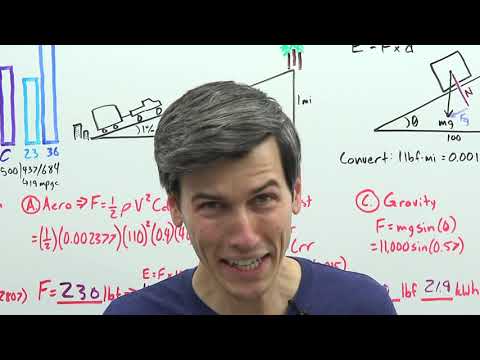
Why Teslas Are Bad At Towing (Today)
768K views • 6 years ago
Engineering Explained
Engineering Explained uses physics to show why today's electric cars, including Teslas, are poor at towing, pointing to battery energy density and weight. It examines Cybertruck and F-150 towing claims.
 8:25
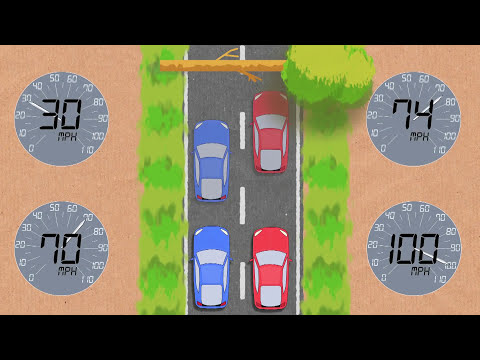
Calculating a Car Crash - Numberphile
446K views • 8 years ago
Numberphile
Numberphile's Ben Sparks works through the physics of a car crash, showing how kinetic energy grows with the square of speed and why stopping distance climbs so quickly as velocity increases.
 5:13
DR. QUANTUM - DOUBLE SLIT EXPERIMENT
1.6M views • 15 years ago
Angel Art
A short animated lesson, featuring Dr. Quantum, on the double slit experiment and how observing electrons seems to change their behavior.
 21:25
Outside In
11.7M views • 15 years ago
ssgelm
A 21-minute animation showing how a sphere can be turned inside out without creases or tears, known as sphere eversion.
 4:14
Computer Color is Broken
4.3M views • 11 years ago
minutephysics
MinutePhysics explains that computers store brightness nonlinearly, so blurring and blending colors in raw RGB gives wrong, dark results. It shows why mixed colors, such as in gradients, look off.
 17:35
Bell's Theorem: The Quantum Venn Diagram Paradox
8.1M views • 9 years ago
minutephysics
MinutePhysics, with 3Blue1Brown, explains Bell's theorem using a Venn diagram paradox and polarizing filters. It shows why no local hidden variable theory can reproduce quantum correlations.
 17:31
How Quantum Computers Break Encryption | Shor's Algorithm Explained
3.4M views • 7 years ago
minutephysics
MinutePhysics explains Shor's algorithm, showing how a quantum computer factors large integers by finding the period of a number modulo N. It walks through the modular arithmetic and number theory that give the exponential speedup over classical factoring, and why this threatens encryption.
 4:12
Correlation CAN Imply Causation! | Statistics Misconceptions
744K views • 9 years ago
minutephysics
A four-minute minutephysics video arguing that causal models and causal networks let statistics infer causation from correlation. It touches on Reichenbach's principle, common causes, feedback and quantum causal discovery.
 18:40
But what is a neural network? | Deep learning chapter 1
25.1M views • 9 years ago
3Blue1Brown
3Blue1Brown's first chapter on deep learning explains what neurons and layers are and the math underlying a basic neural network, using handwritten digit recognition with visual animations.
 4:48
Hans Rosling's 200 Countries, 200 Years, 4 Minutes - The Joy of Stats - BBC
11.5M views • 15 years ago
BBC
Hans Rosling uses augmented-reality animation to show 200 countries over 200 years in four minutes, built from 120,000 data points. It tracks life expectancy and income to show the world's development.
 12:46
The Speed of Light is NOT About Light
7.1M views • 11 years ago
PBS Space Time
PBS Space Time argues that the speed of light is better understood as the speed of causality, the universal limit on how fast cause and effect propagate. Light travels at that speed because it is massless, but the limit itself is a property of spacetime.
 31:51
Visualizing the 4d numbers Quaternions
5.6M views • 8 years ago
3Blue1Brown
3Blue1Brown builds visual intuition for quaternions, showing how to think about this four-dimensional number system using stereographic projection and rotations in 3D space. It is part one of a two-part series with an interactive companion site.
 6:51
Star Size Comparison 2
48.7M views • 10 years ago
morn1415
A visual scale comparison of stars and cosmic objects, from planets up to some of the largest known stars, set to music. It is meant to convey the vastness of the universe.
 13:02
Noether's Theorem and The Symmetries of Reality
1.1M views • 8 years ago
PBS Space Time
PBS Space Time explains Noether's theorem: conservation laws such as energy and momentum are consequences of deeper symmetries. It also covers why those laws hold only under certain conditions.
 24:47
But what is a Fourier series? From heat flow to drawing with circles | DE4
19M views • 7 years ago
3Blue1Brown
3Blue1Brown introduces Fourier series, from the heat equation to drawing arbitrary shapes with rotating circles. It builds a visual intuition for decomposing functions into sine waves.