queueing theory
 40:39
Category Theory in Life - Eugenia Cheng
113K views • 9 years ago
Lambda World
Eugenia Cheng gives the opening keynote at Lambda World 2017, presenting category theory as very abstract algebra whose abstraction gives it broad applicability. She applies it to everyday questions including privilege and prejudice.
 1:36:54
Category Theory by Tom LaGatta
73K views • 12 years ago
AI Council
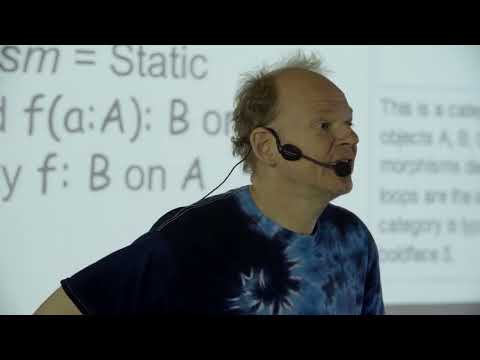
Tom LaGatta's talk on category theory at a 2014 LispNYC meetup, covering objects, morphisms and the basic ideas in an informal, conversational style. It runs about 97 minutes.
 1:03:14
Category Theory, The essence of interface-based design - Erik Meijer
74K views • 11 years ago
FooCafe
Erik Meijer argues that category theory is the mathematicians' version of interface-based design. He shows that Java 8 lambdas and method references form a Cartesian closed category.
 40:13
Zach Tellman - Everything Will Flow
27K views • 11 years ago
ClojureTV
Zach Tellman's Clojure West talk covers the basics of queueing theory and its practical use in systems, including backpressure, how queues break down under load, and pitfalls of naive core.async use.
 42:20
"Stop Rate Limiting! Capacity Management Done Right" by Jon Moore
41K views • 9 years ago
Strange Loop Conference
Jon Moore's Strange Loop 2017 talk argues that rate limiting is the wrong tool for protecting services from noisy clients. He proposes concurrency-based capacity management and quotas instead.
 45:31
New Horizons in Music: Polyrhythms | Loop
493K views • 8 years ago
Ableton
Adam Neely's Ableton Loop 2017 talk links rhythm, pitch and synaesthesia. He shows that polyrhythms sped up become chords, so tempo and pitch are related by ratios.
 39:21
Functional Composition - Chris Ford
31K views • 13 years ago
ClojureTV
Chris Ford builds up from a single sine wave through layered abstractions to a Bach canon, using Clojure and the Overtone audio environment. The talk shows music theory as a natural fit for functional programming.
 1:06:21
David Deutsch on Physics Without Probability
38K views • 11 years ago
Simon Benjamin
A 2015 talk by David Deutsch with slides and audio about constructor theory and how physics, in particular the many-worlds interpretation, can be framed without probability.
 57:21
An Observation on Generalization
210K views • 3 years ago
Simons Institute for the Theory of Computing
Ilya Sutskever gives a Simons Institute talk on why neural networks generalize, framing learning as finding short descriptions, like compression. It was part of the Large Language Models and Transformers program.
 1:32:08
Theory and Practice of Cryptography
73K views • 18 years ago
Google TechTalks
A Google Tech Talk by Steve Weis that introduces modern cryptography and its use in practice and at Google. It covers proofs of security and security definitions and a special topic. HN commenters treat it as a talk on verifiable electronic voting.
 52:06
K Lars Lohn - Keynote - PyCon 2016
42K views • 10 years ago
PyCon 2016
K Lars Lohn's PyCon 2016 keynote weaves together music theory, programming, biking road trips and fractals. It is a personal, wide-ranging talk rather than a Python how-to.
 53:46
Dasher: information-efficient text entry
7K views • 19 years ago
Google TechTalks
David MacKay's 2007 Google Tech Talk presents Dasher, a text-entry system driven by continuous gestures and a language model, reaching about 35 words per minute with one finger and 25 hands-free. It explains the information-theory reasoning behind the design.
 1:13:10
Parsing with Derivatives
13K views • 15 years ago
Stanford
A Stanford talk by Matthew Might on parsing with derivatives, a new way to write parsers, and why better parsing tools are needed. It discusses language theory and criticizes ad-hoc hand-written parsers.
 42:43
"Propositions as Types" by Philip Wadler
143K views • 11 years ago
Strange Loop Conference
Philip Wadler's Strange Loop talk on Propositions as Types, the link between logic and computation (the Curry-Howard correspondence). He traces its history through Church, Godel and Turing and shows how it shaped theorem provers and programming languages.
 1:07:22
Invited Talk - Guy Steele
39K views • 9 years ago
ClojureTV
Guy Steele's invited talk at Clojure/conj on the informal metanotation computer scientists use in papers to describe languages. He traces how this notation developed and why it is often unspecified and arcane.
 1:30:45
The Simple Essence of Automatic Differentiation - Conal Elliott
17K views • 8 years ago
Microsoft Research
Conal Elliott presents his paper on automatic differentiation, deriving a simple, generalized AD algorithm from a natural specification. Varying the representation of derivatives yields forward and reverse mode algorithms that avoid the complexity and statefulness of backpropagation.
 1:12:12
2017 ACM PPoPP Keynote: It's Time for a New Old Language
7K views • 9 years ago
Guy Steele
Guy Steele's PPoPP 2017 keynote surveying the history of computer science metanotation, including BNF, inference rules, and overline notation. He argues the field's notations are inconsistent and fragmented.
 1:54:46
Lenses, Folds, and Traversals
54K views • 13 years ago
Edward Kmett
Edward Kmett's talk to the NY Haskell User Group on the lens library, building from fmap and function composition up to lenses, folds and traversals. It shows how these composable combinators access and modify parts of data structures.
 1:00:52
Joscha: From Computation to Consciousness (31c3)
28K views • 11 years ago
Joscha Bach
Joscha Bach's 31c3 talk argues that the mind should be understood as an information-processing system and that even the physical universe can be seen as computational. It tours the philosophy underlying artificial intelligence and cognitive science.
 56:58
Philip Wadler - Propositions as Types (Lambda Days 2016)
20K views • 10 years ago
Erlang Solutions
Philip Wadler's Lambda Days talk on propositions as types, the link between logic and computation that underlies theorem provers and programming language design.
 38:36
"A Little Taste of Dependent Types" by David Christiansen
48K views • 8 years ago
Strange Loop Conference
David Christiansen gives a Strange Loop 2018 introduction to dependent types, where one language serves for both compile-time and run-time code and programs unite with proofs. It draws on his book The Little Typer.
 49:43
Nima Arkani-Hamed: The End of Space-Time
254K views • 4 years ago
Max-Planck-Institut für Physik
Theoretical physicist Nima Arkani-Hamed gives a public talk on why spacetime may not be fundamental and what might replace it, including newer approaches to scattering amplitudes.
 38:47
RailsConf 2014 - All the Little Things by Sandi Metz
190K views • 12 years ago
Confreaks
Sandi Metz takes an ugly section of conditional code and refactors it into a few simple objects, bridging object-oriented theory and practice. The talk includes her take on the Gilded Rose refactoring kata and the idea that duplication is cheaper than the wrong abstraction.
 59:23
28c3: The Science of Insecurity
42K views • 14 years ago
28c3
Meredith Patterson and Sergey Bratus argue that networked software stays insecure because protocols and inputs are too complex to recognize safely. They propose using formal language theory and grammars to build secure, verifiable input handling.
 37:41
EPC2018 | Wave Function Collapse in Bad North | Oskar Stalberg
176K views • 8 years ago
BUas Games
Oskar Stalberg explains how Wave Function Collapse assembles island dioramas from handcrafted tilesets in Bad North. He covers the theory, implementation, tooling, and how he blends art and technology.
 1:01:45
Information, Evolution, and intelligent Design - With Daniel Dennett
586K views • 11 years ago
The Royal Institution
Daniel Dennett gives a Royal Institution talk toward a unified theory of information, tying together evolution, learning and engineering. He argues that design can arise bottom-up through small steps without a designer.
 1:04:45
Stanford Seminar - Concatenative Programming: From Ivory to Metal
14K views • 8 years ago
Stanford Online
Jon Purdy's Stanford EE380 seminar giving an overview of concatenative programming, from function composition theory and history down to low-level implementation and correctness benefits.
 49:47
Monads and Gonads
148K views • 13 years ago
Google TechTalks
Douglas Crockford's Google Tech Talk explains monads without category theory or Haskell, implementing them in JavaScript and tying them to Ajax and promises. He also touches on odd asides such as coloring code by scope.
 19:31
How Will You Measure Your Life? Clay Christensen at TEDxBoston
1.3M views • 14 years ago
TEDx Talks
Clayton Christensen's TEDx talk applying business theory to personal life. He argues that career success is not the right measure of a life and urges attention to relationships and values.
 42:31
"Datafun: a functional query language" by Michael Arntzenius
9K views • 9 years ago
Strange Loop Conference
Michael Arntzenius's Strange Loop talk on Datafun, a functional query language that brings database-style querying into a general-purpose language. It discusses bridging database theory and programming languages.
 1:15:05
The Stuff of Thought | Steven Pinker | Talks at Google
419K views • 19 years ago
Talks at Google
Steven Pinker presents his book The Stuff of Thought at Google in 2007. He covers language as a window into human nature, including taboo words, swearing and the psychology and game theory of indirect speech like bribery.
 17:04
The dirty secret of capitalism -- and a new way forward | Nick Hanauer
3.2M views • 7 years ago
TED
A TED talk by entrepreneur Nick Hanauer arguing that decades of 'greed is good' economic theory drove inequality and instability. He proposes an economics built on reciprocity and cooperation.
 52:23
Nicholas Zakas: Scalable JavaScript Application Architecture
68K views • 15 years ago
YUI Library
Nicholas Zakas of Yahoo discusses architecture for large, modular JavaScript web applications. He lays out the theory behind building front ends that scale in complexity.
 18:29
You aren't at the mercy of your emotions -- your brain creates them | Lisa Feldman Barrett
3.2M views • 8 years ago
TED
Psychology professor Lisa Feldman Barrett presents her research on what emotions are, arguing that the brain constructs them rather than reading them off faces. She says this means we have more control over our emotions than we think.
 1:02:06
Building Brains to Understand the World's Data
84K views • 13 years ago
Google TechTalks
Jeff Hawkins presents his view that the neocortex works on principles different from traditional computers. He describes sparse distributed representations and how they are learned, then shows how Numenta applies them to predict from high-velocity data streams.
 53:29
Politics and Language | Noam Chomsky | Talks at Google
414K views • 18 years ago
Talks at Google
Noam Chomsky gives a Talks at Google lecture covering his work on politics and language. It touches on his linguistic theory, including universal grammar, alongside his political criticism.
 22:51
NIPS 2017 Test of Time Award "Machine learning has become alchemy.” | Ali Rahimi, Google
26K views • 8 years ago
Preserve Knowledge
Ali Rahimi accepts the NIPS 2017 Test of Time Award and argues that machine learning has become alchemy, with practice running ahead of understanding.