rendering performance
 1:21
Improving VR with NVIDIA’s Foveated Rendering
110K views • 10 years ago
NVIDIA
A one-minute NVIDIA research demo of foveated rendering for VR using SMI eye tracking. It renders at full detail only where the eye is looking, matching the physiology of human vision.
 56:55
AWS re:Invent 2017: How Netflix Tunes Amazon EC2 Instances for Performance (CMP325)
18K views • 8 years ago
Amazon Web Services
A Netflix performance engineer presents how Netflix tunes EC2 instances, covering instance type choice, Xen modes, SR-IOV and kernel tuning. The goal is near bare-metal performance in the cloud.
 31:17
React.js Conf 2015 - Hype!
108K views • 11 years ago
Meta Developers
Ryan Florence's React.js Conf 2015 talk pushes React into unusual use cases, including a demo comparing rendering in React, Ember and Angular.
 1:13:41
CppCon 2014: Chandler Carruth "Efficiency with Algorithms, Performance with Data Structures"
235K views • 12 years ago
CppCon
Chandler Carruth's CppCon 2014 talk on writing fast C++, explaining why data structure choice and memory layout matter more than clever algorithms. It covers why standard containers like unordered_map perform poorly on modern CPUs.
 1:30:53
C++Now 2018: You Can Do Better than std::unordered_map: New Improvements to Hash Table Performance
63K views • 8 years ago
CppNow
Malte Skarupke's C++Now 2018 talk on hash table performance, explaining why std::unordered_map is slow and memory hungry and presenting faster designs, including his bytell hash map.
 42:15
"Performance Matters" by Emery Berger
502K views • 7 years ago
Strange Loop Conference
Emery Berger explains why performance is hard to measure and deliver on modern hardware, showing how code layout and alignment can swamp optimization effects. He presents Stabilizer for statistically sound evaluation and Coz, a causal profiler.
 35:42
Progressive Performance (Chrome Dev Summit 2016)
34K views • 9 years ago
Chrome for Developers
Alex Russell's Chrome Dev Summit 2016 talk on building web experiences that work on slow, flaky networks and low-power devices. It argues developers should focus on the performance of real-world mobile hardware rather than desktop machines.
 33:25
Dan Abramov: Beyond React 16 | JSConf Iceland
139K views • 8 years ago
JSConf
Dan Abramov's JSConf Iceland talk on what came after React 16, with live-coded prototypes of async rendering and time slicing. It previews the ideas that became concurrent mode and suspense.
 1:29:54
CppCon 2015: Chandler Carruth "Tuning C++: Benchmarks, and CPUs, and Compilers! Oh My!"
188K views • 11 years ago
CppCon
Chandler Carruth walks through tuning C++ performance, from writing benchmarks to analyzing results on real CPUs and compilers. It focuses on small-scale problems such as loop kernels, data structures and algorithms, and on keeping compilers from optimizing benchmarks away.
 59:21
A Crash Course in Modern Hardware by Cliff Click
21K views • 9 years ago
Devoxx
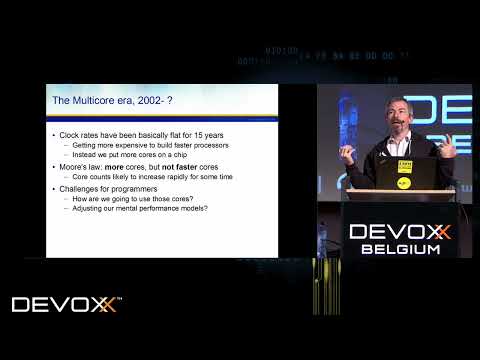
Cliff Click walks through a small performance example on a modern out-of-order CPU. He covers pipelining, ILP, CISC vs RISC, multicore, and why cache misses and the memory subsystem dominate performance.
 15:00
Fastest browser engine by far at 500 FPS! Servo Webrender - CSS on the GPU part 1: Rust
19K views • 10 years ago
𝓖𝓷𝓸𝓶𝓮💫𝓢𝓪𝓷𝓮
An excerpt from a Bay Area Rust meetup on Servo's WebRender, which renders CSS display lists on the GPU at very high frame rates. It explains the approach and demos rendering at around 500 FPS.
 55:49
CppCon 2016: Chandler Carruth “High Performance Code 201: Hybrid Data Structures"
119K views • 10 years ago
CppCon
Chandler Carruth's CppCon 2016 talk on designing hybrid data structures for performance. He covers cache locality, working-set size and allocation overhead, and why standard C++ containers fall short.
 7:43
Unlimited Detail Real-Time Rendering Technology Preview 2011 [HD]
4.4M views • 15 years ago
Axiom Holographics
Euclideon's 2011 technology preview of Unlimited Detail, a rendering approach claiming unlimited geometric detail in real time via point-cloud style data. The company promised more to come while keeping most work secret.
 0:14
Chrome vs Firefox vs Safari vs Servo WebRender
121K views • 10 years ago
Jake Archibald
A short side-by-side recording by Jake Archibald of the same animation demo running in Chrome, Firefox, Safari and Servo WebRender nightlies on a 60Hz display. It shows the smoothness difference of GPU-based rendering.
 18:50
Creating a Doom-style 3D engine in C
991K views • 11 years ago
Bisqwit
Bisqwit builds a Doom or Duke Nukem 3D style software-rendered 3D engine in C from scratch, supporting non-Euclidean geometry. It covers vector rotation and portal rendering with sped-up, tool-assisted coding.
 1:00:07
CppCon 2017: Carl Cook “When a Microsecond Is an Eternity: High Performance Trading Systems in C++”
357K views • 9 years ago
CppCon
Optiver's Carl Cook explains how to build high-frequency trading systems in C++, where the critical path runs rarely but must be extremely fast. He covers techniques for low and predictable latency, including avoiding main memory and cache misses.
 30:37
High-performance Tree Wrangling, the APL Way // Aaron Hsu // Dyalog '18
6K views • 7 years ago
Dyalog User Meetings
Aaron Hsu shows how to manipulate and transform tree data in APL using arrays and inverted tables instead of pointers. He claims much smaller code, better performance and easier parallelisation.
 18:27
Dan Tepfer: NPR Music Tiny Desk Concert
133K views • 7 years ago
NPR Music
A Tiny Desk concert in which pianist Dan Tepfer plays with a Disklavier player piano driven by a program he wrote that responds to his playing. He performs four pieces from his Natural Machines project.
 25:55
React.js Conf 2015 - Beyond the DOM: How Netflix plans to enhance your television experience
26K views • 11 years ago
Meta Developers
Jafar Husain of Netflix explains at React.js Conf 2015 how Netflix runs React-style rendering without the DOM on smart TVs and game consoles. It uses a canvas-like API for performance.
 1:06:37
Destiny's Multithreaded Rendering Architecture
45K views • 11 years ago
GDC Festival of Gaming
A GDC 2015 talk in which Natalya Tatarchuk describes the multithreaded renderer Bungie built for Destiny. It covers the low-latency architecture across platforms, its successes and its challenges.
 14:59
Piano Phase (solo) - First solo performance ever
767K views • 15 years ago
Rob Kovacs
A solo performance of Steve Reich's Piano Phase, with one pianist playing both parts, recorded in 2004 with Reich in attendance. It is a 15-minute minimalist phasing piece.
 45:49
Breaking the 1000ms Time to Glass Mobile Barrier
104K views • 13 years ago
InfoQ
Ilya Grigorik of Google's Make the Web Fast team explains how to build a mobile site that appears on screen within one second. He covers the network and rendering constraints on mobile.
 9:10
The Who - Won't Get Fooled Again (Shepperton Studios / 1978)
27.4M views • 7 years ago
TheWhoVEVO
The Who performing Won't Get Fooled Again at Shepperton Studios in 1978, filmed for The Kids Are Alright. It was Keith Moon's last performance with the band.
 1:27:46
CppCon 2014: Mike Acton "Data-Oriented Design and C++"
862K views • 12 years ago
CppCon
Mike Acton of Insomniac Games argues that a program's purpose is transforming data, and shows how common C++ approaches work against that in performance-critical game development. He covers cache behavior, data layout and the limits of compilers.
 30:46
Alex Evans at Umbra Ignite 2015: Learning From Failure
68K views • 11 years ago
Media Molecule
Media Molecule's Alex Evans recounts the journey, including the failures, of finding the Dreams engine, based on his Siggraph 2015 talk. It covers the signed-distance-field and splat-based rendering approach and the artistic goals behind it.
 1:05:56
Steve Reich, "Music for 18 Musicians" - FULL PERFORMANCE with eighth blackbird
2.7M views • 14 years ago
Vic Firth
A full performance of Steve Reich's Music for 18 Musicians by eighth blackbird with Third Coast Percussion and others, recorded in Chicago in 2011. It is an hour-long minimalist piece built on phasing and repeating patterns.
 1:00:58
CppCon 2017: Chandler Carruth “Going Nowhere Faster”
113K views • 9 years ago
CppCon
Chandler Carruth shows how to squeeze more performance out of already-optimized C++ code, covering how the CPU executes it. The talk goes into pipelining, branch prediction and speculative execution using benchmarks.
 45:05
Servo Architecture: Safety and Performance
12K views • 9 years ago
linux conf au 2017 - Hobart, Australia
Jack Moffitt presents the architecture of Servo, Mozilla's experimental browser engine written in Rust, focusing on parallelism across cores, GPUs and SIMD and the safety properties gained from Rust.
 1:00:46
CppCon 2018: Stoyan Nikolov “OOP Is Dead, Long Live Data-oriented Design”
271K views • 8 years ago
CppCon
A CppCon 2018 talk arguing that OOP has failed to deliver on reuse and performance, and presenting data-oriented design for C++ with practical worked examples from real systems.
 3:58
Marble Marcher - A Fractal Physics Game
1.7M views • 7 years ago
CodeParade
A demo of Marble Marcher, a game using a fractal physics engine and fully procedural ray-marched rendering. The player rolls a marble through shifting fractal levels.
 49:16
XFS: Recent and Future Adventures in Filesystem Scalability - Dave Chinner
29K views • 14 years ago
Linux.conf.au 2012 -- Ballarat, Australia
Dave Chinner's linux.conf.au 2012 talk on XFS scalability, covering pain points with large numbers of files and complex metadata, and the work to fix XFS metadata performance.
 55:42
CppCon 2019: Matt Godbolt “Path Tracing Three Ways: A Study of C++ Style”
77K views • 7 years ago
CppCon
Matt Godbolt builds a toy path tracer in C++ in three different styles and compares them on clarity, testability, compile time and run-time performance. The talk was given at CppCon 2019.
 33:23
ReactiveConf 2017 - Tom Dale: Secrets of the Glimmer VM
3K views • 8 years ago
ReactiveConf
Tom Dale explains the internals of the Glimmer VM, Ember's rendering engine, which compiles templates to opcodes. The talk includes a performance benchmark demo.
 3:51
2013 Sci-Tech Awards: Matt Pharr, Greg Humphreys and Pat Hanrahan
24K views • 12 years ago
Oscars
The Academy's 2014 Sci-Tech Awards segment honoring Matt Pharr, Greg Humphreys and Pat Hanrahan for their physically based rendering work and book. The authors give a short acceptance speech that thanks Donald Knuth for literate programming.
 0:59
One man band
830 views • 10 years ago
Rochus Keller
A one-minute clip of Rochus Keller performing as a one-man band: slap bass with the left hand, Rhodes and lead guitar with the right, and drums with the feet.
 23:32
Industrial Strength High Performance RISC V Processors For Energy Efficient Computing
8K views • 8 years ago
RISC-V International
David Ditzel of Esperanto Technologies presents their massively parallel, energy-efficient RISC-V processors at the 7th RISC-V Workshop in 2017. It covers the high-performance many-core design aimed at machine learning.
 47:34
RailsConf 2011: Aaron Patterson, "Double Dream Hands: So Intense!"
26K views • 15 years ago
O'Reilly
Aaron Patterson's RailsConf 2011 talk on Rails 3.1 performance, showing why deeper Rack middleware stacks slow Rails and how a shallower pipeline helps. It also touches on Rack API design.
 0:13
Star Trek TNG (Peak Performance) Picard Quote - It is possible to commit no mistakes and still lose.
135K views • 10 years ago
Ponyboy
A very short clip from Star Trek: The Next Generation's 'Peak Performance' in which Picard says it is possible to commit no mistakes and still lose. It is a single quotable moment about how outcomes are not fully in your control.
 1:15
Star Trek TNG Peak Performance: It is possible to commit no mistakes and still lose. Full Scene
453K views • 10 years ago
Ponyboy
A short scene from Star Trek TNG season 2, episode 'Peak Performance', in which Picard tells Data that it is possible to commit no mistakes and still lose. He says that is not a weakness but life.
 1:29:55
Sorting Algorithms: Speed Is Found In The Minds of People - Andrei Alexandrescu - CppCon 2019
184K views • 7 years ago
CppCon
Andrei Alexandrescu's CppCon 2019 talk revisits sorting, showing how branchless tricks, hybrid strategies and a cost metric can speed up std::sort-style algorithms on modern hardware.