repl
 1:47:35
Bryan Cantrill on ARC: A Self-Tuning, Low Overhead Replacement Cache [PWL SF] 10/2017
13K views • 9 years ago
PapersWeLove
Bryan Cantrill presents the ARC (Adaptive Replacement Cache) paper by Megiddo and Modha at Papers We Love. He opens with a survey of caching strategies before digging into the self-tuning LRU/MFU design.
 38:03
Replace Your Exploit-Ridden Firmware with Linux - Ronald Minnich, Google
73K views • 9 years ago
The Linux Foundation
Ronald Minnich of Google explains how UEFI firmware is a large closed attack surface and describes Google's work replacing it with Linux-based boot firmware. It also touches on Intel ME and other security coprocessors.
 4:27
The Voting System That Should Replace Every Election
4.7M views • 15 years ago
CGP Grey
A short CGP Grey explainer on the alternative vote (instant runoff voting) versus first past the post, made around the 2011 UK referendum. It shows how ranked ballots are tallied and why they avoid spoiler effects.
 12:22
Is Most Published Research Wrong?
6.2M views • 10 years ago
Veritasium
Veritasium explains why a large share of published research findings may be false, covering p-values, p-hacking, publication bias and low replication rates. It draws on John Ioannidis's well-known paper and describes reforms such as preregistration.
Topic match · Scientific method & science communication 1:53
Richard Feynman on Pseudoscience
363K views • 10 years ago
Jacob Edward
A two-minute clip of Richard Feynman explaining why he considers much of social science pseudoscience. He stresses how easy it is to fool yourself and how much care real knowledge takes.
Topic match · Scientific method & science communication 19:28
Scientific Studies: Last Week Tonight with John Oliver (HBO)
18.1M views • 10 years ago
LastWeekTonight
John Oliver's Last Week Tonight segment on how media outlets report incomplete or untrue findings as settled science. It covers sensational headlines, small studies and pressure on researchers.
Topic match · Scientific method & science communication 23:55
Soylent: How I Stopped Eating for 30 Days
4.1M views • 12 years ago
Motherboard
A Motherboard documentary in which a reporter lives on nothing but Soylent for 30 days after founder Rob Rhinehart's own experiment. It looks at the effects on health, Silicon Valley and the future of food.
 1:52
R. P. Feynman on social sciences
210K views • 16 years ago
x1x2x3ct
A two-minute clip of Richard Feynman on the social sciences, discussing what counts as real science versus pseudo science.
Topic match · Scientific method & science communication 36:42
Bottom Up vs Top Down Design in Clojure - Mark Bastian
29K views • 10 years ago
ClojureTV
Mark Bastian contrasts top-down object-oriented design with bottom-up, data-oriented design in Clojure. He models a board game as plain data plus small composable functions and compares it with a roughly 22-class OOP version.
 9:09
Animations of unseeable biology | Drew Berry | TED
2.7M views • 14 years ago
TED
Drew Berry shows scientifically accurate animations of molecular processes inside cells, such as DNA replication, at TEDxSydney.
 28:00
APL demonstration 1975
111K views • 13 years ago
Imperial College London
A 1975 live demonstration of the APL language by Imperial College professor Bob Spence, showing a REPL on a modified typewriter terminal and APL's appeal to non-programmers.
 3:00:06
Christophe Pettus - PostgreSQL Proficiency for Python People - PyCon 2016
8K views • 10 years ago
PyCon 2016
A three-hour PyCon 2016 tutorial by Christophe Pettus that orients Python developers to PostgreSQL. It covers installation, administration, and use, including vacuuming, MVCC, replication and backups.
 55:29
Marco Baringer's SLIME Tutorial Video
33K views • 15 years ago
손주일 (Cecil)
Marco Baringer's tutorial video on SLIME, the Emacs mode for developing Common Lisp. It demonstrates the interactive workflow of working against a live Lisp image.
 16:48
Yesterday's Computer of Tomorrow: The Xerox Alto │Smalltalk-76 Demo
38K views • 8 years ago
Computer History Museum
A Computer History Museum demonstration with Dan Ingalls of Smalltalk-76 running on a Xerox Alto, recorded in 2017. He shows the live environment and discusses the system.
 40:31
Understanding Specter: Clojure's missing piece
12K views • 9 years ago
Misophistful
A screencast tutorial on Specter, a Clojure library for navigating and transforming nested data structures declaratively, demonstrated in a REPL.
 49:27
DConf 2019: All Spreadsheets Must Die -- Robert Schadek
5K views • 7 years ago
The D Language Foundation
A DConf 2019 talk by Robert Schadek arguing that spreadsheets are the world's dominant programming language and that D can be used to replace them. It looks at spreadsheet quirks and then at techniques for moving away from them.
 46:22
"Clojure in Unity 3D: Functional Video Game Development" by Ramsey Nasser and Tims Gardner
24K views • 12 years ago
Strange Loop Conference
A Strange Loop talk presenting an open-source library that integrates Clojure into the Unity 3D game engine. It covers REPL-based live coding, macros, DSLs and persistent data structures for game development.
 42:03
The Soul of Erlang and Elixir • Sasa Juric • GOTO 2019
384K views • 7 years ago
GOTO Conferences
Sasa Juric explains what makes Erlang and Elixir suited to server-side systems, focusing on the BEAM concurrency model rather than syntax or ecosystem. He demonstrates processes, supervision, and fault tolerance.
Topic match · Distributed systems 1:03:43
The Quantum Conspiracy: What Popularizers of QM Don't Want You to Know
1.8M views • 15 years ago
Google TechTalks
Ron Garret's Google Tech Talk argues that quantum mechanics is no harder to understand than relativity and that popular accounts wrongly rely on the Copenhagen interpretation. He presents measurement as entanglement and explains phenomena like the quantum eraser.
Topic match · Scientific method & science communication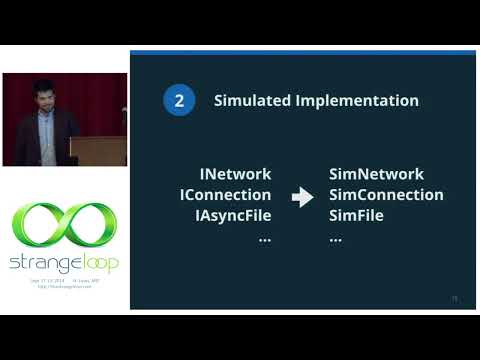 40:20
"Testing Distributed Systems w/ Deterministic Simulation" by Will Wilson
55K views • 12 years ago
Strange Loop Conference
Will Wilson of FoundationDB explains how the team tested their distributed database using deterministic simulation. By running the whole system in a simulator with injected faults and reproducible seeds, they could find rare concurrency and network bugs.
Topic match · Distributed systems 49:22
James Burke Connections, Ep. 1 "The Trigger Effect"
764K views • 7 years ago
DRS_Education
The first episode of James Burke's 1978 BBC series Connections traces modern dependence on complex technological networks, starting with the 1965 New York blackout, and moves through ancient agriculture to Kuwait's oil-driven leap.
Topic match · Scientific method & science communication 44:19
Hamming, "You and Your Research" (June 6, 1995)
368K views • 14 years ago
securitylectures
Richard Hamming's 1995 recording of his talk 'You and Your Research', drawn from his graduate engineering course. He discusses how great scientists pick important problems and build careers, drawing on his years at Bell Labs.
Topic match · Scientific method & science communication 49:15
Erlang Factory 2014 - That's 'Billion' with a 'B': Scaling to the Next Level at WhatsApp
50K views • 12 years ago
Erlang Solutions
Rick Reed of WhatsApp explains at Erlang Factory 2014 how the service scaled to billions of messages with a very small engineering team. He covers the FreeBSD and Erlang stack, Mnesia usage, server counts and bottleneck work.
Topic match · Distributed systems 47:43
"Turning the database inside out with Apache Samza" by Martin Kleppmann
205K views • 12 years ago
Strange Loop Conference
Martin Kleppmann argues that databases are global shared mutable state and proposes treating them as an ever-growing log of immutable facts. Derived data such as caches, indexes and views is then built by stream processors like Apache Samza. The talk draws on Kafka and LinkedIn's experience with commit logs.
Topic match · Distributed systems 1:02:50
The Language of the System - Rich Hickey
174K views • 13 years ago
ClojureTV
Rich Hickey's 2013 talk applies language-design thinking to whole systems, covering names, queues, data, failure, and the interfaces between programs. It ends with a call to action for building systems holistically.
Topic match · Distributed systems 51:27
Google I/O 2012 - Go Concurrency Patterns
894K views • 14 years ago
Google for Developers
Rob Pike's Google I/O 2012 talk shows how goroutines and channels solve tricky concurrency problems with simple Go code. It features a playful goroutine demo with gophers passing messages and a search engine example.
Topic match · Distributed systems 9:01
Powers of Ten™ (1977)
9.5M views • 16 years ago
Eames Office
The Eames Office's 1977 film Powers of Ten starts at a picnic in Chicago and zooms out by a factor of ten every ten seconds to the edge of the universe. It then zooms inward to a proton in a carbon atom.
Topic match · Scientific method & science communication 51:36
Conflict Resolution for Eventual Consistency • Martin Kleppmann • GOTO 2016
46K views • 9 years ago
GOTO Conferences
Martin Kleppmann's GOTO Berlin 2016 talk on how collaborative editors, offline apps, and multi-datacenter databases handle concurrent updates. It covers conflict resolution approaches including operational transformation and CRDTs, with a worked look at text CRDTs.
Topic match · Distributed systems 41:06
"Unison: a new distributed programming language" by Paul Chiusano
45K views • 7 years ago
Strange Loop Conference
Paul Chiusano's Strange Loop 2019 talk introduces Unison, an open-source functional language for distributed, elastic systems. It covers content-addressed code identified by hashes of the syntax tree, a codebase manager, and algebraic effects called abilities.
Topic match · Distributed systems 9:59
Feynman on Scientific Method.
2.4M views • 15 years ago
seabala
A short clip of Richard Feynman explaining the scientific method: guess, compute consequences, compare to experiment, and why vague theories like astrology cannot be proven wrong.
Topic match · Scientific method & science communication 1:56:08
DEF CON 26 - Svea, Suggy, Till - Inside the Fake Science Factory
184K views • 8 years ago
DEFCONConference
A DEF CON 26 talk by investigative journalists and hackers on the fake science industry, with bogus conferences and predatory journals that give studies false credibility. It draws on a large investigation into the money behind them.
Topic match · Scientific method & science communication 18:31
The LED Traffic Light and the Danger of "But Sometimes!"
4.2M views • 8 years ago
Technology Connections
Technology Connections explains how LED traffic lights, which do not melt snow, drew complaints and were blamed for accidents. He uses it to illustrate the 'but sometimes' fallacy against new technology.
Topic match · Scientific method & science communication 1:06:34
Paxos lecture (Raft user study)
114K views • 13 years ago
Diego Ongaro
John Ousterhout's slides-and-voiceover lecture on Paxos, made for the Raft user study comparing how students learn Raft and Paxos. It is a full introduction to the Paxos consensus algorithm.
Topic match · Distributed systems 42:34
Hewitt, Meijer and Szyperski: The Actor Model (everything you wanted to know...)
131K views • 13 years ago
jasonofthel33t
A standing whiteboard conversation at Lang.NEXT 2012 among Carl Hewitt, Erik Meijer and Clemens Szyperski about the actor model. Hewitt, who originated the model, explains its foundations.
Topic match · Distributed systems 7:35
Feynman: Magnets (and Why?) FUN TO IMAGINE 4/ higher quality version!
359K views • 8 years ago
Christopher Sykes
A 1983 BBC interview in which Richard Feynman is asked how magnets work and explains why 'why' questions are hard to answer in everyday terms. He reflects on what counts as an explanation and the limits of analogy.
Topic match · Scientific method & science communication 58:36
Advanced Topics in Programming Languages: A Lock-Free Hash Table
29K views • 14 years ago
GoogleTalksArchive
A 2007 Google Tech Talk in which Cliff Click of Azul Systems presents a lock-free concurrent hash table that scales to 768 CPUs. He explains why it is correct by reasoning in a different way than usual happens-before and memory-order arguments.
Topic match · Distributed systems 52:29
"I See What You Mean" by Peter Alvaro
59K views • 11 years ago
Strange Loop Conference
Peter Alvaro's Strange Loop 2015 talk argues that query languages let you state what you mean, and applies that to distributed programming. It covers Datalog, Dedalus and the Bloom lineage for reasoning about distributed systems.
Topic match · Distributed systems 38:53
ElixirConf 2018 - Docker and OTP Friends or Foes - Daniel Azuma
16K views • 8 years ago
ElixirConf
Daniel Azuma's ElixirConf 2018 talk on whether Docker and OTP conflict. He shows they can coexist and uses Horde and DeltaCrdt, with a live tank-game demo, to keep state alive across container kills.
Topic match · Distributed systems 59:50
Leslie Lamport: Thinking Above the Code
403K views • 12 years ago
Microsoft Research
Leslie Lamport argues that programmers, like architects, should write rigorous specifications before coding, especially for concurrent and distributed systems. The talk introduces the case for writing specs (the TLA+ mindset) as a way of thinking above the code.
Topic match · Distributed systems 40:13
Zach Tellman - Everything Will Flow
27K views • 11 years ago
ClojureTV
Zach Tellman's Clojure West talk covers the basics of queueing theory and its practical use in systems, including backpressure, how queues break down under load, and pitfalls of naive core.async use.
Topic match · Distributed systems