second reality
 14:27
Why is TV 29.97 frames per second?
2.2M views • 10 years ago
Stand-up Maths
Matt Parker explains the history behind NTSC television running at 29.97 frames per second rather than 30, tracing it to the backward-compatible addition of color. He walks through the arithmetic behind the odd ratio.
 6:00
Super Pointy Sprint Missile - 0 to Mach 10 in 15 Seconds - 100Gs & 6000°F
459K views • 6 years ago
Dark Footage
A short video on the US Sprint anti-ballistic missile, which accelerated to around Mach 10 in seconds under extreme g-forces and heat. It includes striking launch footage and a brief development history.
 14:03
The Computer Designed To Die In Microseconds
408K views • 3 years ago
Scott Manley
Scott Manley tells the story of a computerized telemetry system built to sit at the heart of a nuclear test device in place of the plutonium pit, designed to transmit data in the microseconds before it was destroyed.
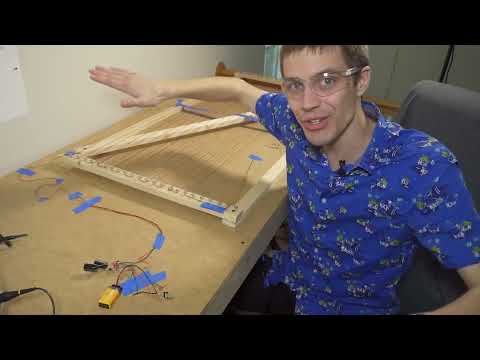 26:29
Watch electricity hit a fork in the road at half a billion frames per second
3M views • 2 years ago
AlphaPhoenix
AlphaPhoenix uses a custom high-speed measurement setup to watch voltage waves travel down wires and split at a fork. It answers how electricity knows where to go and how quickly that process happens.
 13:02
Noether's Theorem and The Symmetries of Reality
1.1M views • 8 years ago
PBS Space Time
PBS Space Time explains Noether's theorem: conservation laws such as energy and momentum are consequences of deeper symmetries. It also covers why those laws hold only under certain conditions.
 10:31
Wendelstein 7-X – from concept to reality
497K views • 12 years ago
Max-Planck-Institut für Plasmaphysik
A CAD-based animation from the Max Planck Institute for Plasma Physics showing how the Wendelstein 7-X stellarator is configured and what its fusion research aims to achieve. It runs about 11 minutes.
 4:48
Hans Rosling's 200 Countries, 200 Years, 4 Minutes - The Joy of Stats - BBC
11.5M views • 15 years ago
BBC
Hans Rosling uses augmented-reality animation to show 200 countries over 200 years in four minutes, built from 120,000 data points. It tracks life expectancy and income to show the world's development.
 12:50
How close is nuclear fusion power?
764K views • 5 years ago
Sabine Hossenfelder
Sabine Hossenfelder explains how close nuclear fusion really is to break-even, and why headlines about ITER and lab milestones are misleading. She distinguishes plasma gain (Q plasma) from whole-system gain (Q total) and shows the latter is still far below one.
 1:03:31
4.5 Billion Years in 1 Hour
17.9M views • 2 years ago
Kurzgesagt – In a Nutshell
Kurzgesagt's hour-long animated film that compresses Earth's 4.5 billion year history into one hour, roughly a million years per second. It follows the evolution of life through to humanity's tiny final stretch.
 6:48
Why Age? Should We End Aging Forever?
9M views • 9 years ago
Kurzgesagt – In a Nutshell
Kurzgesagt's short animated video asks whether humanity should try to end aging, and argues the case for curing age-related disease. It is part one of a pair, with a second part by CGP Grey.
 23:29
How Imaginary Numbers Were Invented
22.7M views • 5 years ago
Veritasium
Veritasium tells the history of how imaginary numbers arose from the quest for a general solution to the cubic equation, including the duels and secrecy among Renaissance mathematicians. It argues math had to give up the requirement that it mirror reality.
 20:33
Gradient descent, how neural networks learn | Deep Learning Chapter 2
9.7M views • 9 years ago
3Blue1Brown
3Blue1Brown's second neural network chapter explains cost functions and gradient descent, showing how a network learns by minimizing error during training.
 16:58
Reynolds Number - Numberphile
560K views • 7 years ago
Numberphile
Numberphile with Tom Crawford of Oxford explains the Reynolds number, the second of three videos on Navier-Stokes and fluid flow, with demonstrations of laminar versus turbulent behavior.
 16:30
Why is light slower in glass? - Sixty Symbols
848K views • 13 years ago
Sixty Symbols
Professor Mike Merrifield of Nottingham explains in a mostly uncut conversation why light travels slower in glass. He treats light as a wave and describes how the material's electrons produce secondary waves that combine to slow it.
 15:14
The most deadly project on the Internet
6.8M views • 4 years ago
bigclivedotcom
BigClive explains why microwave oven transformer projects are extremely dangerous, since the high voltage and high current can kill. He contrasts them with spot welder builds where the secondary is replaced by low-voltage heavy wire.