signal processing
 12:31
The Superheterodyne Radio: No really, that's its name
987K views • 7 years ago
Technology Connections
Technology Connections explains why the superheterodyne radio has its name and how mixing frequencies lets it tune stations well. It walks through the underlying wave phenomena and algebra and why the design solved a hard tuning problem.
Topic match · Information theory & signal processing 19:42
But what is the Fourier Transform? A visual introduction.
12.6M views • 8 years ago
3Blue1Brown
3Blue1Brown's animated visual introduction to the Fourier Transform, showing how a signal breaks into frequency components.
Topic match · Information theory & signal processing 13:43
The Senseless Ambiguity of North American Turn Signals
4.2M views • 8 years ago
Technology Connections
Technology Connections explains why North American tail light rules, which allow red turn signals and flashing brake lights, make signals ambiguous. He argues for amber signals and cites studies showing a safety benefit.
 28:23
The Fast Fourier Transform (FFT): Most Ingenious Algorithm Ever?
2.3M views • 5 years ago
Reducible
Reducible's visual walkthrough of the Fast Fourier Transform, motivated by polynomial multiplication. It shows how the FFT's key ideas can be discovered by asking the right questions.
Topic match · Information theory & signal processing 18:07
The more general uncertainty principle, regarding Fourier transforms
2.3M views • 8 years ago
3Blue1Brown
3Blue1Brown shows how the uncertainty principle arises from Fourier transforms. A wave packet cannot be narrow in both position and frequency, so the principle is a property of waves rather than of measurement.
Topic match · Information theory & signal processing 26:33
The Most Underrated Algorithm
10.8M views • 4 years ago
Veritasium
Veritasium tells the story of the Fast Fourier Transform, from its use in detecting nuclear tests to Cold War politics, and how it could have changed the arms race. It includes a short, intuitive explanation of what the Fourier transform does.
Topic match · Information theory & signal processing 37:16
Why it's not possible to synchronize turn signals (but also absolutely is)
3.3M views • 5 years ago
Technology Connections
Technology Connections explains why car turn signals appear to drift out of sync at stoplights and how thermal and other flasher designs work. It also covers how synchronization could be achieved.
 9:26
CBTC: Communications-Based Train Control
767K views • 11 years ago
mtainfo
An MTA video on communications-based train control, the system meant to replace the New York City subway's century-old signaling. It also shows the mechanical interlocks and signals in use today.
 1:44:34
Is Starlink A Secret Radar Constellation?
498K views • 6 months ago
Noise In Space
A 105-minute technical deep dive from Noise In Space evaluating whether Starlink satellites could work as synthetic aperture radar. It covers SAR signal-to-noise, amplifiers, antennas, duplexing, phased array beamforming and simulations of V2 Mini and V3 satellites.
Topic match · Information theory & signal processing 23:53
D/A and A/D | Digital Show and Tell (Monty Montgomery @ xiph.org)
647K views • 13 years ago
FL Studio
Monty Montgomery of Xiph.org gives real-time demonstrations of sampling, quantization, bit depth and dither using real audio equipment, including both digital analysis tools and vintage analog bench gear. It shows that sampled audio is not stair-stepped and corrects common misconceptions about digital audio.
Topic match · Information theory & signal processing 3:39
(1/4) Intro/History: Introducing a 100-year-old mechanical computer
476K views • 11 years ago
engineerguy
The first of four short videos from Bill Hammack (engineerguy) introducing and giving the history of a 100-year-old mechanical computer, Michelson's harmonic analyzer. The series goes on to explain Fourier synthesis, analysis and operation of the machine.
Topic match · Information theory & signal processing 15:12
JPEG DCT, Discrete Cosine Transform (JPEG Pt2)- Computerphile
697K views • 11 years ago
Computerphile
Mike Pound explains the discrete cosine transform and how it underpins JPEG compression. It is part two of Computerphile's JPEG series.
Topic match · Information theory & signal processing 18:31
Fourier Optics used for Optical Pattern Recognition
103K views • 6 years ago
Huygens Optics
Huygens Optics explains the Fourier transform and shows how a lens performs one optically. A DLP projector is used as a Fourier filter to do simple pattern recognition on lithographic character patterns.
Topic match · Information theory & signal processing 9:37
Characters, Symbols and the Unicode Miracle - Computerphile
2.1M views • 13 years ago
Computerphile
Tom Scott explains for Computerphile how Unicode and UTF-8 grew out of messy older character encodings to become the web's standard. It covers why the design works and how it handles worldwide text.
Topic match · Information theory & signal processing 24:47
But what is a Fourier series? From heat flow to drawing with circles | DE4
19M views • 7 years ago
3Blue1Brown
3Blue1Brown introduces Fourier series, from the heat equation to drawing arbitrary shapes with rotating circles. It builds a visual intuition for decomposing functions into sine waves.
Topic match · Information theory & signal processing 20:05
But what are Hamming codes? The origin of error correction
3.1M views • 6 years ago
3Blue1Brown
3Blue1Brown's discovery-oriented introduction to error correction codes, building up Hamming codes from the puzzle of locating a flipped bit. It explains the parity-check idea and why it is so efficient.
Topic match · Information theory & signal processing 4:20
Why Snow and Confetti Ruin YouTube Video Quality
10.4M views • 10 years ago
Tom Scott
Tom Scott explains why confetti and snow wreck video quality, using interframe compression and bitrate. He demonstrates it live by changing the quality on screen.
Topic match · Information theory & signal processing 1:54
The Loudness War
2.7M views • 20 years ago
Matt Mayfield Music
A two-minute demonstration of the loudness war, showing how heavy dynamic range compression in CD mastering makes music louder while degrading sound quality. It uses audio examples so you can hear the distortion.
Topic match · Information theory & signal processing 9:16
Floating Point Numbers - Computerphile
2.5M views • 12 years ago
Computerphile
Tom Scott explains for Computerphile how floating point numbers work, why moving the binary point is fast, and why it handles money badly.
Topic match · Information theory & signal processing 30:38
Solving Wordle using information theory
11.8M views • 4 years ago
3Blue1Brown
3Blue1Brown uses Wordle as an excuse to teach information theory and entropy, building a solver that picks guesses by expected information and incorporating word frequencies.
Topic match · Information theory & signal processing 3:36
Hold music used to sound better. Here's why.
2.9M views • 8 years ago
Tom Scott
Tom Scott explains why hold music sounds worse than it used to, tracing it to old telephone exchanges and the audio compression applied by modern switches. It is a short visit to the Milton Keynes Museum.
Topic match · Information theory & signal processing 38:01
I published music on Tidal to test MQA - MQA Review
610K views • 5 years ago
GoldenSound
GoldenSound publishes music on Tidal to test MQA, a deep dive into the format's claims and problems including its leaky filter. Testing begins around the 5:45 mark.
Topic match · Information theory & signal processing 25:35
Epicycles, complex Fourier series and Homer Simpson's orbit
421K views • 8 years ago
Mathologer
Mathologer explains epicycles and complex Fourier series, inspired by an animation of Homer Simpson drawn with epicycles. It covers the shape of the Moon's orbit around the Sun and how to make your own epicycle drawings.
Topic match · Information theory & signal processing 35:13
I built a QR code with my bare hands to see how it works
9.7M views • 2 years ago
Veritasium
Veritasium builds a QR code by hand to explain how it works. It covers the history of Morse code and barcodes, how QR codes encode data, why damaged codes still scan, and how safe they are.
Topic match · Information theory & signal processing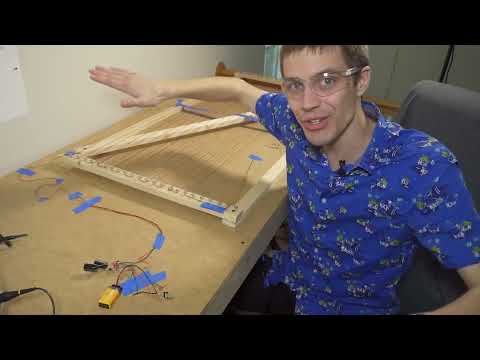 26:29
Watch electricity hit a fork in the road at half a billion frames per second
3M views • 2 years ago
AlphaPhoenix
AlphaPhoenix uses a custom high-speed measurement setup to watch voltage waves travel down wires and split at a fork. It answers how electricity knows where to go and how quickly that process happens.
 10:35
Why the Dutch Wait Less at Traffic Lights
1.2M views • 6 years ago
Not Just Bikes
Not Just Bikes explains how Dutch traffic lights use early detection, transit priority and conflict-free design to cut waiting. The aim is to move as many people as possible rather than as many cars.
 33:43
TSP #183 - Starlink Dish Phased Array Design, Architecture & RF In-depth Analysis
171K views • 5 years ago
The Signal Path
The Signal Path takes apart a Starlink dish layer by layer, analyzing the phased array RF design, system architecture and integrated circuits, with an X-ray of the RF stack.
 4:14
Computer Color is Broken
4.3M views • 11 years ago
minutephysics
MinutePhysics explains that computers store brightness nonlinearly, so blurring and blending colors in raw RGB gives wrong, dark results. It shows why mixed colors, such as in gradients, look off.
 11:27
CGA Graphics - Not as bad as you thought!
2.4M views • 10 years ago
The 8-Bit Guy
The 8-Bit Guy covers IBM's 1981 CGA graphics system, including how composite output and artifacting produced extra colors beyond the nominal palette. He argues CGA looked better in period than it does on RGB monitors.
 27:19
Electric car chargers aren't chargers at all – EVSE Explained
2.2M views • 6 years ago
Technology Connections
Technology Connections explains that the so-called EV charger in an electric car's charging cable or wall unit is really an EVSE, a smart switch that safely delivers AC power. The actual charger is inside the car. The video covers the safety signaling and mechanisms involved.
 21:33
Accent Expert Gives a Tour of U.S. Accents - (Part One) | WIRED
9.6M views • 5 years ago
WIRED
Dialect coach Erik Singer and several linguists tour distinct accents across English-speaking North America. It is the first part of a WIRED series on US accents.
 28:43
Why build an entire computer on breadboards?
3.4M views • 6 years ago
Ben Eater
Ben Eater explains why he builds computers on breadboards, including testing their signal behavior on an oscilloscope. It is a companion to his 6502 breadboard computer series.
 4:42
Why Your Webcam Still SUCKS!
552K views • 6 years ago
Techquickie
A short Techquickie explainer on why laptop webcams are much worse than phone cameras. It covers sensor size, image processing, and the interface differences between laptops and phones, with input from a Logitech engineer.
 12:24
The 1988 VIDEO Floppy Disk Camera: Canon Xap Shot RC-250
452K views • 8 years ago
LGR
LGR looks at the 1988 Canon Xap Shot, a still video camera that records photos to a floppy disk as analog NTSC signal rather than digital data.
 5:17
The IGF-1 Trade-Off: Performance vs. Longevity
517K views • 13 years ago
FoundMyFitness
A short FoundMyFitness explainer on the trade-off between growth hormone/IGF-1 and longevity. Higher IGF-1 helps muscle and cognition, while lower levels are linked to longer lifespan and stress resistance.
 43:00
The step-by-step, mechanical logic of old pinball machines
1.1M views • 2 years ago
Technology Connections
Technology Connections takes apart the step-by-step electromechanical logic of a 1970s pinball machine. He shows how relays, steppers and switches track state and score without electronics.
 31:25
Crossing the Street Shouldn't Be Deadly (but it is)
1.9M views • 4 years ago
Not Just Bikes
Not Just Bikes explains why crossing streets is dangerous in the US and Canada, where roads are designed to move cars fast, and contrasts it with Dutch designs for pedestrians.