signal processing
 1:03:40
David Kriesel: Traue keinem Scan, den du nicht selbst gefälscht hast
7M views • 11 years ago
media.ccc.de
David Kriesel's 31C3 talk, in German, on the discovery that Xerox scanner-copiers silently replace digits and letters in scanned documents. He explains how the bug stayed unnoticed in the wild for years.
Topic match · Information theory & signal processing 53:46
Dasher: information-efficient text entry
7K views • 19 years ago
Google TechTalks
David MacKay's 2007 Google Tech Talk presents Dasher, a text-entry system driven by continuous gestures and a language model, reaching about 35 words per minute with one finger and 25 hands-free. It explains the information-theory reasoning behind the design.
Topic match · Information theory & signal processing 31:46
Moxie Marlinspike, Next Generation Threats 2014
30K views • 11 years ago
Techworld Sverige
Moxie Marlinspike speaks at Next Generation Threats 2014 about the challenges of encrypted communication and how Signal addresses them. He also draws on American action movies as narrative for secure communications.
 1:03:44
CppCon 2015: Timur Doumler “C++ in the Audio Industry”
131K views • 11 years ago
CppCon
Timur Doumler's CppCon 2015 talk on how C++ is used in the audio industry. It covers the patterns and tools audio developers rely on, including handling real-time constraints.
Topic match · Information theory & signal processing 52:59
David Kriesel: Lies, damned lies and scans
58K views • 11 years ago
Free and Open Source Software Conference (FrOSCon) e.V.
David Kriesel's FrOSCon talk on how Xerox scancopiers, due to JBIG2 compression, silently replaced digits in scanned documents. He walks through how he discovered the bug and why it is so dangerous.
Topic match · Information theory & signal processing 1:26:11
Succinct Data Structures
9K views • 12 years ago
Edward Kmett
Edward Kmett's 2013 talk at Prezi in Budapest on succinct data structures, which store data in close to the information-theoretic minimum space while supporting fast queries. It ties together the research and walks through his Haskell succinct library.
Topic match · Information theory & signal processing 57:21
An Observation on Generalization
210K views • 3 years ago
Simons Institute for the Theory of Computing
Ilya Sutskever gives a Simons Institute talk on why neural networks generalize, framing learning as finding short descriptions, like compression. It was part of the Large Language Models and Transformers program.
Topic match · Information theory & signal processing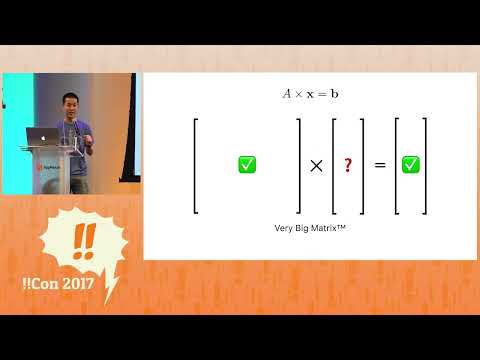 11:47
!!Con 2017: HDR Photography in Microsoft Excel?! by Kevin Chen
119K views • 9 years ago
Confreaks
A short conference talk from !!Con 2017 in which Kevin Chen explains the HDR imaging algorithm from a foundational paper, framing it as a system of linear equations, and implements it in a Microsoft Excel spreadsheet. No prior image processing knowledge is needed.
 25:52
Halide Talk
53K views • 12 years ago
Andrew Adams
Andrew Adams, a Halide developer, presents the Halide language for image processing and tensor computation. The talk explains the separation of algorithm from schedule with illustrated examples of parallelism, locality and redundancy tradeoffs.
 58:50
David Heinemeier Hansson-Unlearn Your MBA (Entire talk)
85K views • 13 years ago
Entrepreneurship.org
David Heinemeier Hansson, creator of Ruby on Rails and partner at 37signals, argues that planning is guessing and startups should focus on today. He says constraints are an advantage and that startups can bootstrap profitably in sizable markets.
 46:27
Sensor Fusion on Android Devices: A Revolution in Motion Processing
517K views • 16 years ago
Google TechTalks
David Sachs of InvenSense explains how gyroscopes, accelerometers and compasses work on their own and together, demonstrated on a modified Android handset. He covers sensor fusion algorithms and why rotation math such as Euler angles matters.
 29:47
The Truth about Rust/WebAssembly Performance
218K views • 3 years ago
Greg Johnston
Leptos creator Greg Johnston examines Rust/WebAssembly frontend frameworks against JavaScript frameworks using the JS framework benchmark. He argues that WASM is no longer too slow for DOM-heavy rendering.
 43:03
36C3 - The ecosystem is moving
2K views • 6 years ago
media.ccc.de
Moxie Marlinspike's 36C3 talk examines why distributed and decentralized technology is hard to build into consumer products, from the perspective of developing Signal. It argues that ecosystems move slowly and federation causes problems.
 17:01
Your Brain Hallucinates Your Conscious Reality | Anil Seth | TED
12M views • 9 years ago
TED
Neuroscientist Anil Seth argues in this TED talk that perception is a controlled hallucination: the brain constantly predicts the world and our shared agreement is what we call reality. He also touches on the construction of the self.
 31:06
Jim Keller - Moore's Law in the age of AI Chips
33K views • 6 years ago
Matroid
Jim Keller's talk at the 2020 Scaled Machine Learning conference on Moore's Law in the age of AI chips. He compares scalar, vector and GPU-style parallel approaches to computation.
 47:43
"Turning the database inside out with Apache Samza" by Martin Kleppmann
205K views • 12 years ago
Strange Loop Conference
Martin Kleppmann argues that databases are global shared mutable state and proposes treating them as an ever-growing log of immutable facts. Derived data such as caches, indexes and views is then built by stream processors like Apache Samza. The talk draws on Kafka and LinkedIn's experience with commit logs.
 31:56
David Heinemeier Hansson at Startup School 08
202K views • 18 years ago
startupschool
David Heinemeier Hansson's talk at Startup School 2008 on building a profitable startup. He argues for bootstrapping and small, well-run companies instead of chasing investment and exits.
 1:03:22
What your Differential Pairs Wish You Knew with Rick Hartley - AltiumLive Keynote
107K views • 7 years ago
Altium
Rick Hartley's AltiumLive keynote on differential pairs in PC boards. He argues the rules from cables and twisted pairs do not carry over, and covers which pair geometry gives the best impedance control, the right spacing, routing practice and how much skew is acceptable.
 39:33
Bret Victor - Media for Thinking the Unthinkable
33K views • 11 years ago
Colin McDonnell
Bret Victor's 2013 MIT Media Lab talk argues that the media we think with determine which thoughts are possible. He demos new representations for scientific papers, circuits, filters and signal processing.
 1:02:09
Seymour Cray's Only Surviving Talk: "Cray-1 Introduction" (1976, LANL)
59K views • 16 years ago
UC Berkeley Events
Seymour Cray's only surviving recorded talk, introducing the Cray-1 supercomputer in 1976. He describes the machine's design, including its vector architecture and cooling through the frame.
 52:07
What Bodies Think About: Bioelectric Computation Outside the Nervous System - NeurIPS 2018
103K views • 7 years ago
The Artificial Intelligence Channel
Michael Levin's NeurIPS 2018 talk on bioelectric computation outside the nervous system, showing how cell electrical networks shape development and regeneration. It covers morphological information processing in living tissue.
 59:56
AWS re:Invent 2018: Amazon DynamoDB Deep Dive: Advanced Design Patterns for DynamoDB (DAT401)
468K views • 7 years ago
Amazon Web Services
Rick Houlihan's AWS re:Invent 2018 deep dive on advanced DynamoDB design patterns. It covers index overloading, GSI sharding, composite keys, graph processing and transactions.
 19:41
Michael Levin: The electrical blueprints that orchestrate life | TED
575K views • 5 years ago
TED
Biologist Michael Levin explains the bioelectric layer that coordinates cells to build organs and bodies, showing footage of two-headed worms and introducing xenobots. He discusses implications for medicine and the nature of life.
 56:33
The Secret History of Silicon Valley
258K views • 18 years ago
Google TechTalks
Steve Blank tells how World War II, Stanford's Frederick Terman and military and intelligence agencies shaped the rise of Silicon Valley. The talk centers on the Cold War electronic warfare and signals intelligence work that seeded the region's tech industry.
 1:00:52
Joscha: From Computation to Consciousness (31c3)
28K views • 11 years ago
Joscha Bach
Joscha Bach's 31c3 talk argues that the mind should be understood as an information-processing system and that even the physical universe can be seen as computational. It tours the philosophy underlying artificial intelligence and cognitive science.
 1:00:57
Tobias Engel: SS7: Locate. Track. Manipulate.
84K views • 11 years ago
media.ccc.de
Tobias Engel's 31C3 talk shows how weaknesses in the SS7 telephone signaling network let companies and attackers locate, track and manipulate phones from anywhere in the world, with precision down to about 50 meters.
 47:34
DEF CON 23 - Robinson and Mitchell - Knocking my neighbors kids cruddy drone offline
695K views • 10 years ago
DEFCONConference
A DEF CON 23 talk on researching whether a commercial quadcopter could be forced to land by interfering with its GPS signal, inspired by a neighbor's kid's drone. It covers the research and the legal and technical issues encountered.
 59:13
AWS re:Invent 2019: [REPEAT 1] Amazon DynamoDB deep dive: Advanced design patterns (DAT403-R1)
115K views • 6 years ago
AWS Events
An AWS re:Invent 2019 session for advanced DynamoDB users on design patterns used by large customers, including Amazon retail. It covers GSI sharding, index overloading, graph processing, composite keys and transactional workflows.
 1:04:08
Mike Levin - Live ALife 2020 Keynote - Robot Cancer
8K views • 6 years ago
ALife 2020 Conference
Michael Levin's keynote at the ALife 2020 conference, 'Robot Cancer', on how bioelectric signaling in embryogenesis and regeneration informs unconventional computing, cognition and the 'software of life'. He argues biology offers lessons for building adaptive machines.
 19:00
Optical illusions show how we see | Beau Lotto
3.5M views • 17 years ago
TED
Neuroscientist Beau Lotto runs the audience through color and pattern illusions to show that perception is shaped by context and evolutionary history rather than being a direct readout of the world. The talk is playful and hands-on, and it argues that the brain interprets ambiguous signals.
 15:30
Chris Urmson: How a driverless car sees the road
886K views • 11 years ago
TED
Chris Urmson, head of Google's self-driving car program, shows footage of how the car perceives the road and decides what to do. Examples include cyclist hand signals, school buses, police officers and complex intersections.
 6:17
The synthesis of imagination: Rony Abovitz and Magic Leap at TEDxSarasota
229K views • 13 years ago
TEDx Talks
A surreal multimedia TEDxSarasota performance by Magic Leap founder Rony Abovitz, held on 12/12/12, mixing performance art with talk about imagination and creativity.
 58:42
Inbox Zero
511K views • 19 years ago
Google TechTalks
Merlin Mann's 2007 Google Tech Talk on Inbox Zero, covering Getting Things Done, why an empty inbox matters, and strategies for handling high-volume email. It is a talk on attention and processing mail rather than on emptying it for its own sake.
 1:08
Winning at programming competitions is a negative factor for being good on the job
67K views • 11 years ago
pkrumins
A one-minute clip of Peter Norvig saying that Google found programming contest success correlates negatively or poorly with job performance. The description links to a blog post discussing it.