wave simulation
 7:02
Traffic Waves
1M views • 18 years ago
wbeaty
A short video from the trafficwaves.org site showing how traffic jams and standing waves form, including the fight between cheaters and blockers at an exit-lane backup. It also touches on how individual driving behavior affects the flow.
 14:21
The Antique Microwave Oven that's Better than Yours
2.7M views • 5 years ago
Technology Connections
Technology Connections examines an old feature-rich microwave and shows how it uses a humidity or steam sensor and lookup data to cook food well, arguing it beats many modern ones.
 11:21
How does a whip break the sound barrier? (Slow Motion Shockwave formation) - Smarter Every Day 207
6.5M views • 7 years ago
SmarterEveryDay
Smarter Every Day uses high-speed and Schlieren photography to show how a whip crack is a supersonic shockwave formed at the tip. It references academic papers on whip physics.
 9:07
The Absurdity of Detecting Gravitational Waves
7.9M views • 9 years ago
Veritasium
Veritasium explains in detail how LIGO detects gravitational waves, with a laser interferometer measuring displacements smaller than a proton. The video focuses on the extreme precision and the techniques needed rather than the general discovery story.
 16:32
Pilot Wave Theory and Quantum Realism | Space Time | PBS Digital Studios
1.9M views • 9 years ago
PBS Space Time
A PBS Space Time episode introducing de Broglie-Bohm pilot wave theory, an interpretation of quantum mechanics that avoids much of the strangeness of the mainstream views. It is aimed at curious lay viewers.
 12:09
I promise this story about microwaves is interesting.
9M views • 5 years ago
Tom Scott
Tom Scott investigates the claim that the microwave was invented to heat hamsters, and interviews James Lovelock about freezing and microwave-thawing hamsters in the 1950s. It traces early magnetron uses beyond radar.
 7:41
Is This What Quantum Mechanics Looks Like?
6.2M views • 10 years ago
Veritasium
Veritasium shows silicone oil droplets bouncing on a vibrating bath, a physical analogue of pilot wave theory that reproduces quantum-like behavior such as double-slit patterns.
 14:28
Superpositions, Sudoku, the Wave Function Collapse algorithm.
764K views • 6 years ago
Martin Donald
Martin Donald explains the Wave Function Collapse algorithm using Sudoku-like constraint solving and shows how he implemented it with Blender and Godot. It links demos and reference articles.
 12:00
Do we have to accept Quantum weirdness? De Broglie Bohm Pilot Wave Theory explained
125K views • 9 years ago
Looking Glass Universe
Looking Glass Universe explains de Broglie-Bohm pilot wave theory (Bohmian mechanics) as an alternative to the standard interpretation of quantum mechanics. The video lays out the pros and cons of the theory and links to related videos on contextuality and entanglement.
 11:33
Light Waves Visualized using Photon Sieves.
69K views • 6 years ago
Huygens Optics
Huygens Optics shows how DIY photon sieves shape a laser's wave front, explaining how they differ from zone plates and how aperture count affects the focal point, with time-resolved visualizations of the diffraction.
 11:07
The music theory of V A P O R W A V E
1.8M views • 10 years ago
Adam Neely
Adam Neely analyzes vaporwave through music theory, timbre and nostalgia, and includes a parody track made for the video. He also touches on the phenomenology of music.
 14:34
Visualization of Quantum Physics (Quantum Mechanics)
2.8M views • 9 years ago
udiprod
An animated visualization of basic quantum mechanics using a free particle, with simulations based on the actual equations. It covers waves, particles, and how measurement collapses the wavefunction.
 5:26
Neural Network Learns The Physics of Fluids and Smoke | Two Minute Papers #118
209K views • 9 years ago
Two Minute Papers
Two Minute Papers covers a paper on speeding up fluid and smoke simulation with convolutional networks. It contrasts the approach with earlier regression forest methods.
 18:07
The more general uncertainty principle, regarding Fourier transforms
2.3M views • 8 years ago
3Blue1Brown
3Blue1Brown shows how the uncertainty principle arises from Fourier transforms. A wave packet cannot be narrow in both position and frequency, so the principle is a property of waves rather than of measurement.
 13:23
Simulating Green Beard Altruism
4.5M views • 5 years ago
Primer
Primer simulates green beard altruism, where individuals recognize and help others carrying a shared marker, and shows how imposters affect its evolution. It is an animated evolution simulation based on published papers.
 14:48
Is 5G Spelling Our DOOM?! How EM Waves Can Hurt
4.2M views • 6 years ago
ElectroBOOM
ElectroBOOM examines whether 5G and other electromagnetic waves can harm people, explaining the EM spectrum and the difference between ionizing and non-ionizing radiation. It includes experiments and measurements in his usual humorous style.
 16:30
Why is light slower in glass? - Sixty Symbols
848K views • 13 years ago
Sixty Symbols
Professor Mike Merrifield of Nottingham explains in a mostly uncut conversation why light travels slower in glass. He treats light as a wave and describes how the material's electrons produce secondary waves that combine to slow it.
 7:40
The Original Double Slit Experiment
10.2M views • 13 years ago
Veritasium
Veritasium revisits Thomas Young's original double slit experiment with light, showing how interference supports the wave nature of light. It uses a pond-wave demonstration to explain the pattern.
 12:04
Why Being Delusional is a Superpower
15.2M views • 6 years ago
Veritasium
Veritasium examines the role of luck in success, with simulations and examples showing how small advantages and chance can compound. It argues that top outcomes are disproportionately luck-driven while still crediting effort.
 5:55
Richard Feynman talks about light
1.8M views • 19 years ago
sdfhsfh
A PBS clip in which Richard Feynman explains the strange nature of light and electromagnetic radiation. He conveys how little of it we actually see and how radio waves are present everywhere.
 6:18
Animated Voting Methods
16K views • 9 years ago
Unify The Vote
An animated simulation comparing single-winner voting methods such as plurality, instant runoff and STAR. Colored regions show which candidate wins as a randomized electorate shifts across a two-dimensional political space, building on Ka-Ping Yee's earlier diagrams.
 10:24
Why does light slow down in water?
1.3M views • 7 years ago
Fermilab
Fermilab's Don Lincoln explains why light travels slower in water and glass. He knocks down common wrong explanations such as absorption and re-emission, then gives the wave-mechanics reason tied to refractive index.
 10:15
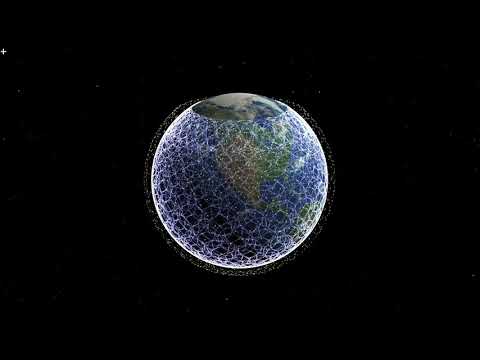
Using ground relays with Starlink
506K views • 6 years ago
Mark Handley
Mark Handley of UCL explains, with simulation visualizations, how early Starlink satellites without inter-satellite links could still give low-latency wide-area communication by hopping via ground relays. He shows it can beat fibre on many long paths.
 4:40
This 1970s tank simulator drives through a tiny world
12M views • 4 years ago
Tom Scott
Tom Scott visits the Swiss Military Museum to see the last surviving 1970s tank-driving simulator. It uses a real camera moving over a miniature model landscape rather than any computer graphics.
 17:48
All you need to know to understand 5G
1.6M views • 5 years ago
Sabine Hossenfelder
Physicist Sabine Hossenfelder explains how 5G works and examines the health concerns around millimeter wave radiation. She reviews the scientific evidence and the open letters from scientists.
 14:03
Simulating alternate voting systems
4.5M views • 6 years ago
Primer
Primer uses simulations to compare voting systems such as first-past-the-post, approval, ranked choice and others. It shows how each system behaves and can be manipulated, with links to further voting theory resources.
 15:48
How to Detect Extra Dimensions
1.6M views • 8 years ago
PBS Space Time
A PBS Space Time episode on how gravitational wave observations of a neutron star merger, GW170817, can limit the number of spacetime dimensions. It is based on a 2018 paper.
 15:14
The most deadly project on the Internet
6.8M views • 4 years ago
bigclivedotcom
BigClive explains why microwave oven transformer projects are extremely dangerous, since the high voltage and high current can kill. He contrasts them with spot welder builds where the secondary is replaced by low-voltage heavy wire.
 8:28
The Fastest Way to Board a Plane Feels Like the Slowest
37.5M views • 7 years ago
CGP Grey
CGP Grey compares airplane boarding methods, based on an arXiv paper, and shows why the intuitive back-to-front approach is slow while random or outside-in boarding does better.
 5:13
DR. QUANTUM - DOUBLE SLIT EXPERIMENT
1.6M views • 15 years ago
Angel Art
A short animated lesson, featuring Dr. Quantum, on the double slit experiment and how observing electrons seems to change their behavior.
 7:16
Unix and Google
9K views • 10 years ago
FOAM
A short animated simulation comparing how Multics and Unix were developed, showing why Unix's small composable programs and pipes gave it a efficiency advantage. It frames Unix as a moonshot achievable by a small team.
 12:50
Fasting vs. Eating Less: What's the Difference? (Science of Fasting)
13.2M views • 9 years ago
Joseph Everett - WIL
A short explainer on the physiological differences between fasting and simply eating less. It covers ketosis, ghrelin and hunger waves, and the hormonal effects of fasting.
 6:47
Starlink revisions, Nov 2018
173K views • 8 years ago
Mark Handley
Mark Handley of UCL looks at how SpaceX's November 2018 revisions to the Starlink constellation affect network behavior. The video visualizes the orbits and routing and estimates latencies, building on his earlier video and research paper.
 12:31
The Superheterodyne Radio: No really, that's its name
987K views • 7 years ago
Technology Connections
Technology Connections explains why the superheterodyne radio has its name and how mixing frequencies lets it tune stations well. It walks through the underlying wave phenomena and algebra and why the design solved a hard tuning problem.
 9:36
Dance p 3 Mar09
83K views • 17 years ago
Geoff Cumming
Geoff Cumming uses a simulation to show how wildly the p value varies from one replication to the next because of sampling variability. He argues for estimation and confidence intervals over null hypothesis significance testing.
 12:25
This Invention Made Disney MILLIONS, but Then They LOST It!
7.3M views • 2 years ago
Corridor Crew
Corridor Crew tracks down Disney's lost sodium vapor prism process, used for Mary Poppins-era transparency mattes. They explain how a narrow sodium wavelength and a beam splitter enabled better compositing than green screen.
 19:47
Why There are Now So Many Shortages (It's Not COVID)
7.8M views • 5 years ago
Wendover Productions
Wendover Productions explains the wave of supply shortages in 2021, arguing the causes go beyond COVID. It covers how just-in-time manufacturing was applied, container imbalances and the chip shortage.
 16:36
JWST just made the "Crisis in Cosmology" WORSE
1.3M views • 3 years ago
Dr. Becky
Astrophysicist Dr. Becky explains the Hubble tension, the disagreement between expansion-rate measurements from the cosmic microwave background and the distance ladder, and what early JWST Cepheid observations add.