web development
 22:52
2016/2017 MUST-KNOW WEB DEVELOPMENT TECH - Watch this if you want to be a web developer
916K views • 10 years ago
LearnCode.academy
LearnCode.academy presents a roadmap of web development technologies to learn in 2016 and 2017, spanning front-end, back-end and DevOps tools.
 13:39
How is this Website so fast!?
2.4M views • 2 years ago
Wes Bos
Wes Bos breaks down the techniques behind the McMaster-Carr website's speed: server-rendered HTML, prefetching, CDN and service worker caching, preloading, critical CSS and fixed-size images. He also notes its old-school jQuery and YUI JavaScript.
 3:45
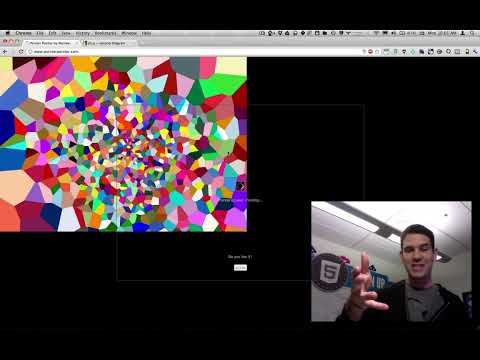
pointerpointer.com's use of voronoi, canvas, and javascript
40K views • 14 years ago
Paul Irish
Paul Irish explains how pointerpointer.com works. It uses a hidden canvas of colored Voronoi regions to look up which photo matches the cursor position.
Topic match · Web development 15:15
why Japan's internet is weirdly designed
5.2M views • 3 years ago
Answer in Progress
Answer in Progress investigates why Japanese websites look different from those elsewhere, using an AI clustering approach to test the 2013 claim. It then looks at possible explanations.
Topic match · Web development 4:32
Web 2.0 ... The Machine is Us/ing Us
12.1M views • 19 years ago
Michael Wesch
Michael Wesch's five-minute video about Web 2.0, showing how the read/write web, XML and user-generated content change how people create and share information.
 4:42
Why Your Webcam Still SUCKS!
552K views • 6 years ago
Techquickie
A short Techquickie explainer on why laptop webcams are much worse than phone cameras. It covers sensor size, image processing, and the interface differences between laptops and phones, with input from a Logitech engineer.
 1:20
Paul Otlet, visioning a web in 1934
102K views • 18 years ago
Attila Gárdos
A one-minute clip about Paul Otlet, the Belgian bibliographer who in 1934 imagined users accessing a remote database through an electric telescope over a phone line. It presents his vision as a precursor of the web.
 10:48
PHP doesn't suck (anymore)
223K views • 3 years ago
Aaron Francis
Aaron Francis walks through how PHP has changed from 2012 to 2023, covering traits, array destructuring, generators, typed properties and more. It is a quick chaptered tour of modern PHP features.
Topic match · Web development 31:12
The Insane Engineering of James Webb Telescope
8.8M views • 4 years ago
Real Engineering
Real Engineering explains the engineering behind the James Webb Space Telescope, including its folding mirror, sunshield, orbit and cooling systems, and why deployment was so difficult.
 4:18
Flexbox vs. CSS Grid — Which is Better?
314K views • 8 years ago
Layout Land
Jen Simmons explains the difference between CSS Flexbox and CSS Grid, and when to use each. She makes the case that Grid does not replace Flexbox and most sites use both.
Topic match · Web development 25:15
Understanding the Honda CR-V Hybrid E-Drive
941K views • 5 years ago
WeberAuto
WeberAuto explains how the Honda E-Drive (i-MMD) hybrid transaxle works in the CR-V, Accord, Insight and Clarity hybrids. It walks through the system's three modes of operation.
 12:23
Xanadu Basics 1a - VISIBLE CONNECTION
20K views • 8 years ago
TheTedNelson
Ted Nelson explains the original Xanadu hypertext idea of visible connection, the notion that links between documents should be shown and preserved. He argues that the Web and current document standards lost this concept.
 3:37
Why Web Filters Don't Work: Penistone and the Scunthorpe Problem
3.6M views • 10 years ago
Tom Scott
Tom Scott visits Penistone to explain the Scunthorpe problem, showing why naive web and profanity filters block innocent words.
 8:13
How Suburban Development Makes American Cities Poorer [ST02]
1.2M views • 5 years ago
Not Just Bikes
Not Just Bikes contrasts traditional and suburban development in North America. It looks at the financials behind each pattern and argues that suburban development leaves cities unable to pay for their own infrastructure.
 10:39
This Video Has 77,321,815 Views
77.3M views • 6 years ago
Tom Scott
Tom Scott's video whose title shows its own live view count, and the story of how he made that work. It explains why open APIs were once common and why they largely disappeared.
Topic match · Web development 4:48
Hans Rosling's 200 Countries, 200 Years, 4 Minutes - The Joy of Stats - BBC
11.5M views • 15 years ago
BBC
Hans Rosling uses augmented-reality animation to show 200 countries over 200 years in four minutes, built from 120,000 data points. It tracks life expectancy and income to show the world's development.
 4:59
This library has every book ever published.
2.4M views • 3 years ago
Tom Scott
Tom Scott visits the British Library, a UK legal deposit library that receives a copy of everything published, and discusses storing so much material, including the web archive.
 14:23
The Long, Twisted And Slightly Ridiculous Story of Avgas Part 1
291K views • 4 years ago
AVweb
AVweb's Paul Bertorelli explains why general aviation has failed to replace leaded avgas, blaming industry inertia, bureaucratic delay and an exemption that removes the incentive. This is part one of two.
 15:16
The Long, Twisted and Slightly Ridiculous Story of Avgas Part 2
169K views • 4 years ago
AVweb
AVweb's Paul Bertorelli explains in part two of a series why general aviation has not replaced leaded avgas. He covers industry inertia, bureaucratic delays and the exemption that lets the industry keep using lead.
 13:44
Are Planes With Parachutes Really Safer?
1M views • 7 years ago
AVweb
AVweb's Paul Bertorelli analyzes the safety record of the Cirrus Airframe Parachute System (CAPS), looking at the 90-plus deployments over 20 years of Cirrus flying. He asks whether the whole-aircraft parachute has actually saved lives.
 7:15
A Selfish Argument for Making the World a Better Place – Egoistic Altruism
11.4M views • 8 years ago
Kurzgesagt – In a Nutshell
Kurzgesagt makes a selfish case for improving the world, arguing that helping people far away raises prosperity and innovation for everyone, including yourself. The animated video frames this as egoistic altruism and positive-sum cooperation.
 4:01
Spherical Geometry Is Stranger Than Hyperbolic - Hyperbolica Devlog #2
1.8M views • 6 years ago
CodeParade
CodeParade's short devlog on how spherical geometry looks in 2D and 3D and why it feels so unusual, part of the Hyperbolica series on a non-Euclidean game.
 5:01
How a Laser-Shot Disk Defeats Hackers & Pirates (Coding Secrets)
132K views • 8 years ago
GameHut
An episode of Coding Secrets by Jon Burton on retro copy protection, in particular physically damaging a disk with a laser so copies fail. It explains how this defeated hackers and pirates.
 10:13
The Problem with Time & Timezones - Computerphile
4.4M views • 12 years ago
Computerphile
Tom Scott explains for Computerphile why handling time and timezones in code is so hard, walking through a simple web app that computes how long ago something happened. It covers the quirks of timezones and calendars and ends in an exasperated rant.
 14:35
Why Japan Looks the Way it Does: Zoning
639K views • 5 years ago
Life Where I'm From
A video explaining why Japanese cities look the way they do, through Japan's national tiered zoning system that permits mixed use and flexible development. It compares this approach with more restrictive zoning elsewhere.
 9:37
Characters, Symbols and the Unicode Miracle - Computerphile
2.1M views • 13 years ago
Computerphile
Tom Scott explains for Computerphile how Unicode and UTF-8 grew out of messy older character encodings to become the web's standard. It covers why the design works and how it handles worldwide text.
 6:00
Super Pointy Sprint Missile - 0 to Mach 10 in 15 Seconds - 100Gs & 6000°F
459K views • 6 years ago
Dark Footage
A short video on the US Sprint anti-ballistic missile, which accelerated to around Mach 10 in seconds under extreme g-forces and heat. It includes striking launch footage and a brief development history.
 11:07
How to achieve nanometer precision in space?
748K views • 4 years ago
Breaking Taps
Breaking Taps explains how the cryogenic mirror actuators on the James Webb Space Telescope achieve nanometer precision using flexures. It shows a 3D-printed replica and how one motor handles both coarse and fine motion.
 13:05
Smoother animation ≠ Better animation [read pinned comment]
16.1M views • 5 years ago
Noodle
Animator Noodle explains why frame interpolation does not make animation better, covering timing, easing, smear frames and using the wrong tool for the job. A pinned correction says the video is partly outdated given later AI developments.
 21:09
The Origins of Russian Authoritarianism
1.9M views • 5 years ago
Kraut
Kraut traces centuries of political development, from Mongol rule and the Orthodox church to Muscovite autocracy, that shaped Russia's authoritarian state. It uses countryball animation and compares Russia with Europe and China.
 3:05
Why does PUNCHING Sonic 3D trigger a Secret Level Select?
510K views • 6 years ago
Coding Secrets
A short Coding Secrets episode explaining why hitting a Sonic 3D cartridge triggers a hidden level select. The cause was a custom crash handler that redirected CPU error interrupts to the level select screen.
 10:40
This Ponzi Scheme Might END Suburban Prosperity
324K views • 3 years ago
Strong Towns
Strong Towns explains the Growth Ponzi Scheme, in which post-war suburban growth takes on infrastructure costs that new development must keep funding. It describes why municipal finances become insolvent.
 15:15
WHY Exercise is so Underrated (Brain Power & Movement Link)
4.3M views • 9 years ago
Joseph Everett - WIL
A video arguing that exercise matters for the brain as much as the body, linking movement, the nervous system and BDNF to learning and memory. It draws on research connecting complex movement to brain development.
 14:32
Why Gas Engines Are Far From Dead - Biggest EV Problems
4.4M views • 6 years ago
Engineering Explained
Engineering Explained argues that internal combustion engines are far from dead, and discusses the continued development of ICEs and the problems facing electric vehicles.
 8:47
Cloaking
238K views • 15 years ago
Google Search Central
Matt Cutts of Google explains what cloaking is: serving different content to search engine crawlers than to users. He covers why it violates Google's webmaster guidelines.