causal models
 4:12
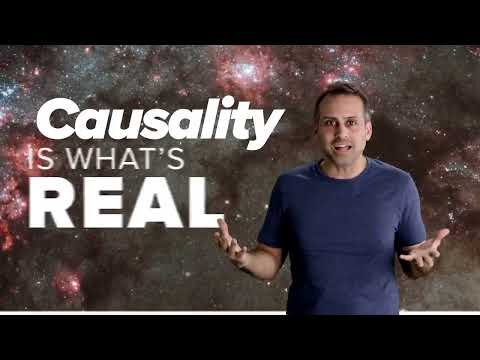
Correlation CAN Imply Causation! | Statistics Misconceptions
744K views • 9 years ago
minutephysics
A four-minute minutephysics video arguing that causal models and causal networks let statistics infer causation from correlation. It touches on Reichenbach's principle, common causes, feedback and quantum causal discovery.
 20:39
AI Language Models & Transformers - Computerphile
354K views • 7 years ago
Computerphile
Rob Miles explains on Computerphile how language models generate plausible text and how transformers improved on recurrent networks, with a look at what comes next.
 16:07
The Geometry of Causality
1.8M views • 9 years ago
PBS Space Time
PBS Space Time explains how spacetime geometry and light cones determine the order of events and what can cause what. It visualizes causality in special relativity.
 39:43
Do we need Attention? - Linear RNNs and State Space Models (SSMs) for NLP
35K views • 3 years ago
Sasha Rush
Sasha Rush surveys linear RNNs and state space models as replacements for attention in transformer-style models, in a talk for MLSys. It covers the foundational preliminaries and predates Mamba.
 1:31:13
A Hackers' Guide to Language Models
580K views • 3 years ago
Jeremy Howard
Jeremy Howard's 90-minute practical tour of language models. It covers how they work, GPT-4's capabilities and limits, using the OpenAI API, code writing, data analysis and fine-tuning.
 59:48
[1hr Talk] Intro to Large Language Models
4.3M views • 2 years ago
Andrej Karpathy
Andrej Karpathy gives a one-hour general-audience introduction to large language models, covering what they are, how they are trained, comparisons to operating systems, and security challenges such as jailbreaks.
 8:25
Large Language Models from scratch
375K views • 4 years ago
Graphics in 5 Minutes
A short cartoon explaining how language models like ChatGPT work, from autocomplete and conditional probabilities to neural networks, gradient descent and backpropagation. It shows how networks act as universal function approximators.
 42:15
"Performance Matters" by Emery Berger
502K views • 7 years ago
Strange Loop Conference
Emery Berger explains why performance is hard to measure and deliver on modern hardware, showing how code layout and alignment can swamp optimization effects. He presents Stabilizer for statistically sound evaluation and Coz, a causal profiler.
 3:18
Causal understanding of water displacement by a crow
9.8M views • 12 years ago
PLOS Media
A silent PLOS ONE video of New Caledonian crows solving Aesop's Fable puzzles by dropping objects to raise water and reach food. It shows example trials from experiments testing causal understanding of water displacement.
 59:23
Why Can't AI Make Its Own Discoveries? — With Yann LeCun
222K views • 1 year ago
Alex Kantrowitz
Yann LeCun on the Big Technology Podcast discusses why current AI models cannot make discoveries despite their knowledge. He argues systems need abstract world models and also covers limits of AI research, investor expectations, and open source after DeepSeek.
 21:37
I wasn't worried about climate change. Now I am.
2.5M views • 2 years ago
Sabine Hossenfelder
Sabine Hossenfelder explains climate sensitivity and why recent observations suggest climate models may have underestimated warming. She says this changed her view on how worried to be.
 25:57
GPT3: An Even Bigger Language Model - Computerphile
446K views • 6 years ago
Computerphile
Rob Miles discusses GPT-3 on Computerphile, covering how scaling parameters kept improving results over GPT-2 and how the model nearly learned arithmetic without anyone knowing exactly how.
 27:14
Transformers, the tech behind LLMs | Deep Learning Chapter 5
11.6M views • 2 years ago
3Blue1Brown
3Blue1Brown's visual explanation of how transformers and GPT-style language models work, tracing data through tokens, embeddings and attention.
 3:31:24
Deep Dive into LLMs like ChatGPT
10.2M views • 1 year ago
Andrej Karpathy
Andrej Karpathy's three-hour-plus general-audience deep dive into how ChatGPT-style LLMs are built, covering the full training stack from pretraining to post-training. It also gives mental models for their quirks, like hallucination, and how to use them well.
 12:46
The Speed of Light is NOT About Light
7.1M views • 11 years ago
PBS Space Time
PBS Space Time argues that the speed of light is better understood as the speed of causality, the universal limit on how fast cause and effect propagate. Light travels at that speed because it is massless, but the limit itself is a property of spacetime.
 1:16:23
The Psychology of Human Misjudgement - Charlie Munger Full Speech
1.4M views • 13 years ago
BuffettMungerWisdom
Audio of Charlie Munger's 1995 Harvard speech on the psychology of human misjudgment, laying out a framework of cognitive biases and mental models for decision making. It covers factors like incentives, social proof and denial.
 54:52
Introduction to NoSQL • Martin Fowler • GOTO 2012
1M views • 13 years ago
GOTO Conferences
Martin Fowler's GOTO 2012 introduction to NoSQL databases: where they came from, their data models, how consistency thinking differs, and when to use them. He argues they won't make relational databases obsolete and introduces polyglot persistence.
 14:40
How the Quantum Eraser Rewrites the Past | Space Time | PBS Digital Studios
2.9M views • 10 years ago
PBS Space Time
PBS Space Time explains the quantum eraser experiment, in which erasing which-path information appears to reverse causality in a double-slit setup. It discusses what this means for quantum mechanics.
 12:51
The Delayed Choice Quantum Eraser, Debunked
718K views • 5 years ago
Sabine Hossenfelder
Sabine Hossenfelder explains the delayed choice quantum eraser and argues it does not rewrite the past, as popular accounts claim. She walks through what the experiment actually shows.
 17:08
Playing a Neural Network's version of GTA V: GAN Theft Auto
766K views • 5 years ago
sentdex
Sentdex demonstrates GAN Theft Auto, a GameGAN-based neural network that recreates GTA V so the network itself is the playable environment. He shows the results and releases the code.
 1:06:45
Let's #TalkConcurrency Panel Discussion with Sir Tony Hoare, Joe Armstrong, and Carl Hewitt
13K views • 7 years ago
Erlang Solutions
A panel with Tony Hoare, Joe Armstrong and Carl Hewitt, hosted by Francesco Cesarini, on the history and future of concurrency. The three creators of CSP, Erlang and the actor model discuss their differing approaches.
 18:15
So... the minute hand shows progression — apparently we think of time in wildly different ways
706K views • 4 years ago
Technology Connextras
A Technology Connections video essay on how analog and digital clocks shape different mental models of time, with the minute hand acting as a progress indicator.
 8:55
Are Space and Time An Illusion?
3.3M views • 11 years ago
PBS Space Time
A PBS Space Time episode hosted by Gabe Perez-Giz on the nature of spacetime and whether space and time are fundamental. It builds up reference frames and causality in a short, dense format.
 1:02:57
Peter Norvig - The Unreasonable Effectiveness of Data
74K views • 15 years ago
UBC Computer Science
Peter Norvig's UBC distinguished lecture on how massive amounts of simple data, such as for language modeling, can yield understanding that hand-built models could not.
 22:47
Freeman Dyson on the Global Warming Hysteria April, 2015
471K views • 11 years ago
1000frolly PhD
A 2015 interview in which physicist Freeman Dyson, then 91, argues that global warming concerns are exaggerated, that CO2 is beneficial and that climate models oversimplify complex systems. It is posted on a channel that opposes climate consensus.
 47:49
Quants | The Alchemists of Wall Street | VPRO documentary
2.7M views • 16 years ago
vpro documentary
A VPRO documentary on quantitative analysts who designed the mathematical models and high-speed trading systems behind modern finance. It features figures such as Paul Wilmott and asks what risks come from treating markets as a machine.
 1:03:32
John Schulman - Reinforcement Learning from Human Feedback: Progress and Challenges
88K views • 3 years ago
UC Berkeley EECS
UC Berkeley EECS colloquium by OpenAI's John Schulman on reinforcement learning from human feedback. He covers why RL helps with truthfulness, hallucination, and the limits of behavior cloning.
 37:20
But how do AI images and videos actually work? | Guest video by Welch Labs
2.2M views • 1 year ago
3Blue1Brown
A guest video by Welch Labs on 3Blue1Brown explaining how text-to-image and video models work. It covers CLIP, shared embedding spaces, diffusion models (DDPM, DDIM), conditioning, guidance and negative prompts.
 0:31
The Simpsons Anti-Tiger Rock
320K views • 14 years ago
megamasterdrive
A one-minute clip from The Simpsons in which Lisa demonstrates the Anti-Tiger Rock to Homer, showing that the rock keeps away tigers because no tigers are around. It is a short comedic scene about faulty causal reasoning.
 1:56:20
Let's build GPT: from scratch, in code, spelled out.
8.2M views • 3 years ago
Andrej Karpathy
Andrej Karpathy builds a GPT from scratch in code, following Attention Is All You Need and GPT-2/3, in about two hours using PyTorch. He connects it to ChatGPT and assumes familiarity with his earlier makemore videos.
 14:36
Distributed Systems 1.1: Introduction
382K views • 6 years ago
Martin Kleppmann
The first lecture in Martin Kleppmann's 8-lecture distributed systems series from the University of Cambridge undergraduate course. It introduces the subject, and accompanying lecture notes are available.
 53:46
Dasher: information-efficient text entry
7K views • 19 years ago
Google TechTalks
David MacKay's 2007 Google Tech Talk presents Dasher, a text-entry system driven by continuous gestures and a language model, reaching about 35 words per minute with one finger and 25 hands-free. It explains the information-theory reasoning behind the design.
 47:15
Will AI outsmart human intelligence? - with 'Godfather of AI' Geoffrey Hinton
878K views • 1 year ago
The Royal Institution
Geoffrey Hinton's 2025 Royal Institution Discourse on what AI has learned from biological intelligence and how it might surpass it. He explains neural networks and argues that human language use resembles what backpropagation-trained networks do.
 19:20
GPT-4chan: This is the worst AI ever
1M views • 4 years ago
Yannic Kilcher
Yannic Kilcher explains how he trained a language model on three years of 4chan's /pol/ board and let it post on the site. He evaluates how good the model was and discusses the ethics and fallout.
 45:55
Turning Waves Into Particles
194K views • 1 year ago
Huygens Optics
Huygens Optics explores the idea that space is a non-linear elastic medium, and uses simulations to show how wave energy might be confined locally into particle-like objects. It touches on inertia, the Schwinger limit and the vacuum as a medium.
 20:55
Why ChatGPT Can't Draw a Full Glass of Wine
6.3M views • 1 year ago
Alex O'Connor
Alex O'Connor shows that ChatGPT cannot draw a wine glass filled to the brim, and ties the failure to David Hume's missing shade of blue. It asks what the failure says about how image models learn.
 25:42
The Man behind Stable Diffusion
146K views • 4 years ago
Yannic Kilcher
Yannic Kilcher interviews Emad Mostaque, founder of Stability AI, about the company's funding, its mission, and the release of Stable Diffusion. Topics include access to compute, handling harmful outputs, and avoiding the corrupting influence of profit.
 1:01:09
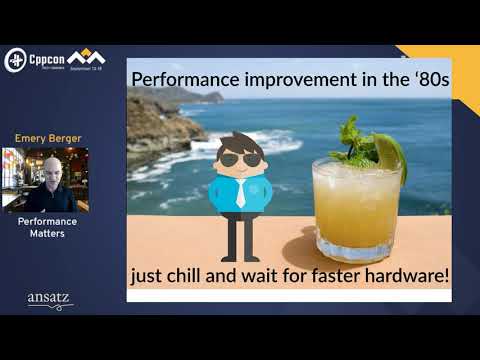
Plenary: Performance Matters - Emery Berger - CppCon 2020
32K views • 6 years ago
CppCon
Emery Berger's CppCon 2020 plenary on why performance is hard on modern hardware after the end of Dennard scaling. It covers benchmarking pitfalls and introduces new profiling tools for finding real bottlenecks.
 36:02
ChatGPT with Rob Miles - Computerphile
517K views • 3 years ago
Computerphile
Computerphile interviews AI safety researcher Rob Miles about ChatGPT: how it was trained with human feedback, why it tends to produce confident nonsense, and where it may or may not be dangerous.
 43:30
Are we stuck with the same Desktop UX forever? | Ubuntu Summit 25.10
509K views • 11 months ago
Canonical Ubuntu
Scott Jenson, a veteran UX designer formerly at Apple and Google, argues that the 'UX/UI' split pits programmers against designers and narrows ambition in open source. He makes the case that desktop UX has stagnated and that open source projects could lead experimentation beyond current interaction models.