compute module
 10:00
SICP / What is "Computer Science" ?
131K views • 20 years ago
LarryNorman
An excerpt from Hal Abelson's opening SICP lecture introducing computer science and contrasting declarative and imperative knowledge. He argues that computer science is not really a science and is more like magic or engineering of ideas.
 6:53
8-bit computer update
2.8M views • 10 years ago
Ben Eater
Ben Eater's short update announcing his plan to build another 8-bit computer from scratch on camera. It kicks off the breadboard computer series that became widely known.
 19:43
U.S. NAVY BASIC MECHANISMS OF FIRE CONTROL COMPUTERS MECHANICAL COMPUTER INSTRUCTIONAL FILM 27794
225K views • 8 years ago
PeriscopeFilm
A 1953 US Navy training film on the basic mechanisms in fire control computers: shafts, gears, cams and differentials. It shows how these mechanical parts compute ship and target firing solutions.
 7:26
Tomorrow's World: Nellie the School Computer 15 February 1969 - BBC
113K views • 16 years ago
BBC
A 1969 BBC Tomorrow's World segment about Nellie, a school computer used by pupils at Forest Grammar School to solve equations and play music. Students learn programming and maintenance, and act out binary arithmetic.
 10:13
The Problem with Time & Timezones - Computerphile
4.4M views • 12 years ago
Computerphile
Tom Scott explains for Computerphile why handling time and timezones in code is so hard, walking through a simple web app that computes how long ago something happened. It covers the quirks of timezones and calendars and ends in an exasperated rant.
 8:21
Why Electronic Voting is a BAD Idea - Computerphile
2.3M views • 11 years ago
Computerphile
Tom Scott explains for Computerphile why electronic voting is a bad idea, arguing that paper ballots are transparent, auditable and hard to tamper with at scale. He covers why moving voting to phones, tablets or computers undermines trust and verifiability.
 15:12
JPEG DCT, Discrete Cosine Transform (JPEG Pt2)- Computerphile
697K views • 11 years ago
Computerphile
Mike Pound explains the discrete cosine transform and how it underpins JPEG compression. It is part two of Computerphile's JPEG series.
 9:37
Characters, Symbols and the Unicode Miracle - Computerphile
2.1M views • 13 years ago
Computerphile
Tom Scott explains for Computerphile how Unicode and UTF-8 grew out of messy older character encodings to become the web's standard. It covers why the design works and how it handles worldwide text.
 17:40
3D Gaussian Splatting! - Computerphile
273K views • 2 years ago
Computerphile
A Computerphile video in which Dr Mike Pound and PhD student Lewis Stuart explain 3D Gaussian splatting, a quick technique that turns photos of a scene into a 3D model without much compute. It includes a demo and compares the approach to NeRFs.
 8:45
Chip & PIN Fraud Explained - Computerphile
851K views • 11 years ago
Computerphile
Computerphile interview with Prof. Ross Anderson on how Chip and PIN payment systems are being compromised, and the attacks researchers have seen.
 9:16
Floating Point Numbers - Computerphile
2.5M views • 12 years ago
Computerphile
Tom Scott explains for Computerphile how floating point numbers work, why moving the binary point is fast, and why it handles money badly.
 6:14
Turing & The Halting Problem - Computerphile
919K views • 12 years ago
Computerphile
A Computerphile video in which Mark Jago of the University of Nottingham explains Turing's halting problem and how it led to the blueprint for the modern computer.
 16:48
Yesterday's Computer of Tomorrow: The Xerox Alto │Smalltalk-76 Demo
38K views • 8 years ago
Computer History Museum
A Computer History Museum demonstration with Dan Ingalls of Smalltalk-76 running on a Xerox Alto, recorded in 2017. He shows the live environment and discusses the system.
 13:52
Ch(e)at GPT? - Computerphile
617K views • 3 years ago
Computerphile
Computerphile video in which Mike Pound explains a University of Maryland paper on watermarking LLM output. The method biases token choices so generated text can later be detected statistically.
 6:57
Nathan For You - Fixing Computer Repair
2.2M views • 9 years ago
Comedy Central
A Nathan For You sketch in which Nathan Fielder tackles customers' privacy fears at computer repair shops with an awkwardly absurd business solution. It is a comedy clip from the Comedy Central show.
 12:23
Typesetters in the '80s - Computerphile
105K views • 12 years ago
Computerphile
Professor Brailsford of the University of Nottingham describes how the university set out to print its own mathematics exam papers in the 1980s. The story centers on getting a Mergenthaler Linotron 202 typesetter to work with their own software.
 12:35
The Mathematics of Quantum Computers | Infinite Series
718K views • 9 years ago
PBS Infinite Series
A PBS Infinite Series episode explaining the mathematics of quantum computers, including how qubits store complex numbers and how quantum computation differs from classical computation. Hosted by Kelsey Houston-Edwards.
 5:51
Susan Kare explains Macintosh UI ergonomics on the Computer Chronicles (1984)
51K views • 6 years ago
erg0steur
A 1984 Computer Chronicles segment in which Susan Kare explains the ergonomics and interface design of the original Macintosh. She introduces the interface step by step for newcomers.
 9:10
Smarter than a Smart TV! (Raspberry Pi Inside)
2.4M views • 4 years ago
Jeff Geerling
Jeff Geerling looks at a Sharp NEC commercial display with a slot for a Raspberry Pi Compute Module. It is a large screen without built-in smart TV features or tracking.
 4:06
DEC LAB-8/e (PDP-8/e) playing music
50K views • 18 years ago
Philipp Hachtmann
A 1971 DEC LAB-8/e (PDP-8/e) minicomputer plays music by inducing noise into a nearby AM radio. The software is Richard Wilson's 1975 Music Compiler running under OS/8.
 14:02
Computers for Cynics 2 - It All Went Wrong at Xerox PARC
23K views • 14 years ago
TheTedNelson
Ted Nelson, in his Computers for Cynics series, gives a critical history of Xerox PARC's vision of personal computing. He lists what he sees as the limitations and wrong turns in PARC's approach to the desktop and documents.
 18:57
Why the Soviet Computer Failed
4.2M views • 4 years ago
Asianometry
An Asianometry explainer on why the Soviet Union, once a leading computing power, fell far behind the US in computers by the 1980s. It traces the gap from the 1960s onward despite strong state support for science.
 14:03
The Computer Designed To Die In Microseconds
408K views • 3 years ago
Scott Manley
Scott Manley tells the story of a computerized telemetry system built to sit at the heart of a nuclear test device in place of the plutonium pit, designed to transmit data in the microseconds before it was destroyed.
 7:42
KIDS REACT TO OLD COMPUTERS
28.1M views • 12 years ago
REACT
An episode of REACT in which children try to figure out 1970s-1980s computers, including an Apple II and floppy disks. It was made to promote the AMC show Halt and Catch Fire.
 8:30
Deadly Truth of General AI? - Computerphile
941K views • 11 years ago
Computerphile
A Computerphile video in which Rob Miles warns against assuming a general AI will think like a human. He uses the thought experiment of a stamp-collecting AI to show how a goal-driven system could pursue its aim with dangerous results.
 8:16
Why Asimov's Laws of Robotics Don't Work - Computerphile
873K views • 11 years ago
Computerphile
Rob Miles explains for Computerphile why simple rule sets like Asimov's Three Laws cannot make robots and AI safe. Terms like harm and human are too ambiguous to specify precisely.
 19:55
The Great 202 Jailbreak - Computerphile
532K views • 12 years ago
Computerphile
Computerphile with Professor Brailsford on how a 1979 Bell Labs team reverse engineered a Linotron 202 phototypesetter over a summer to get high-quality print output. It covers typesetting history and the later 2013 rebuild of the famous vacation memo.
 17:31
How Quantum Computers Break Encryption | Shor's Algorithm Explained
3.4M views • 7 years ago
minutephysics
MinutePhysics explains Shor's algorithm, showing how a quantum computer factors large integers by finding the period of a number modulo N. It walks through the modular arithmetic and number theory that give the exponential speedup over classical factoring, and why this threatens encryption.
 19:29
Glitch Tokens - Computerphile
353K views • 3 years ago
Computerphile
Rob Miles explains "glitch" tokens, odd strings in large language model vocabularies that make the model produce gibberish. He covers how they likely arise from tokenizer training data, such as Reddit usernames, that never appeared in the model's own training.
 10:07
Where GREP Came From - Computerphile
1.3M views • 8 years ago
Computerphile
Brian Kernighan explains how grep came to be, written overnight by Ken Thompson, and how it got its name from the ed command g/re/p. He also covers the lineage from QED to ed that led to it.
 7:26
Ted Nelson's Eulogy for Douglas Engelbart
17K views • 12 years ago
Computer History Museum
Ted Nelson's short eulogy for Douglas Engelbart, delivered at the Computer History Museum in 2013, reflecting on his friend and Engelbart's ideas.
 12:24
Elliptic Curve Back Door - Computerphile
554K views • 8 years ago
Computerphile
Dr Mike Pound explains the suspected backdoor in the Dual_EC_DRBG random number generator and how elliptic curve constants could let someone predict its output.
 13:29
!!Con 2016 - How I Code and Use a Computer at 1,000 WPM!! By Sina Bahram
11K views • 10 years ago
Confreaks
A short !!Con 2016 talk by blind developer Sina Bahram on how he uses a computer and writes code with a screen reader at about 1,000 words per minute. He plays how common interfaces sound and challenges the audience to go a day using only the keyboard.
 17:54
Coding Adventure: Ant and Slime Simulations
2.2M views • 5 years ago
Sebastian Lague
Sebastian Lague explores an ant-inspired algorithm and simulates ant and slime mold behavior, using compute shaders. Source code for both simulations is available.
 4:14
Computer Color is Broken
4.3M views • 11 years ago
minutephysics
MinutePhysics explains that computers store brightness nonlinearly, so blurring and blending colors in raw RGB gives wrong, dark results. It shows why mixed colors, such as in gradients, look off.
 14:46
Computers for Cynics 0 - The Myth of Technology
33K views • 14 years ago
TheTedNelson
The opening episode of Ted Nelson's Computers for Cynics series, in which he casts doubt on conventional accounts of computer basics. He argues that conventions and packaging are mistaken for technology.
 19:20
Conrad Wolfram: Teaching kids real math with computers
363K views • 15 years ago
TED
Conrad Wolfram argues that the part of math taught in schools, hand calculation, is tedious and mostly irrelevant to real mathematics. He proposes teaching math through computer programming so students can tackle real problems.
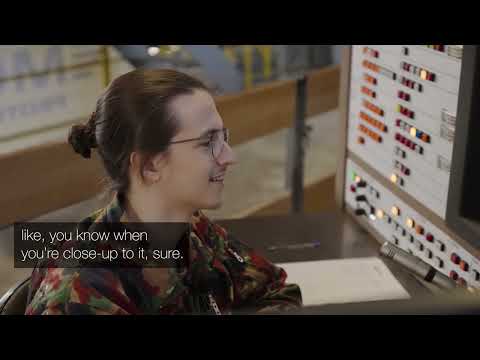 4:40
This 1970s tank simulator drives through a tiny world
12M views • 4 years ago
Tom Scott
Tom Scott visits the Swiss Military Museum to see the last surviving 1970s tank-driving simulator. It uses a real camera moving over a miniature model landscape rather than any computer graphics.
 11:17
EEVblog #822 - World's Worst Tablet Computer Teardown
1.2M views • 10 years ago
EEVblog
Dave Jones of EEVblog tears down an Esinomed Infoview medical tablet computer built around an 800MHz AMD Geode board, exposing extremely shoddy construction and design.
 11:39
The Unbeatable Game from the 60s: Dr NIM
7.2M views • 10 years ago
Stand-up Maths
Matt Parker of Stand-up Maths explains single-pile Nim and the trick that wins it, using Dr NIM, a 1960s mechanical plastic computer that plays perfectly. He teaches the strategy so viewers can beat friends.