derren brown
 21:15
Brown; color is weird
5.3M views • 6 years ago
Technology Connections
Technology Connections explains why brown is not a spectral color but a context-dependent perception, essentially dark orange seen against brighter surroundings.
 2:53
Brené Brown on Empathy
24.1M views • 12 years ago
Royal Society of Arts
A short animated RSA piece with Dr Brene Brown's voiceover on the difference between empathy and sympathy. She argues that real connection requires getting in touch with your own vulnerability, rather than trying to fix someone's pain.
 32:11
Darts in Higher Dimensions (with 3blue1brown) - Numberphile
2.1M views • 6 years ago
Numberphile
Numberphile talks with Grant Sanderson of 3Blue1Brown about a darts puzzle with a shrinking bullseye. Solving it takes the volumes of high-dimensional spheres, and the answer turns up Euler's number.
 10:43
Bertrand's Paradox (with 3blue1brown) - Numberphile
1.4M views • 4 years ago
Numberphile
Numberphile interviews Grant Sanderson of 3blue1brown about Bertrand's paradox, where different reasonable ways of picking a random chord of a circle give different probabilities.
 11:15
The hardest problem on the hardest test
16.5M views • 8 years ago
3Blue1Brown
3Blue1Brown walks through a very hard Putnam competition problem and its elegant solution, emphasizing the visual intuition and the thought process behind solving it.
 16:30
Who cares about topology? (Old version)
3.3M views • 10 years ago
3Blue1Brown
An older 3Blue1Brown video on why topology matters, built around the inscribed rectangle problem. It walks through how tori and Mobius strips appear in the solution. The channel later replaced it with an updated version.
 29:43
Pi hiding in prime regularities
2.8M views • 9 years ago
3Blue1Brown
3Blue1Brown shows how pi emerges from prime numbers via complex numbers and sums of squares, culminating in a formula for approximating pi.
 19:42
But what is the Fourier Transform? A visual introduction.
12.6M views • 8 years ago
3Blue1Brown
3Blue1Brown's animated visual introduction to the Fourier Transform, showing how a signal breaks into frequency components.
 18:40
But what is a neural network? | Deep learning chapter 1
25.1M views • 9 years ago
3Blue1Brown
3Blue1Brown's first chapter on deep learning explains what neurons and layers are and the math underlying a basic neural network, using handwritten digit recognition with visual animations.
 10:03
The determinant | Chapter 6, Essence of linear algebra
5M views • 10 years ago
3Blue1Brown
A 10-minute 3Blue1Brown chapter explaining the determinant as the factor by which a linear transformation scales area or volume. It builds the idea geometrically with animations before any formulas.
 21:36
Fractals are typically not self-similar
4.6M views • 9 years ago
3Blue1Brown
3Blue1Brown explains fractal dimension and shows why many fractals are not strictly self-similar. Self-similarity turns out to be a special case of the broader idea of fractional dimension.
 25:13
Thinking outside the 10-dimensional box
3.2M views • 9 years ago
3Blue1Brown
3Blue1Brown visualizes high-dimensional spheres to explain a surprising puzzle about how a sphere fits in a box as dimensions grow. It builds geometric intuition for counterintuitive properties of high-dimensional space.
 17:16
Eigenvectors and eigenvalues | Chapter 14, Essence of linear algebra
6.4M views • 10 years ago
3Blue1Brown
3Blue1Brown's chapter on eigenvectors and eigenvalues in the Essence of Linear Algebra series. It builds a visual intuition for what they mean, why an eigenbasis is useful, and ends with a puzzle.
 18:07
The more general uncertainty principle, regarding Fourier transforms
2.3M views • 8 years ago
3Blue1Brown
3Blue1Brown shows how the uncertainty principle arises from Fourier transforms. A wave packet cannot be narrow in both position and frequency, so the principle is a property of waves rather than of measurement.
 15:08
What does it feel like to invent math?
4.6M views • 11 years ago
3Blue1Brown
3Blue1Brown explores infinite sums from convergent to divergent, with an introduction to the 2-adic metric, themed on the cycle between discovering and inventing mathematics.
 23:12
Simulating an epidemic
5.2M views • 6 years ago
3Blue1Brown
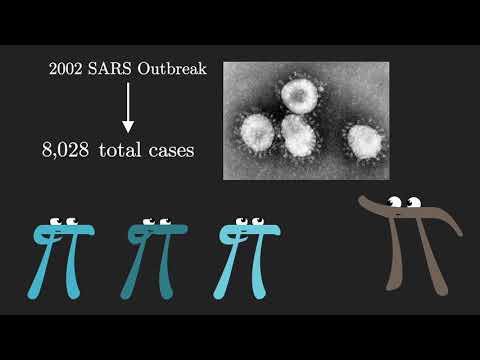
3Blue1Brown builds toy SIR models to simulate how an epidemic spreads and tests scenarios like social distancing, travel restrictions, central gathering places and quarantine. It was made during the early COVID-19 outbreak.
 22:11
But what is the Riemann zeta function? Visualizing analytic continuation
5.4M views • 9 years ago
3Blue1Brown
3Blue1Brown visualizes the Riemann zeta function and the analytic continuation that extends it beyond where its series converges, building toward the Riemann hypothesis.
 22:21
Why do prime numbers make these spirals? | Dirichlet’s theorem and pi approximations
7.6M views • 7 years ago
3Blue1Brown
3Blue1Brown explains why plotting primes in polar coordinates produces spiral patterns, using modular arithmetic, Dirichlet's theorem and rational approximations of pi.
 28:34
But why would light "slow down"? | Visualizing Feynman's lecture on the refractive index
2.9M views • 2 years ago
3Blue1Brown
3Blue1Brown visualizes Feynman's lecture on the refractive index, explaining why light appears to slow down in glass and why the effect depends on color. It builds the idea from waves produced by oscillating charges in the material.
 26:10
Attention in transformers, step-by-step | Deep Learning Chapter 6
4.8M views • 2 years ago
3Blue1Brown
3Blue1Brown's visual walkthrough of the attention mechanism inside transformers, covering self-attention, multiple heads and cross-attention. It is chapter 6 of his deep learning series.
 24:47
But what is a Fourier series? From heat flow to drawing with circles | DE4
19M views • 7 years ago
3Blue1Brown
3Blue1Brown introduces Fourier series, from the heat equation to drawing arbitrary shapes with rotating circles. It builds a visual intuition for decomposing functions into sine waves.
 7:42
Triangle of Power
812K views • 10 years ago
3Blue1Brown
3Blue1Brown presents the Triangle of Power, an alternate notation that unifies powers, logarithms and roots in a single triangular symbol. The video shows how the inverse operations relate and how the notation could help.
 18:18
Hilbert's Curve: Is infinite math useful?
2.4M views • 9 years ago
3Blue1Brown
3Blue1Brown explains space-filling curves and the Hilbert curve, and how infinite mathematical constructions connect to finite, practical approximations. It touches on mapping between dimensions and sensory ideas.
 20:05
But what are Hamming codes? The origin of error correction
3.1M views • 6 years ago
3Blue1Brown
3Blue1Brown's discovery-oriented introduction to error correction codes, building up Hamming codes from the puzzle of locating a flipped bit. It explains the parity-check idea and why it is so efficient.
 4:08
e^(iπ) in 3.14 minutes, using dynamics | DE5
3.4M views • 7 years ago
3Blue1Brown
A short 3Blue1Brown video explaining Euler's formula e^(i*pi) = -1 through dynamics, treating velocity as the thing that moves a point to a new position. It builds geometric intuition for why an exponent with i produces rotation.
 46:24
How are holograms possible?
7.2M views • 2 years ago
3Blue1Brown
3Blue1Brown explains how holograms record a 3D scene on 2D film, using wave diffraction and phase. The video includes demonstrations of several real holograms.
 20:33
Gradient descent, how neural networks learn | Deep Learning Chapter 2
9.7M views • 9 years ago
3Blue1Brown
3Blue1Brown's second neural network chapter explains cost functions and gradient descent, showing how a network learns by minimizing error during training.
 24:28
Euler's formula with introductory group theory
2.8M views • 9 years ago
3Blue1Brown
3Blue1Brown builds intuition for Euler's formula, e^(pi i) = -1, using the core ideas of group theory. It treats exponentiation geometrically as rotation and scaling instead of repeated multiplication.
 28:33
Terence Tao on the cosmic distance ladder
6.5M views • 1 year ago
3Blue1Brown
Terence Tao and Grant Sanderson of 3Blue1Brown walk through the cosmic distance ladder, showing how humans measured distances from the Earth to the Moon, Sun, planets and beyond. It includes animations and the history behind each step.
 15:11
Bayes theorem, the geometry of changing beliefs
6M views • 6 years ago
3Blue1Brown
3Blue1Brown presents Bayes' theorem through a geometric diagram, showing how evidence should update beliefs. It works through the Kahneman and Tversky style questions and base rates.
 10:18
Backpropagation calculus | Deep Learning Chapter 4
4M views • 9 years ago
3Blue1Brown
3Blue1Brown's chapter 4 on deep learning gives a more formal, symbol-based account of backpropagation calculus, connecting the intuition from the previous chapter to the math found in textbooks and code.
 30:38
Solving Wordle using information theory
11.8M views • 4 years ago
3Blue1Brown
3Blue1Brown uses Wordle as an excuse to teach information theory and entropy, building a solver that picks guesses by expected information and incorporating word frequencies.
 21:58
Group theory, abstraction, and the 196,883-dimensional monster
3.8M views • 6 years ago
3Blue1Brown
3Blue1Brown introduces group theory and abstract groups, then builds toward classification of finite simple groups and the enormous Monster group with its 196,883 dimensions.
 25:16
But how does bitcoin actually work?
18.1M views • 9 years ago
3Blue1Brown
3Blue1Brown explains the math and mechanics behind Bitcoin visually: ledgers, digital signatures, proof of work and the blockchain, building up a decentralized payment system from first principles.
 27:14
Transformers, the tech behind LLMs | Deep Learning Chapter 5
11.6M views • 2 years ago
3Blue1Brown
3Blue1Brown's visual explanation of how transformers and GPT-style language models work, tracing data through tokens, embeddings and attention.
 31:51
Visualizing the 4d numbers Quaternions
5.6M views • 8 years ago
3Blue1Brown
3Blue1Brown builds visual intuition for quaternions, showing how to think about this four-dimensional number system using stereographic projection and rotations in 3D space. It is part one of a two-part series with an interactive companion site.
 21:14
The medical test paradox, and redesigning Bayes' rule
1.4M views • 5 years ago
3Blue1Brown
3Blue1Brown explains why positive results on accurate medical tests are often false positives, and reframes Bayes' rule using likelihood ratios (Bayes factors) to update odds. It uses visual examples to make the reasoning intuitive.
 12:47
Backpropagation, intuitively | Deep Learning Chapter 3
6.4M views • 9 years ago
3Blue1Brown
3Blue1Brown's third deep learning chapter gives a visual, intuitive account of backpropagation and what happens to a neural network as it learns. A follow-up video covers the underlying calculus.
 5:06
How secure is 256 bit security?
3.7M views • 9 years ago
3Blue1Brown
3Blue1Brown illustrates how enormous the 256-bit search space is, showing how infeasible it is to find a hash or key by guessing and checking.
 20:46
Blue Bubbles vs Green Bubbles: Explained!
6.5M views • 4 years ago
Marques Brownlee
Marques Brownlee explains why iMessage's blue and green bubbles matter, covering the technical, commercial and social side of Apple's messaging lock-in. It also discusses RCS and what could be done about it.