geometric algebra
 1:37:22
Siggraph2019 Geometric Algebra
87K views • 7 years ago
Bivector
A SIGGRAPH 2019 course on geometric algebra. Charles Gunn gives an intro, then Steven De Keninck gives a programmer-focused course with live examples in ganja.js.
 44:23
A Swift Introduction to Geometric Algebra
1.1M views • 6 years ago
sudgylacmoe
An animated introduction to geometric algebra, presented as a language that can describe most of physics. It was made with manim and covers multivectors and how they generalize familiar tools like cross products and quaternions.
 5:09
Essence of linear algebra preview
2.8M views • 10 years ago
3Blue1Brown
A five-minute preview of 3Blue1Brown's Essence of Linear Algebra series, which uses animation to build geometric intuition for topics from a standard linear algebra course.
 9:52
Vectors | Chapter 1, Essence of linear algebra
13M views • 10 years ago
3Blue1Brown
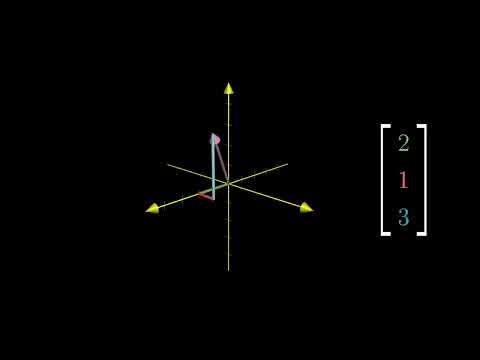
The first chapter of 3Blue1Brown's Essence of Linear Algebra series, introducing vectors with animated geometric visuals. It begins a series that builds intuition for linear algebra from the basics.
 51:16
Why can't you multiply vectors?
524K views • 3 years ago
Freya Holmér
Freya Holmer's Dutch Game Day 2023 talk asking why vectors can't be multiplied, building from complex numbers to a single axiom and arriving at geometric algebra, quaternions and multivectors.
 1:04:35
The Algebra of Algebraic Data Types
27K views • 13 years ago
London Haskell
A London Haskell talk on the algebra of algebraic data types, showing how sum and product types behave like arithmetic. It frames types as numbers obeying algebraic laws.
 10:03
The determinant | Chapter 6, Essence of linear algebra
5M views • 10 years ago
3Blue1Brown
A 10-minute 3Blue1Brown chapter explaining the determinant as the factor by which a linear transformation scales area or volume. It builds the idea geometrically with animations before any formulas.
 2:48:23
A Portal Special Presentation- Geometric Unity: A First Look
902K views • 6 years ago
Eric Weinstein
Eric Weinstein's roughly three-hour presentation of Geometric Unity, his proposed theory unifying physics, given as a special episode of The Portal. It includes clarifications at the end.
 39:49
Lec 1 | MIT 18.06 Linear Algebra, Spring 2005
4.9M views • 17 years ago
MIT OpenCourseWare
The first lecture of Gilbert Strang's MIT 18.06 Linear Algebra course, covering the geometry of linear equations. It opens a full 35-lecture university course.
 17:16
Eigenvectors and eigenvalues | Chapter 14, Essence of linear algebra
6.4M views • 10 years ago
3Blue1Brown
3Blue1Brown's chapter on eigenvectors and eigenvalues in the Essence of Linear Algebra series. It builds a visual intuition for what they mean, why an eigenbasis is useful, and ends with a puzzle.
 1:28:23
Quantum Computing for Computer Scientists
2.2M views • 8 years ago
Microsoft Research
An 88-minute Microsoft Research talk that explains how quantum computers beat classical ones using basic linear algebra, qubits, superposition and gates. It works through the Deutsch oracle problem and ends with entanglement, teleportation and a live demo.
 46:06
Lower Latency Graph Queries in Cypher with Redis GraphRoi Lipman, Redis LabsTim Davis, Texas A&M U
3K views • 8 years ago
Redis
Redis Labs and Tim Davis present RedisGraph, which uses GraphBLAS to treat graph queries in Cypher as sparse linear algebra for lower latency.
 41:06
"Unison: a new distributed programming language" by Paul Chiusano
45K views • 7 years ago
Strange Loop Conference
Paul Chiusano's Strange Loop 2019 talk introduces Unison, an open-source functional language for distributed, elastic systems. It covers content-addressed code identified by hashes of the syntax tree, a codebase manager, and algebraic effects called abilities.
 19:12
Taking Vector Transposes Seriously | Jiahao Chen | JuliaCon 2017
7K views • 9 years ago
The Julia Programming Language
Jiahao Chen's JuliaCon 2017 talk argues that vector transposes should be taken seriously in type systems and linear algebra libraries. It explains why treating vectors as matrices causes trouble in languages.
 5:56
Special Topics - The Kalman Filter (1 of 55) What is a Kalman Filter?
660K views • 11 years ago
Michel van Biezen
The first video in a 55-part series by Michel van Biezen that introduces the Kalman filter and builds from the rationale through algebraic examples to the full matrix treatment. The videos are short, blackboard-style lectures.
 30:55
[JSConfUS 2013] Steven Wittens: Making WebGL Dance
56K views • 13 years ago
JSConf
Steven Wittens' JSConf US 2013 talk on drawing with WebGL, using animated visuals to walk through vectors, matrices and the rendering pipeline. Despite the title, it works as a visual primer on the linear algebra behind 3D graphics.
 23:29
How Imaginary Numbers Were Invented
22.7M views • 5 years ago
Veritasium
Veritasium tells the history of how imaginary numbers arose from the quest for a general solution to the cubic equation, including the duels and secrecy among Renaissance mathematicians. It argues math had to give up the requirement that it mirror reality.
 1:20:33
Lecture 1 | Convex Optimization I (Stanford)
753K views • 18 years ago
Stanford
The introductory lecture of Stephen Boyd's Stanford Convex Optimization I course (EE 364A). It outlines convex sets, functions and problems, and the course's coverage of least-squares, linear and semidefinite programming, duality and interior-point methods.
 40:19
Physics in Clojure - Colin Smith
13K views • 9 years ago
ClojureTV
Colin Smith introduces Structure and Interpretation of Classical Mechanics and his Clojure port, sicmutils. He shows how higher-order functions and a symbolic algebra system can represent Lagrangian mechanics.
 1:01:47
Four Solutions to a Trivial Problem - Guy Steele Jr.
36K views • 10 years ago
Google TechTalks
Guy Steele presents a small geometric problem and compares four computational approaches: a classic sequential solution and three parallel-friendly ones. Each is illustrated pictorially and with working code, weighing total work against time to solution.
 22:22
Some light quantum mechanics (with minutephysics)
2.2M views • 9 years ago
3Blue1Brown
3Blue1Brown, in collaboration with minutephysics, introduces the math of superposition and quantum states using polarized light. It builds up the quantum behavior of photons as a simple counting and probability problem.
 21:58
Group theory, abstraction, and the 196,883-dimensional monster
3.8M views • 6 years ago
3Blue1Brown
3Blue1Brown introduces group theory and abstract groups, then builds toward classification of finite simple groups and the enormous Monster group with its 196,883 dimensions.
 25:13
Thinking outside the 10-dimensional box
3.2M views • 9 years ago
3Blue1Brown
3Blue1Brown visualizes high-dimensional spheres to explain a surprising puzzle about how a sphere fits in a box as dimensions grow. It builds geometric intuition for counterintuitive properties of high-dimensional space.
 14:27
All the Numbers - Numberphile
1.8M views • 7 years ago
Numberphile
Matt Parker talks Numberphile through the different kinds of numbers: algebraic, transcendental, computable, normal, and beyond. It shows how few numbers we can actually name or describe.
 4:08
e^(iπ) in 3.14 minutes, using dynamics | DE5
3.4M views • 7 years ago
3Blue1Brown
A short 3Blue1Brown video explaining Euler's formula e^(i*pi) = -1 through dynamics, treating velocity as the thing that moves a point to a new position. It builds geometric intuition for why an exponent with i produces rotation.
 35:59
Literate Programming in the Large
18K views • 13 years ago
Next Day Video
Timothy Daly, an original author of the Axiom computer algebra system, talks about turning a large Common Lisp codebase into a literate program. He argues code should be written as readable manuals, and the talk was given at Write the Docs 2013.
 1:54:46
Lenses, Folds, and Traversals
54K views • 13 years ago
Edward Kmett
Edward Kmett's talk to the NY Haskell User Group on the lens library, building from fmap and function composition up to lenses, folds and traversals. It shows how these composable combinators access and modify parts of data structures.
 12:31
The Superheterodyne Radio: No really, that's its name
987K views • 7 years ago
Technology Connections
Technology Connections explains why the superheterodyne radio has its name and how mixing frequencies lets it tune stations well. It walks through the underlying wave phenomena and algebra and why the design solved a hard tuning problem.
 1:46:33
Lecture 1 | The Theoretical Minimum
969K views • 14 years ago
Stanford
Leonard Susskind opens Stanford Continuing Studies' Theoretical Minimum series with an introduction to quantum mechanics, a course for people who want real physics rather than popularization. It assumes some calculus and linear algebra.
 24:28
Euler's formula with introductory group theory
2.8M views • 9 years ago
3Blue1Brown
3Blue1Brown builds intuition for Euler's formula, e^(pi i) = -1, using the core ideas of group theory. It treats exponentiation geometrically as rotation and scaling instead of repeated multiplication.
 50:27
Hamming, "n-Dimensional Space" (April 14, 1995)
14K views • 14 years ago
securitylectures
Richard Hamming's 1995 lecture on n-dimensional space, showing how geometric intuition about spheres and cubes breaks down in high dimensions. It is part of his course on learning to learn.
 40:39
Category Theory in Life - Eugenia Cheng
113K views • 9 years ago
Lambda World
Eugenia Cheng gives the opening keynote at Lambda World 2017, presenting category theory as very abstract algebra whose abstraction gives it broad applicability. She applies it to everyday questions including privilege and prejudice.
 2:40
Philip Glass - Sesame Street - Geometry of Circles.mp4
154K views • 14 years ago
SamCam2011
A Sesame Street animation from 1979 with music composed by Philip Glass, showing geometric circle patterns.
 15:11
Bayes theorem, the geometry of changing beliefs
6M views • 6 years ago
3Blue1Brown
3Blue1Brown presents Bayes' theorem through a geometric diagram, showing how evidence should update beliefs. It works through the Kahneman and Tversky style questions and base rates.
 11:58
Melt your circuit boards
471K views • 4 years ago
mitxela
mitxela shows his KiCad plugin that rounds PCB tracks to give circuit boards organic, melted-looking layouts instead of rigid geometric ones.
 7:43
Unlimited Detail Real-Time Rendering Technology Preview 2011 [HD]
4.4M views • 15 years ago
Axiom Holographics
Euclideon's 2011 technology preview of Unlimited Detail, a rendering approach claiming unlimited geometric detail in real time via point-cloud style data. The company promised more to come while keeping most work secret.
 1:04:39
Gauge Theory and Inflation: Enlarging the Wu-Yang Dictionary
38K views • 12 years ago
Tom Henderson
A talk by Eric Weinstein on gauge theory and its possible application to economics and inflation. It proposes extending the Wu-Yang dictionary into a geometric tool beyond physics.