geometric intuition
 1:37:22
Siggraph2019 Geometric Algebra
87K views • 7 years ago
Bivector
A SIGGRAPH 2019 course on geometric algebra. Charles Gunn gives an intro, then Steven De Keninck gives a programmer-focused course with live examples in ganja.js.
 5:09
Essence of linear algebra preview
2.8M views • 10 years ago
3Blue1Brown
A five-minute preview of 3Blue1Brown's Essence of Linear Algebra series, which uses animation to build geometric intuition for topics from a standard linear algebra course.
 44:23
A Swift Introduction to Geometric Algebra
1.1M views • 6 years ago
sudgylacmoe
An animated introduction to geometric algebra, presented as a language that can describe most of physics. It was made with manim and covers multivectors and how they generalize familiar tools like cross products and quaternions.
 2:48:23
A Portal Special Presentation- Geometric Unity: A First Look
902K views • 6 years ago
Eric Weinstein
Eric Weinstein's roughly three-hour presentation of Geometric Unity, his proposed theory unifying physics, given as a special episode of The Portal. It includes clarifications at the end.
 1:01:45
Intuition Pumps and Other Tools for Thinking | Daniel Dennett | Talks at Google
129K views • 13 years ago
Talks at Google
Philosopher Daniel Dennett visits Google to discuss his book Intuition Pumps and Other Tools for Thinking, describing thought experiments and thinking tools across psychology, biology, computer science and physics.
 10:03
The determinant | Chapter 6, Essence of linear algebra
5M views • 10 years ago
3Blue1Brown
A 10-minute 3Blue1Brown chapter explaining the determinant as the factor by which a linear transformation scales area or volume. It builds the idea geometrically with animations before any formulas.
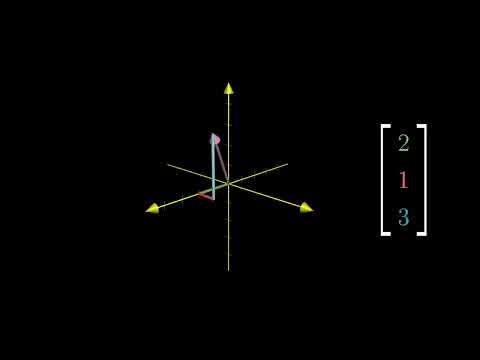 9:52
Vectors | Chapter 1, Essence of linear algebra
13M views • 10 years ago
3Blue1Brown
The first chapter of 3Blue1Brown's Essence of Linear Algebra series, introducing vectors with animated geometric visuals. It begins a series that builds intuition for linear algebra from the basics.
 51:16
Why can't you multiply vectors?
524K views • 3 years ago
Freya Holmér
Freya Holmer's Dutch Game Day 2023 talk asking why vectors can't be multiplied, building from complex numbers to a single axiom and arriving at geometric algebra, quaternions and multivectors.
 17:05
The essence of calculus
11.9M views • 9 years ago
3Blue1Brown
The first video of 3Blue1Brown's Essence of Calculus series, which builds toward integrals, derivatives, and the fundamental theorem of calculus from a simple geometry question. It aims to make viewers feel they could have invented calculus themselves.
 25:13
Thinking outside the 10-dimensional box
3.2M views • 9 years ago
3Blue1Brown
3Blue1Brown visualizes high-dimensional spheres to explain a surprising puzzle about how a sphere fits in a box as dimensions grow. It builds geometric intuition for counterintuitive properties of high-dimensional space.
 4:08
e^(iπ) in 3.14 minutes, using dynamics | DE5
3.4M views • 7 years ago
3Blue1Brown
A short 3Blue1Brown video explaining Euler's formula e^(i*pi) = -1 through dynamics, treating velocity as the thing that moves a point to a new position. It builds geometric intuition for why an exponent with i produces rotation.
 24:28
Euler's formula with introductory group theory
2.8M views • 9 years ago
3Blue1Brown
3Blue1Brown builds intuition for Euler's formula, e^(pi i) = -1, using the core ideas of group theory. It treats exponentiation geometrically as rotation and scaling instead of repeated multiplication.
 50:27
Hamming, "n-Dimensional Space" (April 14, 1995)
14K views • 14 years ago
securitylectures
Richard Hamming's 1995 lecture on n-dimensional space, showing how geometric intuition about spheres and cubes breaks down in high dimensions. It is part of his course on learning to learn.
 1:06:50
The complete FUN TO IMAGINE with Richard Feynman
5.9M views • 8 years ago
Christopher Sykes
All six episodes of the 1983 BBC series Fun to Imagine, in which Richard Feynman muses on jiggling atoms, fire, rubber bands, magnets, electricity and more. He explains how to think about nature and why imagination is fun.
 2:25:52
The spelled-out intro to neural networks and backpropagation: building micrograd
4.4M views • 4 years ago
Andrej Karpathy
Andrej Karpathy's first Neural Networks: Zero to Hero lecture, which builds micrograd, a tiny autograd engine, from scratch in Python. It explains backpropagation and neural network training step by step, assuming only basic Python and some high-school calculus.
 9:18
The Most IMPORTANT Video You'll Ever See (part 1 of 8)
5.4M views • 19 years ago
wonderingmind42
Part 1 of a lecture by physicist Albert Bartlett on the exponential function and its consequences for population growth, resource use and energy. It argues that steady growth rates quickly lead to enormous quantities.
 9:01
Powers of Ten™ (1977)
9.5M views • 16 years ago
Eames Office
The Eames Office's 1977 film Powers of Ten starts at a picnic in Chicago and zooms out by a factor of ten every ten seconds to the edge of the universe. It then zooms inward to a proton in a carbon atom.
 11:15
The hardest problem on the hardest test
16.5M views • 8 years ago
3Blue1Brown
3Blue1Brown walks through a very hard Putnam competition problem and its elegant solution, emphasizing the visual intuition and the thought process behind solving it.
 5:47
Imaginary Numbers Are Real [Part 1: Introduction]
8.6M views • 11 years ago
Welch Labs
The first part of Welch Labs' series on imaginary numbers, presenting them as the natural extension of the number line into two dimensions. It covers the history and the math with strong visuals.
 54:54
The Physics and Philosophy of Time - with Carlo Rovelli
1.4M views • 8 years ago
The Royal Institution
Physicist Carlo Rovelli gives a public lecture at the Royal Institution on how our understanding of time has changed, from Boltzmann and Einstein to quantum theory and loop quantum gravity. He blends physics, philosophy and art to argue that time is stranger than everyday intuition suggests.
 17:16
Eigenvectors and eigenvalues | Chapter 14, Essence of linear algebra
6.4M views • 10 years ago
3Blue1Brown
3Blue1Brown's chapter on eigenvectors and eigenvalues in the Essence of Linear Algebra series. It builds a visual intuition for what they mean, why an eigenbasis is useful, and ends with a puzzle.
 31:51
Visualizing the 4d numbers Quaternions
5.6M views • 8 years ago
3Blue1Brown
3Blue1Brown builds visual intuition for quaternions, showing how to think about this four-dimensional number system using stereographic projection and rotations in 3D space. It is part one of a two-part series with an interactive companion site.
 10:22
How Far Are The Nearest Stars?
3.7M views • 9 years ago
Cody'sLab
Cody's Lab builds a 200-billionth-scale model to show how far away the nearest stars are, using parallax and light speed. A short astronomy explainer on interstellar distances.
 24:47
But what is a Fourier series? From heat flow to drawing with circles | DE4
19M views • 7 years ago
3Blue1Brown
3Blue1Brown introduces Fourier series, from the heat equation to drawing arbitrary shapes with rotating circles. It builds a visual intuition for decomposing functions into sine waves.
 1:02:06
Real Analysis, Lecture 1: Constructing the Rational Numbers
613K views • 16 years ago
HarveyMuddCollegeEDU
The first lecture of Francis Su's Harvey Mudd real analysis course, covering the construction of the rational numbers. It begins a full lecture series that follows a standard analysis text.
 27:15
The Most Misunderstood Concept in Physics
31.5M views • 3 years ago
Veritasium
Veritasium's explainer on entropy, presented as one of physics' most important and least understood concepts. It uses examples such as heat engines and the sun's energy flowing through the Earth.
 1:01:47
Four Solutions to a Trivial Problem - Guy Steele Jr.
36K views • 10 years ago
Google TechTalks
Guy Steele presents a small geometric problem and compares four computational approaches: a classic sequential solution and three parallel-friendly ones. Each is illustrated pictorially and with working code, weighing total work against time to solution.
 1:02
Single particle creates interference after double slit - Wave particle duality at the workshop
17K views • 13 years ago
heligone
A short demo of a walking droplet on a vibrating silicone oil bath passing through a double slit and producing interference, a macro-scale analogue of pilot-wave behavior.
 1:01:40
Four Dimensional Maths: Things to See and Hear in the Fourth Dimension - with Matt Parker
3.1M views • 11 years ago
The Royal Institution
Matt Parker gives a hands-on Royal Institution talk on how four-dimensional shapes appear in a 3D world, with props like straw frames, Mobius strips and a knitted hat. It is a playful general-audience tour of the fourth dimension.
 39:43
Do we need Attention? - Linear RNNs and State Space Models (SSMs) for NLP
35K views • 3 years ago
Sasha Rush
Sasha Rush surveys linear RNNs and state space models as replacements for attention in transformer-style models, in a talk for MLSys. It covers the foundational preliminaries and predates Mamba.
 3:07
How To Draw Mushrooms On An Oscilloscope With Sound
2.4M views • 12 years ago
Jellybean Fenderson
Jerobeam Fenderson shows how to draw a mushroom on an oscilloscope in XY mode using stereo audio, then animates it by modulating with a larger wave. Pd and Max4Live patches are provided.
 1:50:07
JSON Parser 100% From Scratch in Haskell (only 111 lines)
205K views • 6 years ago
Tsoding
Tsoding live-codes a JSON parser from scratch in Haskell in about 111 lines, using only the standard library. It is an edited Twitch stream that explains the intuition behind parser combinators, functors, applicatives and monads.
 1:22:38
CS480/680 Lecture 19: Attention and Transformer Networks
374K views • 7 years ago
Pascal Poupart
A university lecture from CS480/680 by Pascal Poupart on attention mechanisms and transformer networks, worked through on a chalkboard.
 12:20
I Solved Klotski
2.1M views • 1 year ago
2swap
2swap explains how he solved the Klotski sliding-block puzzle by mapping its full state space as a graph and visualizing it. The video includes footage of the Guinness world-record solve and links to an interactive graph.
 16:36
Hacking at Quantum Speed with Shor's Algorithm | Infinite Series
238K views • 9 years ago
PBS Infinite Series
PBS Infinite Series explains how Shor's algorithm lets a quantum computer break RSA encryption, building on earlier episodes about cryptography and the math of quantum computers. It works through the idea step by step.
 2:40
Philip Glass - Sesame Street - Geometry of Circles.mp4
154K views • 14 years ago
SamCam2011
A Sesame Street animation from 1979 with music composed by Philip Glass, showing geometric circle patterns.
 15:11
Bayes theorem, the geometry of changing beliefs
6M views • 6 years ago
3Blue1Brown
3Blue1Brown presents Bayes' theorem through a geometric diagram, showing how evidence should update beliefs. It works through the Kahneman and Tversky style questions and base rates.
 11:58
Melt your circuit boards
471K views • 4 years ago
mitxela
mitxela shows his KiCad plugin that rounds PCB tracks to give circuit boards organic, melted-looking layouts instead of rigid geometric ones.
 10:33
Strange Spheres in Higher Dimensions - Numberphile
767K views • 9 years ago
Numberphile
Matt Parker on Numberphile explains the strange properties of spheres in higher dimensions, such as how they poke out of their bounding boxes. It uses Pythagoras to build intuition for 4D and beyond.
 10:18
Backpropagation calculus | Deep Learning Chapter 4
4M views • 9 years ago
3Blue1Brown
3Blue1Brown's chapter 4 on deep learning gives a more formal, symbol-based account of backpropagation calculus, connecting the intuition from the previous chapter to the math found in textbooks and code.